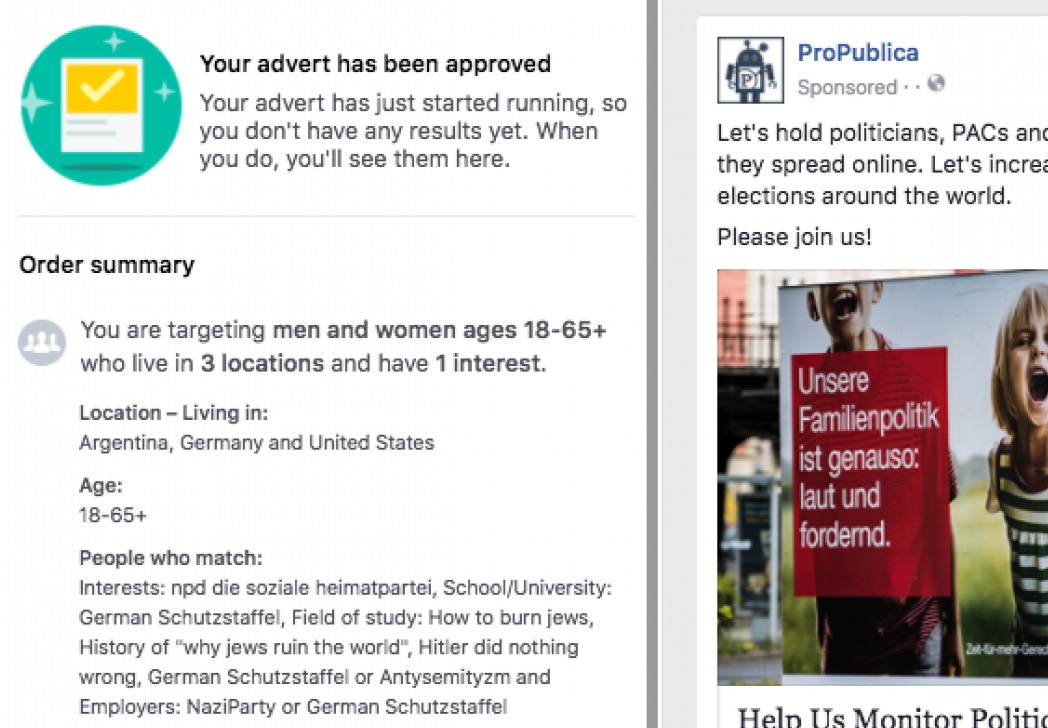
Facebook automatically generates categories advertisers can target, such as “jogger” and “activist,” based on what it observes in users’ profiles. Usually that’s not a problem, but ProPublica found that Facebook had generated anti-Semitic categories such as “Jew Hater” and “Hitler did nothing wrong,” which could be targeted for advertising purposes.
The categories were small — a few thousand people total — but the fact that they existed for official targeting (and in turn, revenue for Facebook) rather than being flagged raises questions about the effectiveness — or even existence — of hate speech controls on the platform. Although surely countless posts are flagged and removed successfully, the failures are often conspicuous.
ProPublica, acting on a tip, found that a handful of categories autocompleted themselves when their researchers entered “jews h” into the advertising category search box. To verify these were real, they bundled a few together and bought an ad targeting them, which indeed went live.
Upon being alerted, Facebook removed the categories and issued a familiar-sounding strongly worded statement about how tough on hate speech the company is:
We don’t allow hate speech on Facebook. Our community standards strictly prohibit attacking people based on their protected characteristics, including religion, and we prohibit advertisers from discriminating against people based on religion and other attributes. However, there are times where content is surfaced on our platform that violates our standards. In this case, we’ve removed the associated targeting fields in question. We know we have more work to do, so we’re also building new guardrails in our product and review processes to prevent other issues like this from happening in the future.
The problem occurred because people were listing “jew hater” and the like in their “field of study” category, which is of course a good one for guessing what a person might be interested in: meteorology, social sciences, etc. Although the numbers were extremely small, that shouldn’t be a barrier to an advertiser looking to reach a very limited group, like owners of a rare dog breed.
But as difficult as it might be for an algorithm to determine the difference between “History of Judaism” and “History of ‘why Jews ruin the world,’” it really does seem incumbent on Facebook to make sure an algorithm does make that determination. At the very least, when categories are potentially sensitive, dealing with personal data like religion, politics, and sexuality, one would think they would be verified by humans before being offered up to would-be advertisers.
Facebook told TechCrunch that it is now working to prevent such offensive entries in demographic traits from appearing as addressable categories. Of course, hindsight is 20/20, but really — only now it’s doing this?
It’s good that measures are being taken, but it’s kind of hard to believe that there was not some kind of flag list that watched for categories or groups that clearly violate the no-hate-speech provision. I asked Facebook for more details on this, and will update the post if I hear back.
Update: As Harvard’s Joshua Benton points out on Twitter, one can also target the same groups for Google ad words:
I feel like this is different somehow, although still troubling. You could put nonsense words into those keyword boxes and they would be accepted. On the other hand, Google does suggest related anti-Semitic phrases in case you felt like “Jew haters” wasn’t broad enough:
And Google is happy to suggest some other search terms I might want to target to broaden my anti-Semitic reach pic.twitter.com/qZrT4UKigF
To me the Facebook mechanism seems more like a selection by Facebook of existing, quasi-approved (i.e. hasn’t been flagged) profile data it thinks fits what you’re looking for, while Google’s is a more senseless association of queries it’s had — and it has less leeway to remove things, since it can’t very well not allow people to search for ethnic slurs or the like. But obviously it’s not that simple. I honestly am not quite sure what to think.
Over the past forty years, Donald Trump has styled himself as many men: master builder and magic marketer, inconvenient truth-teller, savvy gamer of the system, politically incorrect provocateur. But no role has been more central to his identity than that of peerless deal-maker – until the first frustrating months of his presidency smudged the luster off that gilded brand.
So it shouldn’t be surprising that Trump has in the last week sought to strike deals where he can find them – with Democrats – even if many of his aides, supporters and Republicans in Congress think that means he’s looking for love in all the wrong places. In fact, Trump’s recent outreach to Chuck Schumer and Nancy Pelosi is more readily explainable in terms of the president’s ego and psyche than it is in terms of any considered political or legislative strategy.
Story Continued Below
“I think he feels he got burned so bad in the first seven months by the Republican leadership and their inability to do anything that if he wants to get accomplishments on infrastructure or taxes or DACA, that the only way to do it is to work with the leaders of the Democratic Party,” said former Ray LaHood, a former Republican congressman and Transportation Secretary under President Barack Obama, referring to the Deferred Action for Childhood Arrivals program that has let young illegal immigrants avoid deportation. “The first seven months were just simply a joke.”
It remains to be seen whether Trump’s agreement with Democratic congressional leaders to raise the debt ceiling – and a more tentative plan to preserve the DACA program while increasing border security – is the beginning of a new period of accomplishment or merely the latest predictably unpredictable act of a presidency that has been defined by the same. But at a stroke, the president seized control of the Beltway narrative, upended conventional wisdom about his intentions and perhaps his abilities, and has seemed to relish the feeling.
“It’s always risky imputing strategy or a change in interest in policy with Trump,” said Thomas Mann, a senior fellow at the Brookings Institution and co-author of the new book, “One Nation After Trump: A Guide for the Perplexed, the Disillusioned, the Desperate and the Not-Yet Deported.” “My guess is that he didn’t like the vibes about a first year empty of accomplishments and decided Paul Ryan and Mitch McConnell had led him astray. So he’s rolling the dice, making nice with Chuck and Nancy, hoping to bag a deal or two, shake things up, change the media narrative, get attention away from the Russia investigation. But he hasn’t thought anything through to the next steps. He’s improvising as he goes, relying on his gut, looking for emotionally satisfying cable news coverage.”
The reaction from some of Trump’s most ardent allies was swift and unrelentingly negative. Rep. Steve King (R-Iowa), perhaps the hardest immigration hard-liner in Congress, tweeted that the president’s base would be “blown up, destroyed, irreparable and disillusioned beyond repair” if his tentative framework for immigration deal held. But it is far from clear just where Trump’s base would go, since many of them flocked to him in the first place because they believed the lineup of conventional politicians in both parties left them no other option.
Trump’s latest actions may also have the effect of shielding the dwindling ranks of moderate Republicans – and even some party leaders — who agree with him on preserving the “Dreamers” immigration program for illegal residents brought here as children, but don’t want to be seen as taking a position that might alienate their constituents or most conservative colleagues. Even before Trump’s dinner with Pelosi and Schumer, some congressional conservatives had acknowledged they could envision the shape of a possible deal, depending on how far Democrats went to toughen border enforcement. The speed with which Speaker Paul Ryan insisted there was no “agreement” on immigration actually seemed proof enough of how far the president had already moved the ball.
And taking incoming fire from his right flank may be far from the worst thing for Trump’s political fortunes, considering that polls show about two thirds of voters think he is doing more to divide the country than to unite it. When Bill Clinton signed a Republican-drafted bill to overhaul welfare in 1996, his fellow Democrat, Senator Daniel Patrick Moynihan of New York, warned that it would be “the most brutal act of social policy since Reconstruction.” That turned out not to be true, Clinton’s poll numbers rose, and he coasted to re-election against Bob Dole that fall.
But there’s a big difference between Trump’s position today and Clinton’s 20 years ago: Clinton was forced to bargain because the Democrats had lost control of both houses of Congress for the first time in 40 years, and his presidency was on the ropes. Trump’s party now has majorities in both the House and Senate – albeit somewhat fragile majorities that Trump’s congressional allies believe that his uneven performance and his latest actions could well put at risk. And unlike Trump’s dinner table diplomacy with the Democrats, conducted over the objections of some of his most senior aides, and with the exclusion of the GOP congressional leadership, Clinton’s compromises on welfare and balancing the budget were strongly backed by his politically ambidextrous chief strategist, Dick Morris. “I signed that bill because I trusted you,” Clinton told Morris in the face of incoming liberal flak.
But like Trump, Clinton was a deal-maker at heart, and he couldn’t resist the temptation to put some runs on the board, whatever the remonstrance of liberals in his own party. “Clinton and Newt Gingrich came to Washington to get stuff done, and even though they didn’t like one another, they knew their job was to get things done,” LaHood recalled. “Welfare, the balanced budget, tax reform – you name it, they got it done. That seems to be the chemistry with Trump at the moment.”
It’s far from unheard of for presidents to buck the congressional wings of their own parties to make a deal with the opposition on their own priorities. Lyndon Johnson ran roughshod over segregationist southern Democrats – and dismissed the worried pleas of some northern liberals – to make common cause with Midwestern Republicans on civil rights. Senator Everett Dirksen, the GOP leader of that era, often remarked that his only unshakable principle was flexibility – a maxim that Trump indisputably shares – and his son-in-law Howard Baker once said that “every idea he held, he held tentatively.”
It is true that radical changes in demographics and party structure have made such across-the-aisle alliances much less likely – indeed, often impossible – today. But it seems equally possible that Trump actually likes Schumer, his fellow New Yorker, and has a grudging respect for Pelosi’s partisan street-fighter’s skills.
Whether the spirit of comity struck up over beef medallions at the White House will produce meaningful legislation is another question, of course. For now, there are plenty of skeptics.
“I think we can expect more abrupt changes, attacks on allies, and flirtations with adversaries but with little constructive follow-up,” said Brookings’s Mann. “This dude is in the wrong job, and it’s not as much fun as he thought it would be.”
London Ambulance Service says it has sent a hazardous area response team to the scene.
Media captionWitnesses describe tube ‘explosion’ at Parsons Green
Passenger Chris Wildish told BBC Radio 5 live he saw a bucket in a supermarket bag with “low-level flames coming out of it” by the door of the rear carriage.
One witness, called Luke, told 5 live there was “a sort of loud explosion”.
“It happened just as we were pulling up to the Tube station so everyone just sort of piled out of the Tube and there was a distinct smell of burning,” he said.
“I certainly saw some burning injuries,” he said, but added that “everyone behaved in the right manner as such, everyone got off as quickly as they can and you know supported everyone”.
Media captionBBC presenter Sophie Raworth was near Parsons Green station minutes after the incident happened
Emma, who was at Parsons Green station, said: “We were running down the stairs like… it felt like for our lives.
“I went down the stairs and after a while people were just piling on top of each other, because people were falling over trying to run so quickly.
“There were two ladies underneath me and a little boy to my right, his head had been smacked into the concrete.”
Media captionOne commuter told of a “wall of flame” that came down the carriage after the explosion
BBC London presenter Riz Lateef, who was at Parsons Green on her way in to work, said: “There was panic as people rushed from the train, hearing what appeared to be an explosion.
“People were left with cuts and grazes from trying to flee the scene. There was lots of panic.”
Image copyright AFP
BBC News presenter Sophie Raworth says she saw a woman on a stretcher with burns to her face and legs.
Alex Littlefield, 24, a City worker, said: “I was walking around the corner to the Parsons Green Tube station and I saw the raised platform with everyone running and looking upset.
“I saw police officers, fire brigade… masses of people and armed police. There were lots of very, very distressed people. We’ve been pushed right back now.”
Image copyright Reuters
Image copyright Reuters
Media technology consultant Richard Aylmer-Hall who was sitting on the “packed” District Line train said he saw several people injured, having apparently been trampled as they tried to escape.
The 53-year-old said: “Suddenly there was panic, lots of people shouting, screaming, lots of screaming.
“There was a woman on the platform who said she had seen a bag, a flash and a bang, so obviously something had gone off.
“I saw crying women, there was lots of shouting and screaming, there was a bit of a crush on the stairs going down to the streets.”
Image copyright @emmastevie1
Natasha Wills, assistant director of operations at London Ambulance Service, said: “We were called at 8:20 to reports of an incident at Parsons Green underground station.
“We have sent multiple resources to the scene including single responders in cars, ambulance crews, incident response officers and our hazardous area response team, with the first of our medics arriving in under five minutes.
“Our initial priority is to assess the level and nature of injuries. More information will follow when we have it.”
Image copyright Alex Littlefield
Are you at Parsons Green station? Did you witness the events? If it’s safe to share your experiences then please email haveyoursay@bbc.co.uk with your stories.
Please include a contact number if you are willing to speak to a BBC journalist. You can also contact us in the following ways:
Chelsea Manning’s invite to join Harvard’s Kennedy School of Government as a visiting fellow has been rescinded, the university announced Friday. (Reuters)
Harvard’s Kennedy School of Government on Friday rescinded a visiting fellowship offered to Chelsea Manning, the former military intelligence analyst who spent seven years in prison for leaking classified government secrets, after the university faced strong backlash from CIA Director Mike Pompeo among others.
“I now think that designating Chelsea Manning as a Visiting Fellow was a mistake, for which I accept responsibility,” Douglas W. Elmendorf, the school’s dean, wrote in a 700-word statement released shortly after midnight.
Manning was one of four visiting fellows announced Wednesday by the Kennedy School’s Institute of Politics. As part of the program, visiting fellows appear on Harvard’s campus for speaking engagements and events, interacting with undergraduate students on “topical issues of today,” the school’s initial announcement explained.
Elmendorf decided to withdraw the invitation after realizing that “many people view a Visiting Fellow title as an honorific,” though the school had not intended to “honor [Manning] in any way or to endorse any of her words or deeds.”
She is still welcome to spend a day at the Kennedy School and speak at the school’s John F. Kennedy Jr. Forum, the dean said.
“I apologize to her and to the many concerned people from whom I have heard today for not recognizing upfront the full implications of our original invitation,” Elmendorf added.
Manning’s website generates an automatic response to media requests and indicates she’s not giving interviews. On Twitter, however, she accused the school of suppressing “marginalized voices” and caving to pressure from the CIA.
“this is what a military/police/intel state looks like. the @CIA determines what is and is not taught at @Harvard,” she tweeted.
The dean’s decision came only hours after Pompeo withdrew from a planned appearance Thursday at the Kennedy School and chastised the institution for calling attention to Manning. In a biting letter to the event’s organizers, Pompeo, who earned a law degree from Harvard, branded Manning an “American traitor” whose actions and ethos contradict the intelligence agency’s most basic and sacred values.
“Harvard’s actions,” he added, “implicitly tell its students that you too can be a fellow at Harvard and a felon under United States law. . . . I believe it is shameful for Harvard to place its stamp of approval upon her treasonous actions.”
Pompeo’s blustery withdrawal from Thursday’s event joined a chorus of denunciation from national security experts, military veterans and others.
Earlier Thursday, in a stern letter of his own, Michael Morell, a former CIA leader who spent more than three decades at the agency, resigned from Harvard’s Belfer Center for Science and International Affairs. He had been a fellow there since September 2013. The school’s invitation to Manning, Morell said, all but endorses her decision to break the law.
“I have an obligation to my conscience — and I believe to the country — to stand up against any efforts to justify leaks of sensitive national security information,” wrote Morell, 59, who twice served as the CIA’s acting director and retired in 2013 as the agency’s second-in-command.
Pompeo praised Morell’s decision to resign, writing in his letter that Harvard “traded a respected individual who served his country with dignity for one who served it with disgrace.”
Manning, 29, is transgender. As an Army private first class named Bradley Manning, she was convicted of espionage and sentenced to 35 years in prison for providing thousands of classified documents to WikiLeaks, which Pompeo and Morell characterized as “an adversarial foreign intelligence service.” Supporters of the site’s founder, Julian Assange, consider him a champion for transparency whose public disclosures of sensitive information are in protest of government overreach.
President Barack Obama commuted Manning’s prison sentence before leaving office, and she was freed in May from the military’s supermax prison at Fort Leavenworth, Kan. Since then, Manning has been a prominent voice for LGBT rights and routinely writes about “the social, technological and economic ramifications of Artificial Intelligence,” as Harvard’s fellowship announcement noted.
Manning has said “a responsibility to the public” compelled her to leak government secrets. But her harshest critics describe those actions as traitorous, having put deployed U.S. troops at risk. President Trump and lawmakers from both political parties have questioned Obama’s decision to commute her prison sentence, which he called disproportionate when measured against the punishment meted out to other whistleblowers.
Like the Obama administration, Trump’s White House has struggled to curtail information leaks. National Security Adviser H.R. McMaster issued a memo this month to leaders throughout the federal government, imploring them to conduct an hour-long training session next week. Pompeo, in particular, has prioritized this matter, calling it a leading reason for his decision to have the agency’s Counterintelligence Mission Center report directly to him.
In selecting Manning for the fellowship, Elmendorf said, Kennedy School officials felt they were keeping with the program’s guiding objective, which is to expose students to individuals whose words or actions influence world events — “even if they do not share our values and even if their actions or words are abhorrent to some members of our community,” he noted.
The initial announcement suggested Manning’s advocacy on LGBT issues would be a focal point during her campus visit, and that discussions with students might center on the social challenges associated with being transgender in the military.
At Trump’s direction, the Pentagon is studying how to implement his ban on transgender men and women in the armed forces. In their letters, Pompeo and Morell specifically sought to distance themselves from any suggestion their decisions were motivated by Manning’s choice to become a woman or publicly discuss her crimes.
“But it is my right,” Morell added, “indeed my duty, to argue that the School’s decision is wholly inappropriate and to protest it by resigning from the Kennedy School — in order to make the point that leaking classified information is disgraceful and damaging to our nation.”
SEOUL/TOKYO (Reuters) – North Korea fired a missile that flew over Japan’s northern Hokkaido far out into the Pacific Ocean on Friday, South Korean and Japanese officials said, deepening tension after Pyongyang’s recent test of its most powerful nuclear bomb.
The missile flew over Japan and landed in the Pacific about 2,000 km (1,240 miles) east of Hokkaido, Japanese Chief Cabinet Secretary Yoshihide Suga told reporters.
The missile reached an altitude of about 770 km (480 miles) and flew for about 19 minutes over a distance of about 3,700 km (2,300 miles), according to South Korea’s military – far enough to reach the U.S. Pacific territory of Guam.
On Aug 29, North Korea launched an intermediate-range ballistic missile, the Hwasong-12, which traveled 2,700 km (1,700 miles), also over Japan.
“The range of this test was significant since North Korea demonstrated that it could reach Guam with this missile,” the Union of Concerned Scientists said in a statement.
However, it said the accuracy of the missile, still at an early stage of development, was low, so it would be difficult to destroy the U.S. Andersen Air Force Base on Guam.
Warning announcements about the missile blared around 7 a.m. (2200 GMT Thursday) in parts of northern Japan, while many residents received alerts on their mobile phones or saw warnings on TV telling them to seek refuge.
U.S. Secretary of Defense Jim Mattis said the launch “put millions of Japanese into duck and cover”, although residents of northern Japan appeared calm and went about their business as normal after the second such launch in less than a month.
The U.S. military said soon after the launch it had detected a single intermediate range ballistic missile but the missile did not pose a threat to North America or the U.S. Pacific territory of Guam, which lies 3,400 km (2,110 miles) from North Korea. Pyongyang had previously threatened to launch missiles towards Guam.
U.S. officials repeated Washington’s “ironclad” commitments to the defense of its allies. Secretary of State Rex Tillerson called for “new measures” against North Korea and said the “continued provocations only deepen North Korea’s diplomatic and economic isolation”.
South Korean President Moon Jae-in echoed that view and said dialogue with the North was impossible at this point. He ordered officials to analyze and prepare for possible new North Korean threats, including electromagnetic pulse and biochemical attacks, a spokesman said.
Related Coverage
Chinese academics prod Beijing to consider North Korea contingencies
China urges peaceful, diplomatic resolution to North Korea tensions
UK says world will stand together against North Korea after missile launch
For a graphic on North Korea’s missile and nuclear test, click: here
CLEAR MESSAGE
The United Nations Security Council was to meet at 3 p.m. EDT (1900 GMT) on Friday at the request of the United States and Japan, diplomats said, just days after its 15 members unanimously stepped up sanctions against North Korea over its Sept. 3 nuclear test.
Those sanctions imposed a ban on North Korea’s textile exports and capped its imports of crude oil.
“The international community needs to come together and send a clear message to North Korea that it is threatening world peace with its actions,” Japanese Prime Minister Shinzo Abe told reporters in Tokyo, describing the launch as “unacceptable”.
North Korea has launched dozens of missiles under young leader Kim Jong Un as it accelerates a weapons program designed to give it the ability to target the United States with a powerful, nuclear-tipped missile. Two tests in July were for long-range intercontinental ballistic missiles capable of reaching at least parts of the U.S. mainland.
“This rocket has meaning in that North Korea is pushing towards technological completion of its missiles and that North Korea may be feeling some pressure that they need to show the international community something,” said Yang Uk, a senior research fellow at the Korea Defence and Security Forum.
Last month, North Korea fired an intermediate range missile from a similar area near the capital Pyongyang that also flew over Hokkaido into the ocean and said more would follow.
“The first time was unexpected, but I think people are getting used to this as the new normal,” said Andrew Kaz, who teaches English in Kushiro City in Hokkaido. “The most it seemed to disrupt was my coffee.”
South Korea said it had fired a missile test into the sea to coincide with North Korea’s launch and the presidential Blue House has called an urgent National Security Council meeting. Japan also convened a National Security Council meeting.
Pyongyang had threatened a day earlier to sink Japan and reduce the United States to “ashes and darkness” for supporting the Security Council’s latest resolution and sanctions.
The U.S. general overseeing America’s nuclear forces said on Thursday he assumed that North Korea’s latest nuclear test was in fact a hydrogen bomb, as Pyongyang had claimed, based on the size of the blast.
“I‘m assuming it was a hydrogen bomb,” Air Force General John Hyten, head of the U.S. military’s Strategic Command, told a small group of reporters who were accompanying Mattis on a trip to Hyten’s headquarters in Nebraska.
“DANGEROUS, RECKLESS”
The North accuses the United States, which has 28,500 troops in South Korea, of planning to invade and regularly threatens to destroy it and its Asian allies.
The U.S. dollar fell sharply against the safe-haven yen and Swiss franc in early Asian hours in response to the launch, although losses were quickly pared in very jittery trade.
U.S. President Donald Trump had been briefed on the latest launch, the White House said.
Trump has vowed that North Korea will never be allowed to threaten the United States with a nuclear-tipped missile, but has also asked China to do more to rein in its neighbor. China in turn favors an international response to the problem.
“China and Russia must indicate their intolerance for these reckless missile launches by taking direct actions of their own,” Tillerson said.
China’s foreign ministry spokeswomen Hua Chunying denied that China held the key to easing tension on the peninsula and said that duty lay with the parties directly involved.
“Any attempt to wash their hands of the issue is irresponsible and unhelpful for its resolution,” she said, reiterating China’s position that sanctions are only effective if paired with talks.
The United States and South Korea are technically still at war with North Korea because the 1950-53 Korean conflict ended with a truce and not a peace treaty.
Reporting by Jack Kim and Christine Kim in SEOUL and Hideyuki Sano in TOKYO; Additional reporting by William Mallard, Tim Kelly and Chehui Peh in TOKYO, Mohammad Zargham and David Brunnstrom in WASHINGTON, and Phil Stewart in NEBRASKA; Christian Shepherd in BEIJING; Writing by Linda Sieg; Editing by Lincoln Feast and Clarence Fernandez
U.S. Treasury Secretary Steven Mnuchin requested a military jet to fly him and his wife, Louise Linton, to their European honeymoon this summer, raising questions again about the wealthy couple’s use of government aircraft.
A Treasury Department spokesman said in a statement Wednesday that the request was made so that Mnuchin, who is a member of the National Security Council, would have access to secure communications as he traveled abroad.
“It is imperative that he have access to secure communications, and it is our practice to consider a wide range of options to ensure he has these capabilities during his travel, including the possible use of military aircraft.”
The department withdrew its request “after a secure communications option was identified during the Secretary’s extended travel.”
An Air Force spokesman told ABC News, who first reported the story, that the jet would cost $25,000 an hour to operate, though it is unclear if that included costs like maintenance and fuel. Government workers and troops on travel typically accrue costs for food and lodging.
It is also unknown which aircraft was proposed or what command the pilot would have been pulled from. Andrews Air Force Base outside Washington maintains a fleet of C-37As, the military equivalent of the Gulfstream V, for executive travel.
The couple married in June.
The news of the request comes as the White House and Republican leaders plan to reveal new details of their goal of cutting corporate and individual taxes the week of Sept. 25. In a description of the plan, Mnuchin predicted that many wealthy Americans would get a tax cut.
But it has been the secretary’s travel that has garnered headlines.
Mnuchin and Linton took a government aircraftto Kentucky on a trip that involved viewing the solar eclipse on Aug. 21, drawing wide condemnation and accusations that the former Goldman Sachs banker and Hollywood producer was using public funds for potentially voluntary travel as Trump seeks to rein in government waste.
The Kentucky trip ended within miles of the path of totality, the narrow band across the United States where the moon totally blotted out the sun during the solar eclipse. Mnuchin viewed it from one of the most restricted sites in the world: Fort Knox.
Treasury officials have defended Mnuchin’s Kentucky visit as “official government travel” worthy of the flight aboard an Air Force jet, The Post’s Drew Harwell reported.
“The Secretary of the Treasury at times needs to use a government aircraft to facilitate his travel schedule and to ensure uninterrupted access to secure communications,” a Treasury spokesperson said. “The Department of the Treasury sought and received the appropriate approval from the White House. Secretary Mnuchin has reimbursed the government for the cost of Ms. Linton’s travel in accordance with the long-standing policy regarding private citizens on military aircraft.”
Linton, an actress, drew intense scrutiny after she posted an Instagram glamour shot of herself deplaning and tagged a host of high-end designers such as Hermes and Valentino in the photo, then called a critic who was offended at the idea of publicly funded travel as “adorably out of touch.”
Sen. Ron Wyden (D-Ore.), the top Democrat on the Senate Finance Committee, criticized the recent travel request.
“You don’t need a giant rule book of government requirements to just say yourself, ‘This is common sense, it’s wrong,'” the senator told ABC News.
“That’s just slap-your-forehead stuff.”
Rich Delmar, counsel to the inspector general, told The Washington Post in a statement, “The Office of the Treasury Inspector General is reviewing all requests for and use of government aircraft.” He would not go into further detail or discuss reports about the request.
Martin Shkreli is interviewed on Fox Business on Aug. 15. (Richard Drew/AP)
NEW YORK — A federal judge on Wednesday revoked the $5 million bail of Martin Shkreli, the infamous former hedge fund manager convicted of defrauding investors, after prosecutors complained that his out-of-court antics posed a danger to the community.
While awaiting sentencing, Shkreli has harassed women online, prosecutors argued, and even offered his Facebook followers $5,000 to grab a strand of Hillary Clinton’s hair during her book tour. Shkreli, who faces up to 20 years in prison for securities fraud, apologized in writing, saying that he did not expect anyone to take his online comments seriously, and his attorneys pleaded with the judge Wednesday to give him another chance.
“The fact that he continues to remain unaware of the inappropriateness of his actions or words demonstrates to me that he may be creating ongoing risk to the community,” said U.S. District Judge Kiyo Matsumoto, in revoking his bond.
“This is a solicitation of assault. That is not protected by the First Amendment.”
Shkreli, wearing a lavender button-down shirt and slacks, was taken into custody immediately after the hour-long hearing. He did not appear to react at the judge’s decision though he appeared more nervous than when he entered court and refused to ride the elevator with one reporter because they were “fake news.” He will be sent to a maximum-security prison until his sentencing hearing in January.
Shkreli, 34, is best known for raising the price of an AIDS drug by 5,000 percent but he was convicted by a Brooklyn jury of defrauding the investors in his hedge funds. Shkreli lied to obtain investors’ money then didn’t tell them when he made a bad stock bet that led to massive losses, prosecutors argued. Instead, they said, he raised more money to pay off other investors or took money and stock from a pharmaceutical company, Retrophin, he was running.
Shkreli, who has indicated that he will appeal his conviction, argued at trial that he ultimately made money for his investors and did not intend to defraud them.
Instead of shrinking from the public outrage that has followed him for two years, Shkreli has mounted an erratic and sometimes outrageous online defense of himself, appearing to revel in the negative attention.
His 70,000 Facebook followers do not take his statements seriously, said Shkreli’s attorney Benjamin Brafman. “He did not intended to cause harm,” he said. “Being inappropriate does not make you a danger to the community.”
“He says things that are stupid. I don’t think stupid makes you violent,” Brafman said.
Shkreli’s lawyers compared his online comments to the political humor of Kathy Griffin, who once held up a photograph of a faux bloody head of President Trump. They also compared him to Trump himself. During the campaign, Trump used “political hyperbole,” Shkreli’s attorneys said, when he said that Clinton, his Democratic opponent, would abolish the Second Amendment if elected. “By the way, and if she gets to pick her judges, nothing you can do, folks. Although the Second Amendment people, maybe there is, I don’t know,” Trump said.
“He did not hold up the severed head of the president of the United States like Kathy Griffin,” Brafman said.
But prosecutors argued that Shkreli already had been given plenty of opportunities to act appropriately. His posts about Hillary Clinton and female journalists show an “escalating pattern of violence against women that is incredibly disturbing,” Jacquelyn Kasulis, the lead prosecutor said. “It is clear that he is reckless. He knew exactly what he was doing. He has to go in. … He doesn’t respect the rule of law.”
They noted his post was taken seriously enough that the Secret Service sought an interview with Shkreli and had to increase the security measures around Clinton.
After a person is convicted, it is up to them to prove that they should be out on bail pending sentencing, prosecutors argued. “He is not special by any stretch of the imagination. He should be incarcerated because he is a felon,” Kasulis said.
Matsumoto appeared particularly concerned that one of Shkreli’s Facebook followers could take his offer of $5,000 for a strand of Clinton’s hair seriously. Shkreli said he wanted the hair — with a follicle — to compare Clinton’s DNA to a sample he already had. His attorneys said the post was satire and could not be taken seriously.
“What is funny about that,” a visibly frustrated Matsumoto said. “He doesn’t know who his followers are. He doesn’t know if someone it going to take his offer seriously. … He is soliciting an assault on another person for $5,000.”
This is not the first time prosecutors have complained to Matsumoto about Shkreli’s conduct. During the trial, Matsumoto chastised Shkreli for speaking with reporters in the courthouse where jurors could potentially hear him. Prosecutors had complained Shkreli’s comments — including mocking them as the “junior varsity” — were inappropriate and could taint the jury pool. Shkreli apologized after that incident too.
Since his conviction, the loquacious executive has kept an active — and combative — online presence. In addition to asking for someone to grab a strand of Clinton’s hair, he has offered investment advice and announced the sale of the only known copy of “Once Upon a Time in Shaolin,” a Wu Tang Clan album, that he purchased for $2 million in 2015.
“I hope someone with a bigger heart for music can be found for this one-of-a-kind piece and makes it available for the world to hear,” he added.
The most recent bid is for $1,001,300 — a potential loss for Shkreli.
Did Apple change the world with the launch of the new iPhones this week? Or did Tim Cook and his team make the smallest changes possible to inch forward the capabilities of the iOS powered smartphones so the money would keep rolling in?
Let’s be clear, the triple-play of the iPhone 8, 8 Plus, and X are not going to be failures. I still expect Apple’s annual sales to be around the 205 to 210 million handset mark. Sales will remain steady, the faithful will upgrade for another product cycle and everyone stays quietly inside the walled garden of the Apple Store. No risks are taken, the money keeps coming in, and everything is as predictable as cherry pie. In terms of numbers, revenue, and a return for shareholders the three new iPhones are exactly what is required.
I just wish there was more vision and bravery, rather than safety-first business decisions of a company that appears to be scared to make any radical change.
Apple CEO Tim Cook speaks during an Apple special event at the Steve Jobs Theatre to launch the new iPhone range (Photo by Justin Sullivan/Getty Images)
There are tweaks to the screen to allow true tone, new lighting effects for portrait images (they’re not filters, insisted Apple’s team from the stage), and the yearly bump up in chip speeds with the A11 ‘Bionic’ and increased storage options.
In a sense, Apple has performed the minimum viable upgrade to the iPhone 7 family with the iPhone 8. It’s enough to keep existing Apple users comfortable with rolling over their monthly payments to Apple (or their carrier) to get a slightly better handset, but there’s nothing here that will attract new consumers to the platform.
The new iPhone 8, iPhone X and iPhone 8S are displayed during an Apple special event (Photo by Justin Sullivan/Getty Images)
Above the iPhone 8 and iPhone 8 Plus, Apple decided to bring in a new ‘Pro’ handset that is confusingly called iPhone Ten, but pronounced iPhone X. Being outside of the normal iterative handset update means Apple could set the price point where it wanted to, and chose to pass the psychological barrier of $1000 (plus tax).
On the face of it, the iPhone X is everything that the iPhone 8 updates were not. Here was the handset that had presentation time spent on it, here was the handset which was going to change the future, here was the beneficiary of Apple’s truckload of superlatives.
Yet the whole package again feels a little flat. Much has been made of the switch to an OLED screen. Yes the bezels have been shrunk by Apple, but they are not invisible by any stretch of the imagination. In percentage terms the Note 8 still has more screen on display than the iPhone X. Neither is OLED screen new technology – Apple is after all sourcing it from Samsung and the South Korean company has been happily outfitting its handsets with OLED screens at higher resolutions than Apples iPhone X for a number of years.
The user interface around the screen, from the various gestures required to the two different ways of displaying the status bar, all speak to a loss of a draconian controller over the iOS UI. It’s getting messy, haphazard, and someone needs to remind Apple of the Zen of Palm and how it is still vitally important when designing software.
Apple Senior Vice President of Worldwide Marketing Phil Schiller introduces the new iPhone X during an Apple special event (Photo by Justin Sullivan/Getty Images)
The other feature was facial recognition. Here, finally, I believe Apple has something. The new sensors that cut awkwardly into the OLED screen allow Apple to conduct a 3D topographical scan of a small area. In the first instance this is used to scan and recognize the face of the user for biometric recognition.
Looking around the internet today the utility of facial recognition is not being talked about, instead there are basic questions about the interface. Apple talked about some scenarios on stage, but ‘showing’ rather than ’telling’ would have not only answered points about hats, beards, and showing the iPhone a picture, but made for a much better presentation that instilled confidence.
The scanners can also be accessed by developers, as witnessed by the animated emoji shown on stage. With a world of rich of possibilities, Apple could have talked about greater AR experiences, about being lifted into games and digital spaces, or shown some real ‘gee whiz’ applications with real world use and practicality.
Instead Apple decided to have its audience of cheerleaders applaud an animated poop.
Just read that sentence again. Apple’s staff decided that the best use of stage time was that demo.
Apple CEO Tim Cook looks on during an Apple special event at the Steve Jobs Theatre on the Apple Park campus (Photo by Justin Sullivan/Getty Images)
Apple has always talked a good game during launch events about looking towards the future, revolutionary technology and delivering unique experiences to consumers. This week was no different.
Step back from Apple’s script and it becomes a little bit easier to focus on the relative merits of Apple’s hardware compared to the leading Android handsets. Android handsets have more power, higher specifications, and have been earlier to market with new technology. On the other side of the OS argument, Apple continues to draw a benefit from being able to code the operating system to hardware in a way that is impossible with Android’s wide base of hardware support.
But Apple is not using that advantage to push the narrative forward or to change what it means to be a smartphone. It has decided to diminish the impact of AR on the smartphone and to refine the ideas of other manufacturers. It has decided to move its hardware forward by the smallest possible amount to maximise revenue and ensure that the faithful continue to upgrade their handsets and stay on the iPhone path.
Apple has decided that it does not want to define the future. Instead it is happy to make the safest of updates, roll the new iPhones in glitter and keep taking your money.
Emergency workers at Memorial Regional Hospital in Hollywood, Fla., on Wednesday, where residents of a sweltering nursing home were taken. Credit
Jason Henry for The New York Times
HOLLYWOOD, Fla. — The first patient was rushed into the emergency room of Memorial Regional Hospital around 3 a.m. on Wednesday, escaping a nursing home that had lost air-conditioning in the muggy days after Hurricane Irma splintered power lines across the state.
Another arrived at 4 a.m. After a third rescue call, around 5 a.m., the hospital’s staff was concerned enough to walk down the street to check the building themselves.
What they found was an oven.
The Rehabilitation Center at Hollywood Hills needed to be evacuated immediately. Rescue units were hurrying its more than 100 residents out. Dozens of hospital workers established a command center outside, giving red wristbands to patients with critical, life-threatening conditions and yellow and green ones to those in better shape.
Checking the nursing home room by room, the hospital staff found three people who were already dead and nearly 40 others who needed red wristbands, many of whom had trouble breathing. The workers rushed them to Memorial’s emergency room, where they were given oxygen. The rest went to other hospitals nearby.
Four were so ill that they died soon after arriving. In the afternoon, the authorities learned that another had died early in the morning, and was initially uncounted because the person had been taken directly to a funeral home.
In all, eight were dead.
“We had no idea the extent of what was going on until we literally sent people room to room to check on people,” said Dr. Randy Katz, the hospital’s chairman of emergency medicine.
Three days after the hurricane had howled through South Florida, some of the most vulnerable people in the state were dying, not of wind, not of floods, but of what seemed to be an electrical failure.
Florida was still staggering to its feet on Wednesday, and millions of people across the Southeast were facing days or weeks without power in temperatures that, in the Fort Lauderdale area, climbed to as high as 92 degrees in recent days. The nursing home appeared to have electricity, but the hurricane had knocked out power in a critical spot: A tree had apparently hit the transformer that powered the cooling system, intensifying the subtropical heat from oppressive to fatal.
State officials, utility executives and the Rehabilitation Center spent Wednesday trading blame over why and how its patients were left to endure such conditions, even though state and federal regulations require nursing home residents to be evacuated if it gets too hot inside.
The Hollywood Police Department opened a criminal investigation into the deaths of the eight residents, who ranged in age from 71 to 99, and investigators from the state attorney general’s office were also involved. Gov. Rick Scott ordered a moratorium on admissions at the nursing home.
By day’s end, the unanswered questions were still outstanding, even as the deaths magnified scrutiny on other facilities for the old and disabled.
More than three million customers in Florida still lacked power Wednesday, including roughly 160 nursing homes, according to the state’s tracking system. After generators fizzled at the Krystal Bay Nursing and Rehabilitation Center, in North Miami Beach, 79 people were evacuated as a precaution.
“I am going to aggressively demand answers on how this tragic event took place,” Mr. Scott said in a statement. “Although the details of these reported deaths are still under investigation, this situation is unfathomable. Every facility that is charged with caring for patients must take every action and precaution to keep their patients safe — especially patients that are in poor health.”
Dr. Katz said Memorial’s emergency room had been busy for days treating chronically ill patients who were not coping well with the loss of electricity; some were having trouble breathing in the heat, while others needed access to dialysis. At least one came in from the Rehabilitation Center on Tuesday.
Photo
The Rehabilitation Center at Hollywood Hills, which was evacuated on Wednesday. Eight of its residents died. Credit
Jason Henry for The New York Times
But not until Wednesday morning was there any hint that others there might be in trouble.
“I don’t know how many more I’m going to get,” said Craig T. Mallak, the chief medical examiner for Broward County, referring to the rising death toll, in an interview. “These are really sick people.”
The home’s administrator, Jorge Carballo, said in a statement that the transformer connected to the air-conditioning system had experienced a “prolonged power failure,” prompting the staff to contact Florida Power Light. While waiting for a fix, he said, they set up mobile cooling units and fans and tried to make sure residents were hydrated and comfortable.
“We are devastated by these losses,” he said. “We are fully cooperating with all authorities and regulators to assess what went wrong.”
He did not say whether the home had considered evacuating its residents sooner.
Mr. Scott said that the Rehabilitation Center was responsible for the safety of its patients, and that state health officials had told the home’s administrators to call 911 if they believed patients’ health was at risk.
One relative who visited on Tuesday afternoon said she had been so alarmed by the conditions inside that she herself called Florida Power Light four times. The relative, Eli Pina, said the power company told her that help was on the way. But none came.
“It felt like 110 degrees,” said Ms. Pina, whose 96-year-old mother, Mirelle Pina, was evacuated from the nursing home on Wednesday. “I think it’s the fault of FPL,” she added. “They said they were going to come but they didn’t.”
In an interview with the local ABC station, Dave Long, who worked for an air-conditioning company that serviced the nursing home, said he had been asking Florida Power Light since Monday to fix a fuse in the system that had “popped” out because of damage from the hurricane.
“We’ve been calling and calling,” Mr. Long said. “I can’t do anything until we get that fuse popped back in.”
Rob Gould, a spokesman for the power company, said at a news conference Wednesday that the company met in March with Broward County officials to discuss hurricane preparations, but that the officials had not flagged the nursing home as “top-tier” critical infrastructure that would need power first. Memorial Regional Hospital, where many residents were taken, was in the top tier.
Broward County officials, though, said in a statement that they had relied on a Florida Power Light document saying that nursing homes were “non-critical, but play a decisive role in community recovery,” suggesting they were considered a high priority for restoration but not the highest. On Tuesday morning, after the nursing home reported that the air-conditioning was out, county officials asked the utility to make it, along with other nursing homes, a higher priority, the officials said.
The utility “said there were too many to escalate all of them,” Barbara Sharief, the Broward County mayor, said in an interview.
Kristen Knapp, a spokeswoman for the Florida Health Care Association, an advocate for nursing homes, said she was encouraging other facilities to “go ahead and think about moving” residents if they did not think they could keep them safe from the heat.
Florida requires nursing homes to ensure emergency power in a disaster as well as food, water, staffing and 72 hours of supplies. A new federal rule, which takes effect in November, adds that the alternative source of energy must be capable of maintaining safe temperatures.
In general, nursing homes are required to keep temperatures between 71 and 81 degrees, according to the Florida Agency for Health Care Administration. That rule applies to nursing homes certified for the first time after October 1990. However, facilities certified before that time “still must maintain safe and comfortable temperature levels,” the agency’s guidance says.
The causes of death had not been determined Wednesday. Medical professionals said there could be other reasons besides intense heat. Portable generators, as well as other appliances, can cause fatal carbon monoxide poisoning if used indoors.
“It is reasonable to suspect,” said Dr. Beau Briese, an emergency physician at Houston Methodist Hospital who has treated many cases of carbon monoxide poisoning.
One of those who died on Wednesday, Carolyn Jo Eatherly, 78, was living at Rehabilitation Center because of Alzheimer’s she developed many years ago, a close friend, Linda Carol Horton, 65, said Wednesday.
“She couldn’t be by herself, no way,” especially under extreme circumstances, Ms. Horton said. “She would die.”
Photo
Carolyn Jo Eatherly, left, with her friend Linda Horton in a photo provided by Ms. Horton. Ms. Eatherly, a resident of the Hollywood nursing home, died Wednesday.
As Ms. Eatherly’s dementia progressed, Ms. Horton took her in for as long as she could. But about 10 years ago, Ms. Eatherly had to go into nursing care. Ms. Horton took care of her friend’s four cats until they died.
She hated thinking of Ms. Eatherly helpless in the overwhelming heat.
“I’m really saddened at what happened,” she said.
The 152-bed nursing home was acquired in 2015 by Larkin Community Hospital, a growing Miami-area network that includes hospitals, nursing homes and assisted living facilities.
Florida officials had cited a deficiency related to the building’s generator as recently as February 2016. An inspection called for backup power systems to be “installed, tested and maintained” by March 2016, records show.
While praising the nursing home for above-average staffing, Medicare assigned it an overall “below average” rating, with two of five stars. A health inspection report dated from March raises issues with housekeeping, food service and resident cleanliness, but not with the heating or cooling system.
Dr. Jack Michel, the health-care network’s current chairman, did not respond to requests for comment. Dr. Michel and Larkin Community were among defendants who paid $15.4 million in 2006 to settle federal and state civil claims that the hospital paid kickbacks to doctors in exchange for patient admissions.
Elsewhere in Florida, the grim work of clearing debris and identifying people who had died during the storm was continuing. President Trump planned to visit the Naples area on Thursday.
Besides the nursing home deaths, at least 14 deaths in Florida have been tied to the storm and its aftermath, with six more in South Carolina and Georgia. Across the Caribbean, 38 had died.
At least eight died in the Florida Keys, and authorities feared that many more had drowned as they tried to ride out the storm in their boats. One man died of a stroke while emergency services were unavailable and the hospital was closed.
Among the dead from the Hollywood center was Gail Nova, 71, who had worked as an X-ray and mammography technician before her own health declined.
Her son, Jeffrey Nova, 48, said they had chosen the Rehabilitation Center for its round-the-clock skilled nursing care and proximity to the hospital.
“People died under circumstances where it could have been prevented,” he said. “I want accountability. I think that’s something everyone will want.”


 Upon being alerted, Facebook removed the categories and issued a familiar-sounding strongly worded statement about how tough on hate speech the company is:


