
Category Archives: United Airline News

Wildfires in Northern California Kill at Least One and Destroy Hundreds of Buildings

The fires began at about 10 p.m. Sunday and were fanned by wind gusts moving faster than 50 miles an hour, Ms. Upton said. The cause remained under investigation on Monday afternoon.

The worst fires in Northern California tend to hit in October, when dry conditions prime them to spread fast and far as heavy winds, known as north winds or diablo winds, buffet the region.

Ms. Upton said that conditions were critically dry, given the lack of moisture in the air and the buildup of grass, brush and trees.

Photo

Firefighters dousing flames in Napa County on Monday.

Credit
Josh Edelson/Agence France-Presse — Getty Images

“Combined, that’s a recipe for disaster,” she said.

Smoke billowed into the Bay Area, but the Marin County Fire Department reported that there were no separate fires in the area.

Reports suggested that residents in the region were caught unaware, many of them fleeing the area in cars and on foot as firefighters rushed to contain the outbreak. A number of roadways, including highways, were blocked by a fire.

Neighborhoods in Santa Rosa, the county seat of Sonoma, were evacuated, according to the city manager, who said the Kaiser Permanente and Sutter hospitals were being cleared out.

The fires raged through the hills that are home to some of the country’s most prized vineyards. The main north-south highway that connects San Francisco to the northernmost parts of California was closed Monday as fire engulfed both sides of the freeway. Santa Rosa is a hub for tours into wine country. At least two large hotels that cater to the wine tourism trade were destroyed by the fires.

Advertisement

Continue reading the main story

North of Santa Rosa’s downtown, residents of the Overlook, a hilltop apartment complex, used fire extinguishers to put out flames engulfing cypress trees planted along a building’s edge. Minutes later, the flames returned. At least three engines and ladder trucks arrived but could not stop flames on one of the buildings from spreading to the roof.

“It looks like they’re giving up on that one,” said Derek Smith, a Santa Rosa resident watching the blaze whose house was several blocks away.

When Mr. Smith awoke at 2:30 a.m. Monday to prepare to leave for work as an installer of laboratory equipment, he noticed very high winds and smelled smoke.

“It’s weird — I didn’t get any warnings or messages,” he said. “I left the house and then went back to get my mother’s jewelry.”

“The fire is everywhere now,” he said.

Traffic lights at multiple intersections in Santa Rosa were not functioning. Columns of black smoke could be seen in the evergreen forests on the northern outskirts of the city. A pall of white smoke across the city blotted out the sun.

Lisa Kaldunski, an operator at Sutter Santa Rosa Regional Hospital, said around 6:30 a.m. local time that the facility was being evacuated and that patients were being taken to other hospitals.

Marc Brown, a spokesman for Kaiser Permanente, said about 130 patients had been evacuated from the Santa Rosa medical center because of the fires.

The Lake and Mendocino County sheriffs’ offices ordered evacuations. The Butte County sheriff announced that there were two fires in the area and listed neighborhoods where evacuation was mandatory.

Advertisement

Continue reading the main story

Belia Ramos, the chairwoman of the Napa County board of supervisors, said the county was dealing with three main fires. One has threatened more than 10,000 acres in northern Napa County, another has endangered 8,000 to 12,000 acres, and a third has affected about 2,000 acres, she said.

Ms. Ramos said the fires were moving quickly and unpredictably. She said she did not know how many people had been evacuated early Monday, but added that the areas being evacuated were large and densely populated.

“Certainly we know that the numbers are high,” she said. “As day breaks and we get a better handle on this situation, we’ll be able to update those numbers.”

California was hit by fires throughout the summer. Late last month, several blazes led to the evacuation of about 1,000 people in Southern California.

“I’ve been with the department for 31 years and some years are notorious and they’re burned in your memory,” Ms. Upton said. “I’m afraid that 2017 is going to be added to that list now.”

Daniel Victor contributed reporting.


Continue reading the main story

Melania Trump filling out her agenda as first lady

WASHINGTON — It was a moment eight months in the making: Melania Trump bounding down the White House lawn to the vegetable garden made famous by her predecessor.

Clad in a red plaid shirt, her eyes obscured by dark sunglasses, she greeted members of the local Boys and Girls Club who came to help her harvest and plant new crops. One skeptically asked, “Are you Melania Trump?”

“Yes, I’m the first lady” came her cheerful reply. It included two words Mrs. Trump has been using more often lately: first lady.

She says “my platform” a lot more, too.

As Mrs. Trump becomes more comfortable with her new role, she is speaking out about how she envisions using that platform to help children. She’s going beyond cyberbullying, which she’d identified during the presidential campaign as an issue that she would tackle if her husband became president but on which she has yet to announce any formal plan of action.

In a recent flurry of solo public appearances from the United Nations to an international sports event in Canada to the White House, Mrs. Trump has provided clues about her plans in a role that has thrust her into a spotlight far different from the bright lights she grew accustomed to during her career as a fashion model. She tweeted Monday that she’ll be in West Virginia on Tuesday to visit a care center for babies born addicted to opioids.

The first lady called on attendees at a U.N. luncheon last month to set good examples for children. She invited experts and people affected by drug addiction and opioid abuse, including a recovered addict, to the White House for a listening session and told them she plans to “use my platform as first lady” to help as many kids as possible.

During a visit to storm-ravaged Puerto Rico with her husband, Mrs. Trump told Puerto Rico’s non-voting representative in Congress that she was “passionate” about trying to help more communities on the island and asked how she might be able to do that, according to Rep. Jenniffer González-Colón.

The first lady also took her first solo trip — to Canada — to cheer Americans participating in an athletic competition for wounded service members and veterans.

And, on that sunny afternoon in the garden that was the brainchild of former first lady Michelle Obama, she encouraged the children helping her to make healthy eating a priority.

“I’m a big believer in healthy eating because it reflects on your mind and your body,” she said before telling the group to “come with me and have some fun.” She later pulled leeks from the ground and clipped an artichoke from a nearby plant. “I encourage you to continue and eat a lot of vegetables and fruits so you grow up healthy and take care of yourself. … It’s very important.”

The first lady showed some pique Monday when Donald Trump’s first wife, Ivana, referred to herself as “first lady” in an interview on ABC’s “Good Morning America.”

Ivana Trump said she tries not to call her ex-husband too much because “I don’t want to cause any kind of jealousy or something like that because I’m basically first Trump wife. I’m first lady, ok?”

Melania Trump’s spokeswoman, Stephanie Grisham, called that comment “attention-seeking and self-serving noise.”

Mrs. Trump is a unique first lady: a native of Slovenia and former fashion model fluent in several languages. But like her predecessors, she’s still going through an adjustment period.

She was rarely seen in the weeks after the inauguration, and was usually at Trump’s side when she did appear in public. In an unusual move for modern first ladies, she and Barron, the couple’s now-11-year-old son, lived at the family’s Trump Tower penthouse in New York for several months after the inauguration so he wouldn’t have to switch schools in the middle of the year.

They joined Trump at the White House in June, and Barron startd sixth grade at a private school in Maryland after Labor Day.

“I still have a feeling she looks at this and says, ‘Am I really in this position?’” said Myra Gutin, a professor at Rider University who writes about first ladies.

Others attribute the first lady’s more visible, though still low, profile to her satisfaction that her only child is OK after the big move.

“The more comfortable she becomes in the position, the more great work she’s going to be able to do,” said Sam Nunberg, a former Trump campaign aide.

Melania is the most popular Trump in the White House, according to a recent CNN survey in which 44 percent of those polled said they have a favorable opinion of the first lady. Mrs. Trump bested the president, stepdaughter Ivanka Trump and Jared Kushner, Ms. Trump’s husband, in the late-September poll.

It’s typical for first ladies to be more popular than their husbands, who are called upon to sound off on a host of difficult issues. Christopher Ruddy, CEO of the Newsmax website and one of the president’s longtime friends, said he thinks the American people respect the fact that the first lady put her son’s needs first.

“She wasn’t just going to rush down to Washington because her husband was elected,” Ruddy said.

Even Trump, who has experienced some of the lowest public approval ratings of a first-year president, has called attention to his wife’s popularity.

“She’s become very, very popular, I’ll tell you that,” Trump said after she introduced him at a recent event at Joint Base Andrews in Maryland. He said she has become an “incredible emissary” for the American people. “Very proud of her.”

But the higher profile brings sharper scrutiny, too.

On Trump’s first trip to Texas after the hurricane, the first lady’s decision to wear stilettos as she left the White House was panned on social media. Many criticized her footwear as inappropriate for the circumstances, leading Grisham to lament the focus on shoes during a natural disaster. Mrs. Trump changed into sneakers for the arrival of Air Force One in Corpus Christi.

Trump defended his wife’s shoe choice, saying in an interview with former Arkansas Gov. Mike Huckabee on Trinity Broadcasting Network Saturday that she has “taken tremendous abuse.”

“She wants to look, out of respect for the White House, wants to look good leaving the front entrance to the White House. So she dresses up, she puts on formal shoes, high-heels, and she leaves the White House going to Texas,” Trump said.

___

Associated Press writer Jill Colvin contributed to this report.

___

Follow Darlene Superville on Twitter: http://www.twitter.com/dsupervilleap

Copyright 2017 The Associated Press. All rights reserved. This material may not be published, broadcast, rewritten or redistributed.

‘We will keep coming back:’ Richard Spencer leads another torchlight march in Charlottesville


White nationalist groups marched with torches through the University of Virginia campus in Charlottesville on Aug. 11. (Mykal McEldowney/The Indianapolis Star via AP, File)

Richard Spencer, who in August led white nationalists and white supremacists in a torchlight march across the University of Virginia campus that touched off a weekend of deadly clashes, returned Saturday night to Charlottesville.

Spencer, a white nationalist, posted video on social media of followers carrying torches to the statue of Robert E. Lee, which the city has sought to remove.

The march coincided with the university’s celebration of its bicentennial.

“It was a planned flash mob,” Spencer said in an interview Saturday night. “It was a great success. We’ve been planning this for a long time.”

“We wanted to prove that we came in peace in May, we came in peace in August, and we come again in peace,” he said.

Their message, he said, is that, “Our identity matters. We are not going to stand by and allow people to tear down these symbols of our history and our people – and we’re going to do this again.”

Charlottesville Mayor Mike Signer sent a tweet denouncing the march: “Another despicable visit by neo-Nazi cowards. You’re not welcome here! Go home! Meantime we’re looking at all our legal options. Stay tuned.”

Wes Gobar, the leader of the U-Va. Black Student Alliance, who was trying to finish a paper for class when he learned of the rally, said it was difficult balancing studies while bracing for the next burst of hatred that might seize Charlottesville. On Saturday, some members of his group knelt in protest during the National Anthem and the school’s “Good Old Song.”

Spencer, a U-Va. graduate, said he was unaware that the school was marking its bicentennial. They have been planning this “for a long time.”

WVIR-TV reported that Spencer and his group arrived at Emancipation Park, which is not on the university campus, about 7:45 p.m., and departed 15 minutes later.

The video Spencer posted show him and his crowd chanting, “You will not replace us.”

They promised to keep returning to Charlottesville, which they argued had become symbolic of their right to speak and also had come to symbolize the tearing down of symbols of the nation’s history.

“You will not erase us.”

“We are about our heritage. Not just us Virginians. Not just as Southerners. But as white people . . . we’ll take a stand.

“You’ll have to get used to us.

“We’re going to come back again and again and again.”

Then they began singing about Dixie.

They also chanted: “The South will rise again. Russia is our friend. The South will rise again. Woo-hoo! Wooo.”

Officials with the Charlottesville police department did not immediately respond to requests for comment Saturday night.

Spokesmen for the University of Virginia did not immediately respond to requests for comment.

The August march at U-Va. — with people chanting “Jews will not replace us!” — touched off violence between demonstrators and counterprotesters the next day. A man drove into a crowd, killing one woman and injuring others, and two police officers who were monitoring the protests died when their helicopter crashed.

In the days that followed, several public universities denied Spencer a platform.

Last week, the University of Florida reluctantly agreed to allow Spencer to speak later this month, saying it had no choice because as a state institution, it must allow expression of all viewpoints.

The university, in Gainesville, Fla., is charging the National Policy Institute, which Spencer leads, $10,000 to rent a campus facility and to provide security inside the university’s performing arts center.

Trump says he directed Pence to walk out of game if 49ers protested during national anthem

The plan had been for Vice President Mike Pence to attend the Indianapolis Colts game at which Peyton Manning’s number is to be retired, a gala celebration of the former Colts quarterback’s contributions to Pence’s home state.

The former governor of Indiana and his wife, wearing a Manning No. 18 jersey, left Lucas Oil Stadium after the national anthem, following instructions from President Trump after a number of San Francisco 49ers players took a knee during the anthem.

“I asked @VP Pence to leave stadium if any players kneeled,” Trump posted on Twitter. “I am proud of him and @SecondLady Karen.”

Pence said he chose to leave because “we should rally around our Flag.”

“I left today’s Colts game because President Trump and I will not dignify any event that disrespects our soldiers, our Flag, or our National Anthem. At a time when so many Americans are inspiring our nation with their courage, resolve, and resilience, now, more than ever, we should rally around our Flag and everything that unites us,” he said in a statement. “While everyone is entitled to their own opinions, I don’t think it’s too much to ask NFL players to respect the Flag and our National Anthem. I stand with President Trump, I stand with our soldiers, and I will always stand for our Flag and our National Anthem.”

Pence’s response appears to have been triggered by the decision of between 15 to 23 members of the 49ers to take a knee during the anthem, as many NFL players have done to raise awareness of social injustice and racial inequality. Members of the Colts stood for the anthem with arms linked.

Pence’s decision also comes at a time when Kaepernick has reiterated that, should an NFL team sign him, he would now stand for the anthem. Kaepernick, the former quarterback for the 49ers, had said as much when he became a free agent in March, explaining he did not want his protest to detract from the positive change he believes has been created, ESPN reported then. He added that the national conversation that ensued last year, as well as the support he received from NFL and NBA players, among others, affirmed his message.

Although players have stressed that the demonstrations are not meant to disparage military members of the anthem, Pence’s decision to leave revives the story of players protesting social injustice and racial inequality this season.

Pence’s press schedule for Sunday showed him attending the Colts game from 1-4 p.m. EDT. But given Trump’s instructions, an early departure seemed likely. At least one member of the 49ers has protested during the national anthem at every game this season, a practice that originated with the team in 2016. Protests by the 49ers, and from players across the NFL, intensified after Trump called upon league owners to fire or suspend players who did not stand for the anthem last month.

NBC’s Vaughn Hillyard reported from Indianapolis that the media pool was kept in vans ahead of the game, instead of being led inside with Pence. A staffer told the pool there was a chance Pence may depart from the game early, but did not mention how early.

Throughout this season, players have taken a knee. They have linked arms. Some have raised a defiant fist to the sky in the face of presidential directives to the owners of their teams to fire or suspend them. And as their season settles into the critical second quarter, they have sought to pivot toward taking positive action and refining their message.


Member of the San Francisco 49ers kneel during the playing of the national anthem before an NFL football game against the Indianapolis Colts, Sunday. (AP Photo/Michael Conroy)

Away from Indianapolis, other players around the league, like Olivier Vernon of the New York Giants, continued to kneel Sunday, but most stood and linked arms as many have acknowledged that that their message was becoming misinterpreted, co-opted by some who were claiming it was aimed at military members rather than police brutality. So players, who had urged Commissioner Roger Goodell to designate a month to raise awareness, have taken a new approach over the last few weeks, in part because they were hearing boos from fans during the anthem. In Green Bay, players heard it loud and clear late last month after asking fans to join them in linking arms. Not many did and there were boos during the song.

“Beauty is, it’s a free country so they can choose to do it or not. The messaging towards this unfortunately needs to continue to be redirected, I think. It’s never been about the national anthem. It’s never been about the military.” quarterback Aaron Rodgers said. “We’re all patriotic in the locker room. We love our troops. This is about something bigger than that — an invitation to show unity in the face of some divisiveness from the top in this country and I’m proud of our guys.”

The message was muddled over the first month of the season, with President Trump calling for NFL owners to suspend or fire players who took a knee for the anthem, calling any who do, in a veiled reference to Kaepernick, a “son of a bitch.” A false, Photoshopped image of the Seattle Seahawks’ Michael Bennett burning a flag in the locker room became a widely shared meme designed to stir up passions. The Seahawks took the next step in their activism, announcing the creation of an educational fund.

“In an effort to create lasting change and build a more compassionate and inclusive society, we are launching the Seahawks Players Equality Justice for All Action Fund to support education and leadership programs addressing equality and justice,” the team tweeted Sept. 29. “We invite you to join us in donating and taking action.”

The efforts may not have led to results that are more conversational than nationally tangible, but the players pledge that their activism will not end and it’s likely to become an issue again after Pence’s early exit. In their memo to Goodell, Bennett, Philadelphia Eagles Torrey Smith and Malcolm Jenkins and retired player Anquan Boldin requested that the NFL designate a month, as it does for Breast Cancer awareness in October, to highlight player activism and community engagement.

“To counter the vast amount of press attention being referred to as the ‘national anthem protests’ versus the large amount of grass roots work that many players around the league have invested their time and resources, we would like to request a league wide initiative that would include a month dedicated to a campaign initiative and related events,” the memo stated. “Similarly to what the league already implements for breast cancer awareness, honoring military, etc., we would like November to serve as a month of Unity for individual teams to engage and impact the community in their market.”

Their activism has taken root, down to the high school level and over to the NBA, where players have traditionally been more vocal because, among other reasons, their contracts are guaranteed. Although Trump cited declining TV ratings for the NFL, those have improved as the games have and as areas in Texas and Florida have begun to recover from hurricane damage. Players are not backing down, even though the question has always been how to use their platform. Stick to sports? That’s not going to happen, no matter the consequences.

“I’ve heard people say that my colleagues and I are un-American and unpatriotic,” Jenkins wrote in a Washington Post essay. “Well, we want to make America great. We want to help make our country safe and prosperous. We want a land of justice and equality. True patriotism is loving your country and countrymen enough to want to make it better.”

Read more from The Post:

Jerry Brewer: Anthem protests put the NFL in a difficult spot. Good.

Baltimore finds itself at the center of the anthem debate

NBA memo reinforces anthem rule and encourages community engagement

Vegas police say there was ‘reasonable suspicion’ to detain Seahawks’ Bennett

After NFL protests, high school teams weigh decision to demonstrate

Players’ protests, Trump’s response both receive low marks in new poll


Trump Goes After Senator Bob Corker, Who Bites Back

To some extent, however, the rift between the two men had been building for months, as Mr. Corker raised doubts about Mr. Trump’s character and fitness for office. Once a campaign supporter of the president, the senator has become openly derisive of his leadership.

After a report last week that Secretary of State Rex W. Tillerson had once referred to Mr. Trump as a “moron,” Mr. Corker told reporters at the Capitol that Mr. Tillerson was one of three officials helping to “separate our country from chaos.” Those remarks were repeated on “Fox News Sunday,” which may have prompted Mr. Trump’s outburst.

In August, after Mr. Trump’s equivocal response to the deadly clashes in Charlottesville, Va., Mr. Corker told reporters that the president “has not yet been able to demonstrate the stability nor some of the competence that he needs to demonstrate in order to be successful.”

Mr. Trump’s feud with Mr. Corker is particularly perilous given that the president has little margin for error as he tries to pass a landmark overhaul of the tax code — his best hope of producing a major legislative achievement in the coming months.

If Senate Democrats end up unified in opposition to the promised tax bill, Mr. Trump would be able to lose the support of only two of the Senate’s 52 Republicans in order to pass it. That is the same challenging math that Mr. Trump and Senate Republican leaders faced in their failed effort to repeal and replace the Affordable Care Act.

Mr. Corker, who is outspoken about the nation’s mounting debt, has already signaled deep reservations about the Republican effort to pass a tax overhaul, saying he would not vote for a tax bill that adds to the deficit.

In addition, Mr. Corker, who leads the Senate Foreign Relations Committee, could play a key role if Mr. Trump follows through on his threat to “decertify” the Iran nuclear deal, kicking to Congress the issue of whether to restore sanctions on Tehran and effectively scuttle the pact.

Republicans could opt to hold off on sanctions but use the threat of them to force Iran back to the negotiating table — a strategy being advocated by Senator Tom Cotton, the Arkansas Republican who is a leading hard-liner on Iran. But that approach could leave the United States isolated, since European allies have made it clear they would rather stick with the deal.

Advertisement

Continue reading the main story

Beyond the Iran deal, Mr. Corker’s committee holds confirmation hearings on Mr. Trump’s ambassadorial appointments. Were the president to push out Mr. Tillerson secretary of state — as some expect — Mr. Corker would lead the hearings on Mr. Trump’s nominee for the post.

Mr. Trump’s clash with Mr. Corker is somewhat analogous to his rancorous relationship with Senator John McCain, the Arizona Republican who, like Mr. Corker, is winding down his senate career and twice opposed Republican efforts to repeal and replace the Affordable Care Act.

Mr. Trump’s budget chief, Mick Mulvaney, alluded to Mr. Corker’s political liberation, saying on “Meet the Press” that his decision not to run “sort of unleashes him to do whatever and say whatever he wants.”

A former mayor of Chattanooga, Mr. Corker, 65, has carved out a reputation over two terms in the Senate as a reliable, not overly partisan, Republican, who helped maneuver President Barack Obama’s divisive nuclear deal with Iran to a vote on the Senate floor. That exposed him to fierce fire from conservatives, who blame him for not blocking the agreement.

Mr. Corker was briefly a candidate to be Mr. Trump’s running mate in 2016, but he withdrew his name from consideration and later expressed ambivalence about Mr. Trump’s campaign, in part because he said he found it frustrating to discuss foreign policy with him.

“I don’t know that I really have a lot to say,” he said to a reporter in June, adding that he had tried to advise Mr. Trump and was “discouraged by the results.”

For much of Mr. Trump’s byzantine selection process for secretary of state, Mr. Corker was a dark horse. Though he met with Mr. Trump, he drew little of the attention of Mitt Romney, who dined with the president-elect at an expensive Manhattan restaurant and became the object of a very public tug of war between Mr. Trump’s aides.

Advertisement

Continue reading the main story
Known for his easygoing and affable manner, Mr. Corker’s positions on foreign policy issues are generally middle-of-the-road for a Republican. But he has shown occasional flashes of vehemence, particularly on subjects that concern him, like human trafficking.

In September 2016, Mr. Corker joined a small group of lawmakers at the residence of former Vice President Joseph R. Biden Jr. for breakfast with Myanmar’s pro-democracy figure and government leader, Aung San Suu Kyi. Afterward, he bluntly faulted her for her reluctance to condemn the mistreatment of Myanmar’s Muslim Rohingya minority.

“While we certainly appreciate the work Aung San Suu Kyi has done to ensure a democratic transition in Burma,” he said, “I am somewhat appalled by her dismissive reaction to concerns I raised this morning about the problem of human trafficking in her country.”

But Mr. Corker is remembered most — and vilified by critics — for his role in advancing the Iran nuclear deal. Though not a fan of the agreement — he once accused former Secretary of State John Kerry of having been “fleeced” in the negotiations with the Iranians — he was instrumental in winning an up-and-down vote on it.

In the end, Republicans — including Mr. Corker himself, who voted against the deal — fell two votes short of the 60-vote threshold needed to pass a resolution killing the six-nation accord.

Republicans are less likely to do that this time, with a fellow Republican in the White House, but Mr. Corker’s voice will be important to framing how the Senate decides to handle the agreement.


Continue reading the main story

Natural History Museum crash ‘not terror-related’

Media captionVideo shows a man being pinned to the ground near the Natural History Museum

A crash outside a London museum that injured 11 people was not terror-related, police say.

A car mounted the pavement outside the Natural History Museum in Exhibition Road, South Kensington, at 14:20 BST.

The Metropolitan Police earlier said one person had been arrested and video footage that emerged on Twitter showed a man being restrained on the ground.

An update from the force said the incident was now being treated as “a road traffic collision”.

London Ambulance said the people it treated – including the detained man – had mostly sustained head and leg injuries. Nine were taken to hospital.

The Met said none of the injuries were believed to be life-threatening or life changing.

The man is being held in custody at a north London police station.

Prime Minister Theresa May tweeted her thanks to first responders and members of the public, adding: “My thoughts are with the injured.”

Image copyright
AFP/Getty Images

Image caption

A picture of the car at the scene on Exhibition Road

London Mayor Sadiq Khan also tweeted his thanks and hopes for a “swift recovery” for those injured.

“For Londoners and visitors planning to visit our excellent museums and attractions in the area, please be assured they will be open as usual tomorrow.”

It took the Met almost four hours to confirm the circumstances around the incident.

The current terror threat in the UK is at “severe” – the second highest level – meaning an attack is highly likely.

Exhibition Road is an area popular with tourists as it is home to the Natural History Museum, the Science Museum and the Victoria and Albert Museum.

BBC reporter Chloe Hayward, who was leaving the Natural History Museum as the crash happened, said she saw a car “diagonally across the road”, looking like it had hit a bollard, before armed officers arrived.


At the scene

By Dominic Casciani, BBC home affairs correspondent

Image copyright
Reuters

We have been to the south end of Exhibition Road nearest the Tube and the area, normally a busy destination for Saturday afternoon dining by locals and tourists, is deserted.

Eyewitnesses told us that police came rushing into each bar and restaurant and told people to get out.

We can see coats on chairs – some knocked over – half-eaten meals and half-drunk glasses of wine.

Police helped one restaurant owner to recover staff belongings, like house keys, because it’s unclear when the area will reopen.


An eyewitness who was walking to the Science Museum said: “When waiting for the light, we heard what I thought was gunshots and saw a car drive over the pavement. We just ran. My friend dived on the floor and cut her hands.”

The woman, who asked to remain anonymous, said: “When it calmed down we walked back to where we’d been and saw a gentleman on the floor being restrained by police.”

Media captionEllie Mackay, who lives opposite South Kensington tube station, said she heard “a couple of loud bangs”

Connor Honeyman, from Essex, who was in the queue for the museum, said: “We heard a horrible thudding noise and a car engine. Everyone started running and screaming inside.

“We ran in, everyone was following us, and then all the security guards ran out and they closed the main entrance. There was much confusion before the police got there.”

Media captionThe BBC’s Chloe Hayward said she saw a car diagonally across the road

Did you witness what happened? If it is safe to do so please let us know about your experiences. Email

Please include a contact number if you are willing to speak to a BBC journalist. You can also contact us in the following ways:

Hurricane Nate is strengthening as it heads toward landfall on the northern Gulf Coast


NHC Saturday morning advisory and track forecast for Hurricane Nate. (NWS)

Hurricane Nate is headed toward landfall in the northern Gulf Coast. Upgraded to hurricane strength just before midnight Friday, the storm is now packing maximum sustained winds of 90 mph. It is moving speedily to the north at 26 mph.

Hurricane warnings are in place from Grand Isle, La., to the Alabama border with Florida. This includes the city of New Orleans, which has prompted the mayor of the Crescent City to issue mandatory evacuations for parts of the area.

Nate is expected to make landfall Saturday night, now as a Category 2 storm with 105 mph sustained winds. Rain had already begun along the northern Gulf Coast Saturday morning, and conditions will go downhill further through the afternoon and Saturday night.

In the region under a hurricane warning, a dangerous combination of damaging winds, gusting over 100 mph at times, severe coastal flooding, and torrential rain are likely.

Nate is the ninth hurricane to form in the Atlantic this season, which is the highest total since the infamous 2012 season featuring Hurricane Sandy.

Nate, which started forming earlier this week in the southwestern Caribbean, reportedly killed 25 people as it passed along Central America.

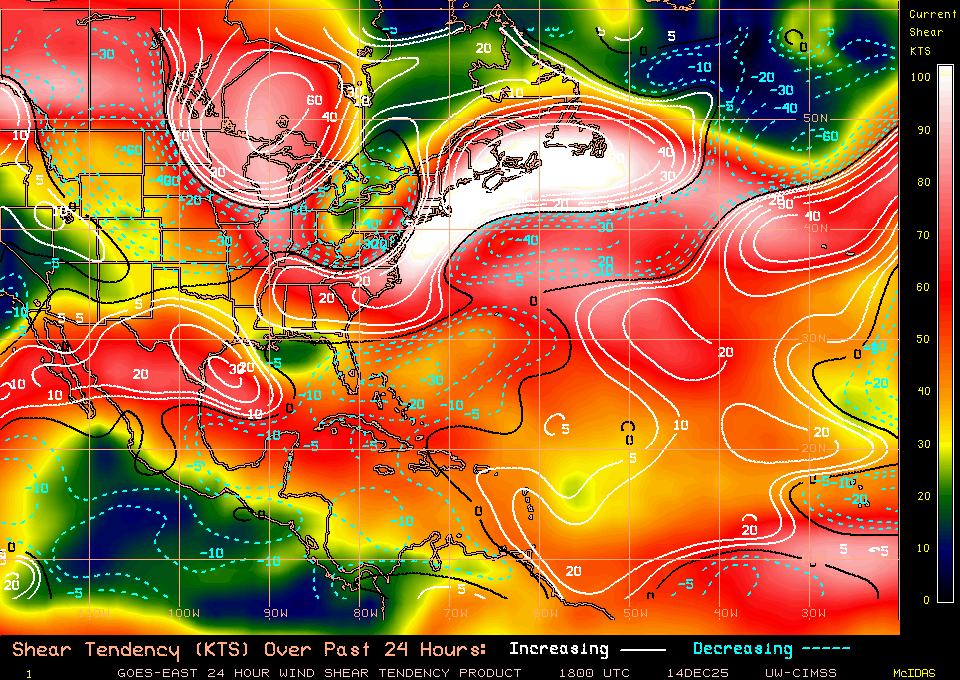
Since Friday, Nate has steadily become better organized over the warm waters of the Caribbean and southern Gulf of Mexico. While some wind shear is preventing the storm from explosively intensifying, Nate is expected to strengthen right up until landfall.

The inner bands of the storm are still located offshore, but with Nate’s fast forward motion, wind speeds and rain intensity will increase throughout Saturday. While landfall is expected to occur Saturday night, tropical storm force are likely to move into the Louisiana coast by midafternoon. They should be impacting Mississippi and Alabama near or shortly after sunset.


Most likely arrival time of tropical force winds via the NHC. (NWS)

Storm surge and damaging wind gusts are the most pressing hazards

Nate is expected to make landfall as a Category 2. Sustained hurricane-force winds and gusts over 100 mph likely to affect some locations from Southeast Louisiana to the near the Alabama-Florida border. These winds could cause widespread downed trees and power outages, as well as some structural damage. The most severe damage will tend to be concentrated in a relatively narrow zone near and just to the east of the storm center. Hurricane-force winds extend about 35 miles from the center, mainly on the east side.

But wind may not be the most dangerous hazard from Nate.

The most immediate threat for the coast will be storm surge generated from the hurricane. Storm surge is best thought of as a general rise in the water level at the coast as the storm comes ashore. It does not include waves on top of it. Water levels as high as 7 to 11 feet above normally dry ground are expected in the hardest hit parts, which the National Hurricane Center expects to be from roughly from the mouth of the Mississippi River to the Mississippi-Alabama border. Around that — as far west as Morgan City, La., and as far east as the Okaloosa-Walton County line in Florida, less severe but still problematic water rises are anticipated — and this whole zone is under a storm surge warning.

“Unfortunately, locations from Grand Isle, La., to Panama City, Fla., will have high tide around midnight, coinciding with landfall and peak storm surge, maximizing coastal inundation anywhere east of the landfall point,” said Brian McNoldy, Capital Weather Gang’s tropical weather expert

On top of the surge, there are giant waves. Nate is already generating wave heights upward of 24 feet in the Gulf of Mexico. While heights seen in open water are unlikely to make it to shore, battering waves are likely to accompany surge along the coast, especially to the east of the center.


Forecast trending to the east of New Orleans

The first round of model runs this morning showed a bit of an eastward shift in Nate’s forecast. If this occurs, it would keep New Orleans on the west, and generally less intense, side of the storm. Given Nate’s fast movement and imminent arrival of bad weather, there’s no reason to let any guard down in these areas, even if the worst misses.

In New Orleans itself, the city’s pumping system is still reeling from several heavy rain events over the summer, with 11 of the 109 city wide pumps still out of service as of earlier this week. Rain from the outer edges of Nate has already reached the area Saturday morning.


8 a.m. simulations from the American GFS model show landfall along the Alabama coast as the most likely scenario.

After landfall

Nate will also be carrying a lot of moisture and promises to drop a large amount of rainfall, despite the fact that the storm is moving quite fast.

A widespread 2 to 6 inches of rain is expected to fall along its track through Sunday. Higher amounts are likely in spots. All of this rain will fall in under 24 hours, so flash flooding will be a concern.


Upward of 10 inches of rain may fall just to the north of Nate’s landfall location. Via WPC

Because the storm is moving so fast, tropical storm-force winds, which could down trees and cause power outages, may extend fairly far inland — through much of Alabama. The National Hurricane Center predicts it could sustain tropical storm strength into Sunday evening, when it should be passing through Tennessee.

Both the “cone of uncertainty” for Nate’s future path and the rainfall forecast for the system include the Mid-Atlantic and Northeast as well. What’s left of Nate will pass west of Washington on Sunday, but we will still be close enough to tap into some much needed rain.

Capital Weather Gang’s Jason Samenow contributed to this story.

Trump says he called Schumer to broker deal with Democrats for ‘a great HealthCare Bill’


President Trump meets Sept. 6 with Senate Minority Leader Charles E. Schumer (D-N.Y.) and other congressional leaders in the Oval Office. (Evan Vucci/AP)

This post has been updated.

Frustrated by Republican inaction on health care, President Trump tweeted Saturday that he had reached out to the Senate Democratic leader in hopes of brokering a deal for a “great HealthCare Bill.”

Trump said that he had called Senate Minority Leader Charles E. Schumer (D-N.Y.) on Friday to ask whether Democrats would work with him on health care — and Trump indicated that he had not been entirely rebuffed.

In a Saturday morning tweet, Trump wrote, “I called Chuck Schumer yesterday to see if the Dems want to do a great HealthCare Bill. ObamaCare is badly broken, big premiums. Who knows!”

Schumer responded, saying he was willing to work with Trump to “improve the existing health care system” but not to “repeal and replace” the Affordable Care Act, former president Barack Obama’s signature 2010 health-care law.

“The president wanted to make another run at repeal and replace and I told the president that’s off the table,” Schumer said in a statement. “If he wants to work together to improve the existing health care system, we Democrats are open to his suggestions. A good place to start might be the Alexander-Murray negotiations that would stabilize the system and lower costs.”

Schumer was referring to a bipartisan health-care proposal by Sens. Lamar Alexander (R-Tenn.) and Patty Murray (D-Wash.).

On Friday, Democratic lawmakers condemned new rules issued by the Trump administration that widen the range of employers and insurers that can avoid the ACA requirement that birth control pills and other contraceptives be covered by insurance as part of preventive care because of religious beliefs.

“Particularly after the birth control decision yesterday, the administration has to stop sabotaging the law before anything real can happen,” a Democratic aide, speaking on the condition of anonymity because the aide was not authorized to be quoted by name, said Saturday.

Trump’s outreach to Schumer comes after the president infuriated fellow Republicans by negotiating a deal last month with Schumer and House Minority Leader Nancy Pelosi (D-Calif.) to raise the debt ceiling and fund the government.

Trump’s dealings with “Chuck and Nancy,” as he affectionately called them, was seen by some congressional Republicans as an act of betrayal but have earned the president plaudits and framed him as the bipartisan dealmaker he said he would be.

Republicans control the House and Senate but have repeatedly failed to pass their health-care bill through the upper chamber. Their efforts to “repeal and replace Obamacare,” which for years has been the GOP’s campaign mantra, so far have garnered no Democratic support.

But Schumer and other Democrats have said they would be open to discussions with Trump and other Republicans to consider selective changes to the ACA. This summer, Schumer publicly offered to negotiate with Trump if Republicans were willing to drop what he called a “fundamentally flawed approach.”

“Let’s start over,” the Democratic leader said in June, challenging the president to invite Senate Democrats to Blair House for a meeting. “You think we’re not serious? Try us. Democrats are ready to turn the page on health care.”

Europe helped draft the Iran nuclear deal. Now EU leaders seek to save it from Trump pressure.

European officials and business executives are quickly mobilizing a counter effort to the expected U.S. rebuff of the Iran nuclear accord, encouraging companies to invest in Iran while urging Congress to push back against White House moves that could hobble the deal.

The European stance — sketched out on the sidelines of an Iran-focused investment forum in Zurich this week — is an early signal of the possible transatlantic rifts ahead as America’s European partners show no sign of following the White House call to renegotiate the landmark pact with Tehran.

“The nuclear deal is working and delivering and the world would be less stable without it,” Helga Schmid, the secretary general of the European’s foreign policy service, said in a speech at the Europe-Iran Forum.

This amounted to a warning shot that Washington may once again find itself isolated from its key Western allies, who have already broke with the White House over issues such as President Trump’s call to withdraw from the Paris climate accord.

Trump plans next week to declare that the 2015 Iran deal — which curbs Iranian nuclear activities in exchange for sanctions relief — is no longer in the U.S. national interest, according to U.S. and European officials. Such a move would then give Congress 60 days to vote to reimpose sanctions.

This could pave the way for the deal’s collapse or, more likely, Europeans and others such as China and India could keep up their growing economic and diplomatic engagement with Iran with the United States on the outside looking in.

“The risk [of sanctions] is there, but my perception is that everybody outside the U.S. who participated in the deal wants to increase relations with Iran,” Ulrich Von Zanthier, director of financial risk management at KPMG, a global audit and advisory firm, told the conference.

If the United States reintroduces sanctions, “it is what it is,” he said. “But at the moment, we can do business, so let’s do business.”

European diplomats and business leaders said they hope the 60-day period will provide them with a diplomatic buffer zone in which they can convince Congress to salvage the agreement.

“There’s a period of 60 days where things need to work out in a way that upholds the [agreement] with the U.S. still in it,” said a senior executive at a Europe-based multinational company. The executive spoke on the condition of anonymity to discuss sensitive matters related to Iran sanctions.

“There’s no real alternative” to the deal, the executive said, adding that “it’s an illusion to think you can reopen and renegotiate” it.

The agreement, also known as the Joint Comprehensive Plan of Action, or JCPOA, was result of years of negotiations between Iran and world powers. It was hailed as a victory for global diplomacy and nuclear nonproliferation, and allowed Iran to resume oil exports and foreign companies to tap in to a vast new consumer market.

Since then, the International Atomic Energy Agency, the U.N. atomic watchdog tasked with monitoring Iran’s nuclear program, has repeatedly certified its compliance with the deal.

Still, the Trump administration has said the agreement does not go far enough in countering Iran’s ballistic missile program and support for groups that the United States considers as terrorists, such as Lebanon’s Hezbollah.

Trump is expected to announce a major policy shift on Iran next week — one that will more aggressively target Iranian security services and push for more radical enforcement of the deal, officials say.

The deal has been “put into question in harsh terms by some in recent months,” said the foreign policy group chief Schmid, referring to the U.S. administration.

“Some critics say that the agreement does not address Iran’s regional activities,” she said, adding that “this is a nonproliferation agreement. It is not an agreement on regional matters or human rights . . . The JCPOA should not be blamed for something it is not supposed to address,” she said. “As Europeans, we will do everything to make sure it stays.”

Iranian leaders also have insisted the nuclear pact cannot be renegotiated. On Friday, the head of Iran’s nuclear agency, Ali Akbar Salehi, warned that Iran would be forced to abandon the accord if other countries followed the U.S. lead to possibly reimpose sanctions.

“But if the U.S. leaves the deal on its own with the others adhering to it, the situation will be different,” Salehi told Iran’s Fars news agency.

Part of the European effort to save the deal includes reassuring European companies and banks that they have political support for their investments, even as some businesses have struggled to navigate Iran’s volatile economy.

As a measure of confidence, the European Commission has recommended that the European Investment Bank be allowed to operate in Iran in the future, Schmid said.

But for others, the risk may be too great.

Before the nuclear deal, the United States imposed what are known as secondary sanctions, where the Treasury Department penalizes companies or people who do business with Iran. The fear is that the United States may revive those strict regulations — putting foreign companies doing business in Iran under the cloud of possible U.S. clampdowns.

“We need to be compliant with international law, or applicable law. And if sanctions come back and that means we cannot do our work inside or outside Iran, then we will stop,” the executive from the multinational said.

“Iran is a big market. It’s also quite a stable country,” the executive said. But multinational companies “have to consider markets around the world, and Iran today is still relatively small, compared to Europe or the U.S.”

Brian Murphy in Washington contributed to this report.