Category Archives: United Airline News

Trump administration narrows Affordable Care Act’s contraception mandate

The Trump administration issued a rule Friday that sharply limits the Affordable Care Act’s contraception coverage mandate, a move that could mean many American women would no longer have access to birth control free of charge.

The new regulation, issued by the Health and Human Services Department, allows a much broader group of employers and insurers to exempt themselves from covering contraceptives such as birth control pills on religious or moral grounds. The decision, anticipated from the Trump administration for months, is the latest twist in a seesawing legal and ideological fight that has surrounded this aspect of the 2010 health-care law nearly from the start.

Several religious groups, which battled the Obama administration for years over the controversial requirement, welcomed the action.

Women’s rights organizations and some medical professionals portrayed it as a blow to women’s health, warning that it could lead to a higher number of unintended pregnancies.

The rule change is among the recent moves by President Trump to dismantle initiatives enacted under the Obama administration. It fulfills a crucial promise Trump made as a candidate to appeal to social conservatives and that he repeated in May when he signed an executive order in the Rose Garden to expand religious liberty.

Senior Health and Human Services officials, briefing reporters early on condition of anonymity, contended the change will still leave “99.9 percent of women” with access to free birth control through their insurance. They said the estimate was based on the finite number of groups that have filed about 50 lawsuits over the provision.

This latest rewriting of the federal policy, in an interim final rule that takes effect immediately, broadens the entities that may claim religious objections to providing contraceptive coverage to nonprofit organizations and for-profit companies, even ones that are publicly traded. Also included are higher educational institutions that arrange for insurance for their students, as well as individuals whose employers are willing to provide health plans consistent with their beliefs.

A separate section covers moral objections, allowing exemptions under similar circumstances except for publicly traded companies.

As part of the rule, made publicly available in the Federal Register late Friday morning, administration officials estimate that 120,000 women at most will lose access to free contraceptives — many fewer than critics predict.

They write that they do not know how many employers or insurers that omitted contraceptive coverage before the ACA did so based on religious beliefs that would now allow them to be exempt. For that reason, the law says, HHS cannot predict how many entities will want exemptions, other than the groups that have filed recent lawsuits or made other public statements against the Obama-era policy.

The analysis concludes that perhaps one-third of women who get insurance through such groups — the estimated 120,000 — would end up paying for birth control on their own.

The new policy “will result in some persons covered in plans of newly exempt entities not receiving coverage or payments for contraceptive services,” the rule acknowledges. But it says there is not “sufficient data to determine the actual effect . . . on plan participants and beneficiaries, including for costs they may incur for contraceptive coverage, nor of unintended pregnancies that may occur.”

The controversy first arose as part of the Obama administration’s initial definition of preventive care that insurers must cover under the ACA — which encompassed birth control, officials decided.

Subsequent accommodations gave exemptions of sorts to houses of worship, nonprofits with religious affiliations and closely held for-profit companies. Such employers have been able to opt out of providing the coverage and instead have their insurance company pay for it by notifying the insurer, a third-party administrator or the federal government. That situation will continue.

Organizations affiliated with the Catholic church, which teaches against birth control other than by natural means, have been among the most vocal opponents. They’ve argued that having to cover the cost of contraception through health insurance plans is tantamount to being forced by the government to be complicit in a sin.

In the past several years, lawsuits have been filed by nuns, Catholic charities, hospitals and universities. Even now, litigation remains in several federal appeals courts.

One challenge was heard by the Supreme Court, and the justices ruled in 2014 that it was illegal to impose the mandate on “closely held corporations” such as Hobby Lobby, the craft store chain. Its Christian owners had objected to the idea of paying for several kinds of the birth control that must be covered.

Despite HHS’s officials 99.9 percent prediction, no one knows how many companies and institutions will now claim an exemption and, in turn, how many women will lose access to no-cost birth control.

The new rule is almost certain to spark fresh litigation. The National Women’s Law Center — which estimates that in 2013 alone, the contraception requirement saved women $1.4 billion in oral contraceptive costs — has vowed to challenge the Trump administration in court. It plans to argue that the new policy amounts to sex discrimination, since it will disproportionately affect women. It also plans to allege religious discrimination, arguing that it will allow employers to impose their religious beliefs on employees.

“The Trump administration is treating birth control as if it’s not even health care. We see this as part of the larger war they are waging on women’s health,” said Mara Gandal-Powers, senior counsel at the National Women’s Law Center. “For some [women], it means choosing between preventive care like contraceptives and paying their rent, their mortgage, electric bill.”

Other groups focused on a different issue, with Anne Davis of Physicians for Reproductive Health arguing that the widened exemptions will leave many women “vulnerable to the whim of their employers. … An employer’s beliefs have no place in these private decisions, just as they would not in any other conversation about a patient’s health care.”

The rule follows some social conservatives’ increasing frustration with the pace at which the Trump administration has addressed their demands on issues such as the ACA contraception requirement. “An awful lot of people who voted for this president did so believing this was going to be something he would solve,” said Mark Rienzi, senior counsel for the Becket Fund for Religious Liberty, who hailed the rule as a correction of overly aggressive liberal actions under President Barack Obama. “There are other ways to get contraceptives. You don’t need to force nuns to give people contraception.”

In his sweeping May 4 executive order on free speech and religious liberty, Trump directed his Cabinet to address the concerns of those who had “conscience-based objections” to contraceptive coverage.

In previewing the rule for reporters, Roger Severino, director of HHS’s office for civil rights and a longtime proponent of religious liberties, reiterated Trump’s May pledge from the Rose Garden. The president had promised that “we will not allow people of faith to be targeted, bullied or silenced any more . . . We are ending the attacks on religious liberties.”

On Friday, Severino elaborated: “That was a promise made, and this is the promise kept. … We should have space for organizations to live out their religious identity and not face discrimination because of their faith.”

The HHS regulation was not the only administration action along these lines to be announced on Friday. Minutes later, Attorney General Jeff Sessions issued sweeping guidance to all executive departments and agencies on the Justice Department’s interpretation of religious liberties. That also triggered an immediate backlash, with civil liberties groups asserting that he was essentially offering a license for discrimination.

Senior Justice Department officials said the guidance was merely meant to offer interpretation and clarification of existing law. But the interpretation seemed to be particularly favorable to religious entities, possibly at the expense of women, LGBT people and others.

The guidance, for example, said the ACA contraceptive mandate “substantially burdens” employers’ free practice of religion by requiring them to provide insurance coverage for contraceptive drugs in violation of their religious of beliefs or face significant fines.

Over the summer, a leaked early draft of the regulation began circulating in Washington, priming both sides for a renewed fight. That draft immediately drew praise from one side and condemnation from the other.

When the contraception mandate was first implemented in August 2012, it required all health insurance offered by employers to cover at least one of the 18 forms of birth control approved by the Food and Drug Administration. Since then, savings on the birth control pill have accounted for more than half of the drop in all out-of-pocket prescription drug spending, according to the Kaiser Family Foundation.

Republicans Open to Banning ‘Bump Stocks’ Used in Massacre

Mr. Cornyn said the continuing legality of the conversion kits was “a legitimate question,” and told reporters he had asked Senator Charles E. Grassley of Iowa, the Judiciary Committee chairman, to convene a hearing on that issue and any others that arise out of the Las Vegas investigation.

Other Republican senators, including Lindsey Graham of South Carolina, Orrin G. Hatch of Utah and Marco Rubio of Florida, said they would be open to considering legislation on bump stocks.

“We certainly want to learn more details on what occurred in Las Vegas,” Mr. Rubio said, “and if there are vulnerabilities in federal law that we should be addressing to prevent such attacks in the future, we would always be open to that.”

In the House, Representative Carlos Curbelo, Republican of Florida, said he was drafting bipartisan legislation banning the conversion kits. Representative Mark Meadows, the head of the conservative Freedom Caucus, also said he would be open to considering a bill, while Representative Bill Flores, Republican of Texas, called for an outright ban.

“I think they should be banned,” Mr. Flores told the newspaper The Hill. “There’s no reason for a typical gun owner to own anything that converts a semiautomatic to something that behaves like an automatic.”

In an often deadlocked Washington, none of the pronouncements guaranteed action. The National Rifle Association, which has poured tens of millions of dollars into Republican campaign coffers, remained mum on the bump stock discussion and could stop it cold.

And Erich Pratt, executive director of another gun rights group, Gun Owners of America, vowed to block any legislation.

Interactive Graphic

What Is a Bump Stock and How Was It Used in the Las Vegas Shooting?

Twelve of the rifles the gunman had in his hotel room were outfitted with a “bump stock,” an attachment that enables a semiautomatic rifle to fire faster.


“We see this as an item that is certainly protected by the Second Amendment, and realistically, they are already on the market, so passing a law banning them isn’t going to stop bad guys like this creep in Las Vegas,” he said.

Advertisement

Continue reading the main story

But Senator Dianne Feinstein, the California Democrat, tried to force the issue, introducing legislation, backed by about two dozen Democrats, that would ban bump stocks.

Ms. Feinstein cautioned that bipartisan support for such narrow legislation would hardly constitute a sea change. She tried to ban bump stocks in 2013, but that was part of broader legislation to renew the assault weapons ban, which went nowhere.

Newsletter Sign Up

Continue reading the main story

“I mean, if not this, what?” she asked. “It doesn’t take a weapon away. It just means you can’t convert it into something it’s not meant to be.”

At a hastily convened news conference, Ms. Feinstein said the Las Vegas massacre, which left 58 people dead and about 500 injured at a country music festival Sunday night, had hit home with her. Her daughter had planned to attend the concert but decided against going at the last minute.

Ms. Feinstein, who has spent years shepherding gun safety legislation — almost always unsuccessfully — said she introduced the measure on the advice of Senator Chuck Schumer of New York, the Democratic leader, who reasoned that by offering a narrowly tailored provision, she might get Republican support.

Bump stocks replace a rifle’s standard stock, which is the part held against the shoulder, freeing the weapon to slide back and forth rapidly, harnessing the energy from the kickback that shooters feel when the weapon fires. The stock “bumps” back and forth between the shooter’s shoulder and trigger finger, causing the rifle to rapidly fire again and again, far faster than an unaided finger can pull a trigger.

In marketing the devices, two Texas companies, Bump Fire Systems and Slide Fire Solutions, were apparently concerned that they would not be legal. But in June 2010, after an inquiry from Slide Fire, the Bureau of Alcohol, Tobacco, Firearms and Explosives, or A.T.F., sent a letter saying that the company’s bump stock product “is a firearm part and is not regulated as a firearm under the Gun Control Act or the National Firearms Act.”

The Las Vegas gunman fired down on concertgoers from the 32nd floor of a nearby hotel. With his fixed firing positions and distance from his victims, he almost certainly was more lethal because of the conversion kits. But until the shooting, many lawmakers said, they had never heard of bump stocks.

Advertisement

Continue reading the main story

The devices were introduced during the past decade by Bump Fire and Slide Fire, both based in Moran, Tex., near Abilene. Bump Fire’s website appeared to be down for much of Wednesday. The company wrote on its Facebook page on Tuesday that its servers had been overwhelmed by “high traffic volume.”

Multiple items on Slide Fire’s site on Wednesday featured the notice, “Due to extreme high demands, we are currently out of stock.”

Bump Fire sells stocks for an AK-47 and an AR-15 for $99.99 each. Slide Fire’s stocks are priced between $140 and $300. Neither company responded to a request for comment.

On Gunbroker.com, an auction site for firearms and shooting accessories, at least three dozen listings featuring bump stocks had attracted multiple bids.

Zack Cernok, a Pennsylvania gun owner, was one of those trying to buy a Bump Fire bump stock.

“I don’t even have the gun for it, but I want the stock just to have it down the line,” he said. “I just like the idea of them and want to see how it feels and if it’s worth it — for $100, it’s almost not a bad investment to buy it, try it out and sell it if I don’t like it.”


Continue reading the main story

Las Vegas shooting motive remains elusive as new details emerge about attack

Investigators probing the Las Vegas massacre continued searching Thursday for what could have motivated the deadliest mass shooting in modern American history, even as they detailed more evidence suggesting that the gunman meant to inflict even greater damage.

Since the moment Stephen Paddock fired the first round out of his high-rise hotel suite overlooking the Las Vegas Strip, unleashing a hail of gunfire on the concertgoers far below, authorities have pieced together many details about the 64-year-old and his attack.

They know he planned extensively, prepared methodically, secretly assembling an arsenal of guns and thousands of rounds of ammunition in his two-room suite in the Mandalay Bay Resort and Casino. Authorities have tracked his gun purchases, tried to piece together his movements in the hours and days before the attack and spoken to his relatives and girlfriend.

What local and federal investigators say remains elusive, though, is an explanation for why Paddock carried out the rampage, killing 58 people and injuring hundreds more before taking his own life. They also are still trying to determine whether he had any help.

Paddock, a retired accountant and avid gambler, was “disturbed and dangerous,” Joseph Lombardo, the Las Vegas sheriff, said at a news briefing Wednesday night.

“Stephen Paddock is a man who spent decades acquiring weapons and ammo and living a secret life, much of which will never be fully understood,” Lombardo said.

Lombardo said authorities hoped to figure out what may have sparked Paddock’s rage.

“Anything that would indicate this individual’s trigger point and would cause him to do such harm, we haven’t understood it yet,” he said.

As the sprawling investigation stretched across the country and around the world, authorities hoped that Marilou Danley, Paddock’s girlfriend, could provide some answers about his mind-set and what could have motivated him. But in a statement released after she was interviewed by the FBI in Los Angeles, Danley said she had no idea of what was about to happen.

“It never occurred to me in any way whatsoever that he was planning violence against anyone,” Danley said in a statement that was read aloud by her attorney. She described Paddock as a “kind, caring, quiet man” and said he never gave any sign “that something horrible like this was going to happen.”

Danley was out of the country when the attack occurred, which she said was by Paddock’s design. Paddock bought her a ticket to visit family in the Philippines, she said, and then wired money that he explained was meant to buy a home for Danley’s relatives. In her statement, Danley said she thought this meant Paddock was breaking up with her.

“I am devastated by the deaths and injuries that have occurred and my prayers go out to the victims and their families and all those who have been hurt by these awful events,” Danley said. “I am a mother and a grandmother, and my heart breaks for all who have lost loved ones.”

Danley pledged to cooperate with authorities, noting that she “voluntarily flew back to America” to speak with them.

Police have called her a “person of interest,” viewing her as a key part of the investigation, although they have not suggested that she is considered an accomplice or involved in any way. Aaron Rouse, special agent in charge of the FBI’s Las Vegas division, declined to say whether Danley was still considered a person of interest at the briefing Wednesday night, although he said she was not in federal custody.

Rouse said that the investigation will take time, noting that the bureau was chasing leads “all across the United States and all across the world.”

The FBI has found no evidence to suggest that the attack was terrorism, Rouse said, adding that the investigation is continuing.

“We will get to the bottom of this no matter how long it takes,” he said.

While investigators still do not know what set Paddock off, they have found evidence that he may have intended an even deadlier attack.

When police stormed Paddock’s room, they found 23 guns, some equipped with “bump” stocks that can allow guns to fire at a more rapid clip, along with thousands of rounds of unused ammunition. Police also found a slip of paper in the room, which is visible in photos that have circulated online; while authorities have not said what was on the paper, Lombardo said it was not a suicide note.

In Paddock’s car, investigators also found several cases containing the chemical tannerite, an explosive, along with an additional 1,600 rounds of ammunition. At Paddock’s homes, authorities found dozens of other guns, additional ammunition and more tannerite.

All told, police have recovered 47 guns in the case, most of them bought since October 2016, according to the Bureau of Alcohol, Tobacco, Firearms and Explosives. Lombardo said police had focused on why Paddock bought 33 rifles between October 2016 and last Thursday, when he checked in at the hotel, and were exploring whether something happened that compelled him to buy so many guns over that time period.

Lombardo said investigators found evidence that Paddock might have intended to escape the attack alive, although he declined to say what that evidence was.

Police were still exploring whether anyone else was involved, Lombardo said. While authorities have described Paddock as the lone attacker, Lombardo pointed to the sheer amount of preparation involved and gear the gunman brought into his room in questioning whether he truly did everything alone.

“You’ve got to make the assumption he had to have some help at some point,” Lombardo said, adding that investigators have not identified any particular person.

But authorities were also exploring whether Paddock had another target before firing upon the country music festival Sunday night. Before that attack, Paddock had rented a room at the Ogden hotel in Las Vegas during a different music festival in September, Lombardo said, although it was still unclear what his intentions were there and authorities were still reviewing surveillance footage.

Speaking Wednesday night, Lombardo offered the most detailed timeline yet of the incident, describing how officers heard the gunshots, closed in on Paddock’s suite and — 75 minutes later — breached the door to find Paddock dead, a handgun not far from his body.

The timeline offered by Lombardo depicts officers checking room after room, unsure what they would find inside. Gunshots first rang out at 10:05 p.m., and two minutes later, two officers arrived on the floor below Paddock and heard gunfire above them, Lombardo said.

The gunfire ended, Lombardo said, at 10:15 p.m. At 10:17 p.m., Lombardo said, officers arrived on the hotel’s 32nd floor, and just a minute later, a hotel security officer relayed that he was shot. By 10:30 p.m., eight more officers were on the floor, clearing room after room.

As with the rest of the attack, Paddock appeared merciless and meticulous. He set up cameras in his room and the hallway to monitor police officers as they approached. At 11:20 p.m., SWAT officers breached the door and found Paddock’s body, Lombardo said. Before they arrived, he had put a gun in his mouth and pulled the trigger. It remains unclear when exactly Paddock shot himself.

This story will be updated throughout the day.

Further reading:

The worst kind of spotlight: When a relative is the mass shooter

Trump to meet with Las Vegas shooting survivors: ‘We’re going to pay our respects’

WASHINGTON – President Trump left Wednesday for Las Vegas to speak with survivors of the mass shooting that left 59 people dead, just one day after traveling to survey hurricane recovery efforts in Puerto Rico. 

“It’s a very sad thing,” Trump told reporters of the deadly shooting, as he exited the White House. “We’re going to pay our respects.”

The president and first lady Melania Trump will travel to a local hospital to visit with patients and medical professionals, according to the White House schedule. They then head to an undisclosed location to meet with what the schedule simply listed as “civilian heroes” and first responders.

“The police who have done really a fantastic job in a very short time,” he said Wednesday. “And yeah they’re learning a lot more. And that’ll be announced at the appropriate time. It’s a very, very sad day for me, personally.” 

More: Trump to console Las Vegas after deadly shooting, but he’s unlikely to change gun policy

More: Trump: Las Vegas shooting suspect is ‘a sick man, a demented man’

Previewing his Las Vegas trip with reporters on Tuesday night, Trump said he has been fully briefed on the investigation into Stephen Paddock, the suspected gunman who fired guns into a crowd of concert goers on Sunday night which also injured more than 500 people.

Trump declined to discuss what might have motivated the shooter, only that he was “a sick and demented person.”

The president has also described the reaction to the Vegas shooting as a “miracle.”

On Twitter, he said Tuesday that “it is a ‘miracle’ how fast the Las Vegas Metropolitan Police were able to find the demented shooter and stop him from even more killing!”

While some lawmakers said the shooting underscores the need for more and better gun control, Trump has declined to discuss that subject.

“We’ll talk about that on a later date,” he told reporters aboard Air Force One as he returned from Puerto Rico.

More: The three gun debate bills to pay attention to in Congress

More: Congress faces paralysis on guns in wake of Las Vegas shooting spree

Declaring that visit a success, Trump said Puerto Rico residents praised the government’s efforts to help them recover from Hurricane Maria.

“I think it means a lot to the people of Puerto Rico that I was there,” Trump said. “They’ve really responded very nicely, and I think it meant a lot to the people of Puerto Rico.”

During a briefing, Trump also cracked a joke about the cost of the recovery, saying that “now I hate to tell you, Puerto Rico, but you’ve thrown our budget a little out of whack,” a comment that drew barbs from critics.

Senate Minority Leader Chuck Schumer, D-N.Y., hit Trump for having “the gall to complain about Puerto Rico” while he has proposed “tax cuts for billionaires” throughout the United States. He also noted that Trump didn’t tell jokes about Texas and Florida after their hurricanes.

“Mr. President, enough,” Schumer said. “Stop blaming Puerto Rico for the storm that devastated their shores, and roll up your sleeves and get the recovery on track. That’s your job as President.”

Before leaving for Las Vegas, Trump protested some of the news coverage of the Puerto Rico visit and presumably other events.

“Wow, so many Fake News stories today,” Trump tweeted. “No matter what I do or say, they will not write or speak truth. The Fake News Media is out of control!”

Tillerson’s Fury at Trump Required an Intervention From Pence

WASHINGTON — Secretary of State Rex Tillerson was on the verge of resigning this past summer amid mounting policy disputes and clashes with the White House, according to multiple senior administration officials who were aware of the situation at the time.

The tensions came to a head around the time President Donald Trump delivered a politicized speech in late July to the Boy Scouts of America, an organization Tillerson once led, the officials said.

Just days earlier, Tillerson had openly disparaged the president, referring to him as a “moron,” after a July 20 meeting at the Pentagon with members of Trump’s national security team and Cabinet officials, according to three officials familiar with the incident.

While it’s unclear if he was aware of the incident, Vice President Mike Pence counseled Tillerson, who is fourth in line to the presidency, on ways to ease tensions with Trump, and other top administration officials urged him to remain in the job at least until the end of the year, officials said.

Officials said that the administration, beset then by a series of high-level firings and resignations, would have struggled to manage the fallout from a Cabinet secretary of his stature departing within the first year of Trump’s presidency.


Pence has since spoken to Tillerson about being respectful of the president in meetings and in public, urging that any disagreements be sorted out privately, a White House official said. The official said progress has since been made.

Yet the disputes have not abated. This weekend, tensions spilled out into the open once again when the president seemed to publicly chide Tillerson on his handling of the crisis with North Korea.

NBC News spoke with a dozen current and former senior administration officials for this article, as well as others who are close to the president.

Tillerson, who was in Texas for his son’s wedding in late July when Trump addressed the Boy Scouts, had threatened not to return to Washington, according to three people with direct knowledge of the threats. His discussions with retired Gen. John Kelly, who would soon be named Trump’s second chief of staff, and Defense Secretary James Mattis, helped initially to reassure him, four people with direct knowledge of the exchanges said.

Related: Trump Tweets Tillerson ‘Wasting His Time’ Talking to North Korea

After Tillerson’s return to Washington, Pence arranged a meeting with him, according to three officials. During the meeting, Pence gave Tillerson a “pep talk,” one of these officials said, but also had a message: the secretary needed to figure out how to move forward within Trump’s policy framework.

Kelly and Mattis have been Tillerson’s strongest allies in the cabinet. In late July, “they did beg him to stay,” a senior administration official said. “They just wanted stability.”

At that time, however, State Department spokesperson Heather Nauert responded to speculation that Tillerson was thinking about resigning by saying he was “committed to staying” and was “just taking a little time off” in Texas.

Tillerson’s top State Department spokesman, R.C. Hammond, said Tillerson did not consider quitting this past summer. He denied that Tillerson called Trump a “moron.” Hammond said he was unaware of the details of Tillerson’s meetings with Pence.

Hammond said he knew of only one time when the two men discussed topics other than policy: A meeting where Pence asked Tillerson if he thought Nikki Haley, the U.S. ambassador to the United Nations, was helpful to the administration, or if he was worried about the role she was playing. He added that whenever the vice president gives advice on how processes could run more smoothly, the advice is a good thing.

Hammond also said that he wouldn’t characterize the secretary’s conversations with Mattis or Kelly as attempts to convince Tillerson to stay in his position.


A Pentagon official close to Mattis denied any awareness of a specific conversation about Tillerson’s future in the administration. But the official said the two men speak all the time and have a regular breakfast together.

The White House declined to comment on the record for this story.

Tillerson and Trump clashed over a series of key foreign policy issues over the summer, including Iran and Qatar. Trump chafed at Tillerson’s attempts to push him – privately and publicly – toward decisions that were at odds with his policy positions, according to officials. Hammond said Tillerson has had no policy differences with Trump. “The president’s policy is his policy,” Hammond said.

In August, Trump was furious with Tillerson over his response to a question about the president’s handling of the racially charged and deadly violence in Charlottesville, Virginia, administration officials said. Trump had said publicly that white nationalists and neo-Nazi sympathizers shared blame for violence with those who came out to protest them.

“The president speaks for himself,” Tillerson said at the time, when asked on “Fox News Sunday” about Trump’s comments.

Hammond said Trump addressed the issue with Tillerson in a meeting the next day. He said that during the meeting, Trump congratulated another White House official, Homeland Security Adviser Tom Bossert, for his performance on the Sunday news talk shows. Bossert had defended Trump’s controversial pardon of former Arizona sheriff Joe Arpaio.

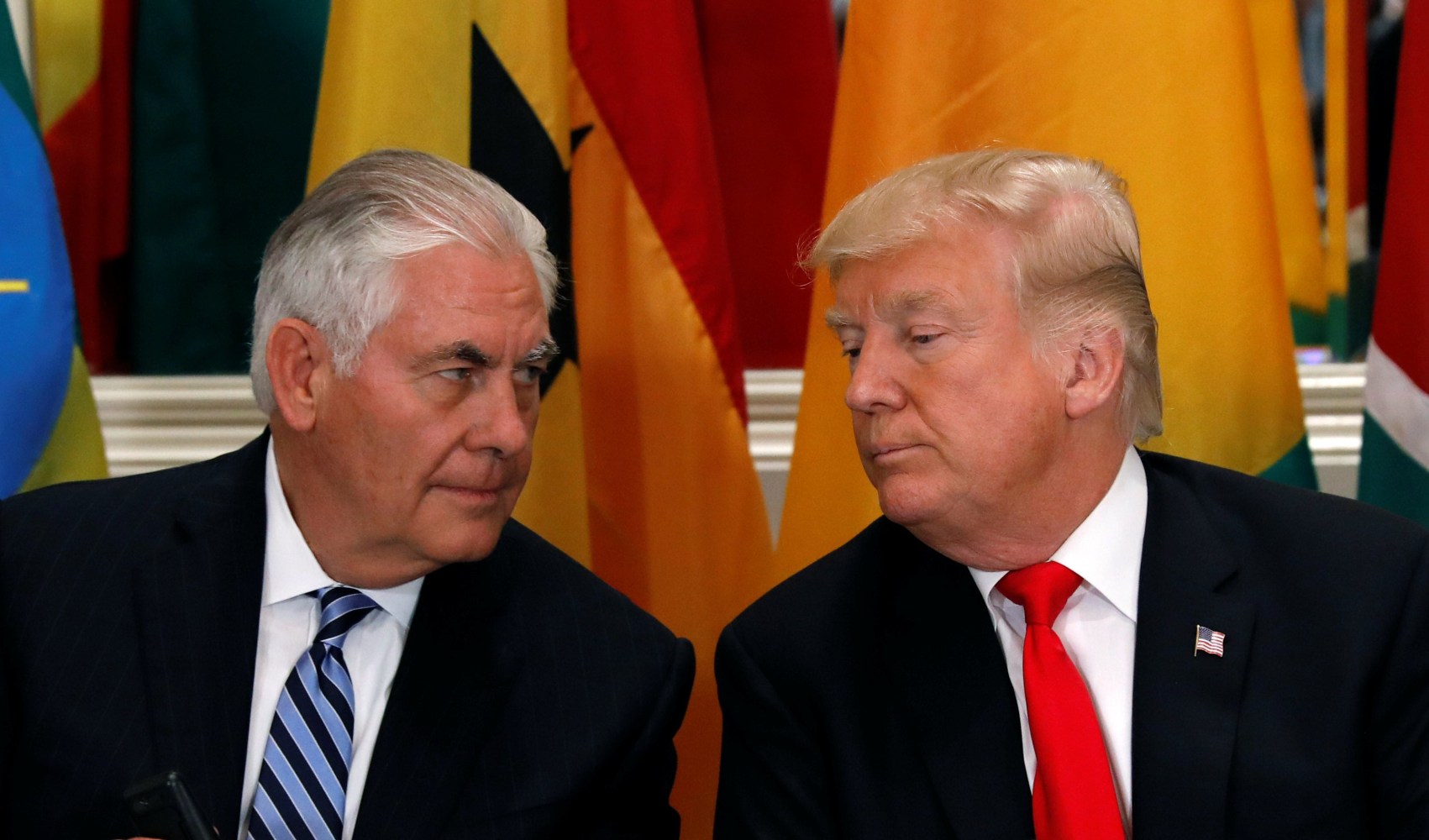
Image: Trump hosts a working lunch with African leaders in New York


Image: Trump hosts a working lunch with African leaders in New York

The president, according to Hammond, told Tillerson he was upset with his comments when he saw them the first time. But, Hammond said Trump told Tillerson, after watching the interview a second and third time, the president understood that Tillerson was trying to say Trump is the best person to convey what his values are.

Still, the message was clear that Trump wanted Tillerson to defend him more, Hammond said.

The frustrations run both ways. Tillerson stunned a handful of senior administration officials when he called the president a “moron” after a tense two-hour long meeting in a secure room at the Pentagon called “The Tank,” according to three officials who were present or briefed on the incident. The July 20 meeting came a day after a meeting in the White House Situation Room on Afghanistan policy where Trump rattled his national security advisers by suggesting he might fire the top U.S. commander of the war and comparing the decision-making process on troop levels to the renovation of a high-end New York restaurant, according to participants in the meeting.

It is unclear whether Trump was told of Tillerson’s outburst after the Pentagon meeting or to what extent the president was briefed on Tillerson’s plan to resign earlier in the year.

Tillerson also has complained about being publicly undermined by the president on the administration’s foreign policy agenda, officials said.

Those strains were on display this past weekend when Tillerson said, to the White House’s surprise, that the U.S. is attempting diplomatic talks with North Korea.

Trump quickly took the opposite position, writing on Twitter “I told Rex Tillerson, our wonderful Secretary of State, that he is wasting his time trying to negotiate with Little Rocket Man…,” using his latest epithet for North Korean leader Kim Jong Un.

“…Save your energy Rex, we’ll do what has to be done!” Trump added in a second tweet.


Asked whether the president still has confidence in Tillerson, White House spokeswoman Sarah Sanders said Monday that he does.

Trump has already seen an unusually high level of turnover in his administration, with the departures of his national security adviser, deputy national security adviser, his chief of staff, press secretary, communications director — twice — his chief strategist, the director of the Federal Bureau of Investigation and the acting head of the Justice Department. Last Friday Trump accepted the resignation of Tom Price, the Health and Human Services secretary.

One senior administration official described late July as “a tough period of time” for Tillerson. His frustrations appeared to mount in the preceding weeks. Trump publicly undermined Tillerson in June over a dispute between Qatar and other Persian Gulf states, including Saudi Arabia and the United Arab Emirates. Tillerson had called on the countries to ease their blockade of Qatar, yet just hours later Trump said the Saudi-led effort was necessary.

Tillerson also pushed Trump to certify in July that Iran was complying with the 2015 nuclear deal.

Tillerson has been at odds with Trump on other issues as well, arguing against sanctions on Venezuela and reportedly suggesting Israel return to the U.S. $75 million in aid. Tillerson also is seeking to use the implementation of arms deals Trump struck with Saudi Arabia and the UAE as leverage to prod the two countries to resolve the dispute with Qatar, according to U.S. and Arab officials.

Administration officials speculate that Tillerson would be succeeded by Haley if Tillerson were to depart.

Tillerson’s tenure has been rocky from the start. He was confirmed by a Republican-led Senate on 56-to-43 vote. That represents the most votes against a secretary of state in Senate history.

Since then, Tillerson, the former chief executive of ExxonMobil, has been slow to fill jobs within his department and appears to have alienated officials in the White House, the Cabinet and Congress.

He has become known for being difficult to reach and tends to take his time returning phone calls, administration and congressional officials said. Congressional Republicans balked at his proposed cuts to the State Department budget.

“It’s hard to get him to return phone calls,” a senior Republican congressional aide said of Tillerson. “It’s hard to get him to answer letters.”

Hammond said Tillerson is quick to return calls and respond to lawmakers.

Tillerson has clashed with the president’s son-in-law and senior adviser Jared Kushner, who has a broad portfolio that includes policies in the Middle East, officials said.

A second White House official downplayed any tensions between Tillerson and Kushner, noting that Kushner’s efforts on an Israeli-Palestinian peace agreement are run through the relevant agencies and that a State Department representative went on his most recent trip to the region.

A third White House official disputed the notion that Tillerson has alienated people in the White House, Cabinet and Congress.

Trump’s July 24 speech at the Boy Scouts gathering struck a political tone unusual for the event, with the president talking about his electoral victory and the “cesspool” of Washington. He also joked about firing his Health and Human Services secretary if congressional Republicans didn’t pass a health care bill. The head of the Boy Scouts later apologized for the political tone of the speech.

Tillerson is an Eagle Scout and a former president of the Boy Scouts. He had appeared at the gathering just three days before Trump. Hammond, his spokesman, said Tillerson was not upset with Trump’s speech. He said Tillerson told him that at the end of the day the scouts are going to remember that the president came to speak at their event, and their parents can answer any questions they might have about the message he delivered.

It’s unclear if the latest disagreement between the White House and Tillerson on North Korea spells an end to the late-July reset.

Nicholas Burns, former undersecretary of state for political affairs under President George W. Bush, said Trump “completely undercut Tillerson” with his tweets.

“This was a direct public, I thought, repudiation of what Tillerson said,” Burns said. “It feeds the perception that Tillerson does not have a trusting relationship with the president, and that’s very harmful.”

New details emerge about Marilou Danley, girlfriend of Las Vegas shooter Stephen Paddock

Marilou Danley, the longtime girlfriend of the Las Vegas gunman, returned to the United States on Tuesday night and was met at the Los Angeles airport by FBI agents. Authorities are hoping she can shed light on what drove Stephen Paddock to open fire from his casino hotel room Sunday night. He killed at least 58 people and injured more than 500 on the Las Vegas Strip before killing himself.

Danley was in the Philippines at the time of the attack. Immigration officials in the Philippines told news outlets there that Danley left the country Tuesday evening on a Philippine Airlines flight to Los Angeles.

As investigators continue to search for a motive, new details have emerged about Paddock and his relationship to Danley.

Paddock met Marilou Danley several years ago while she was working as a high-limit hostess for Club Paradise at the Atlantis Casino Resort Spa in Reno, Nev., said his brother Eric Paddock.

“They were adorable — big man, tiny woman. He loved her. He doted on her,” Eric said.

The two often gambled side by side, he said. Authorities say that prior to the shooting Paddock transferred a large amount of money — close to $100,000 — to someone in the Philippines, possibly his girlfriend. Eric Paddock said he now believes his brother may have been trying to arrange for Danley to be abroad before carrying out his massacre.

Employees at a Starbucks in Mesquite, Nev., however, described the couple’s relationship differently. A supervisor at the coffee shop told the Los Angeles Times that Paddock often berated Danley in public. The Starbucks is the only one in town and is inside the Virgin River Casino.

“It happened a lot,” Esperanza Mendoza, supervisor of the Starbucks, told the Times. He would verbally abuse her when Danley asked to use his casino card to buy food or other things inside the casino, Esperanza said.

“He would glare down at her and say — with a mean attitude — ‘You don’t need my casino card for this. I’m paying for your drink, just like I’m paying for you.’ Then she would softly say, ‘Okay’ and step back behind him. He was so rude to her in front of us.”

The Girlfriend

Danley is from the Philippines but has Australian citizenship, Australian authorities have said.

The Courier Mail, a newspaper in Brisbane, the capital of Queensland, Australia, posted pictures of a trip to Australia Paddock apparently took with Danley in 2013 to meet her family there.

Danley arrived in the Philippines a week before the attack, Filipino news outlets said, quoting immigration officers at the Ninoy Aquino International Airport. The officers told local news outlets that she arrived in Manila from Hong Kong on Sept. 25 via Cebu Pacific flight 5J 115.

Paddock was a frequent gambler at the casino where Danley once worked at one point. She was a high-limit hostess for Club Paradise, a rewards program in the Atlantis Casino Resort Spa in Reno, Nev., according to her LinkedIn profile. In a statement, Atlantis officials said she has not worked for the casino for several years.

Paddock was such a regular at the Atlantis that his entire family once took over the top floor at the casino’s expense, his brother said.

According to court records, Danley may have been living with Paddock as early as August 2013, while she was still married to another man, named Geary Danley.

Geary and Marilou Danley were married in Las Vegas in 1990. According to court records, they jointly filed for divorce on Feb. 25, 2015, and the divorce was finalized the next day. During her divorce, Marilou Danley listed a downtown Reno apartment as her address. Property records show the apartment was owned by Paddock.

Paddock invested and sold several properties in recent years as a way of making money, according to relatives and property records. Neighbors at two other properties owned by Paddock in Reno and Mesquite said Danley lived with Paddock there as well and often disappeared with him for long stretches — sometimes for months at a time — during his visits to casinos.

At one point, Danley worked for an airline based out of California’s Bay Area, said one longtime neighbor in Reno, where Danley and Paddock lived together in a retirement community. She later worked for Avon, the cosmetic sales company, and tried to sell their products to other residents, Elizabeth Tyee said. Danley traveled all the time, and when she was at the home she shared with Paddock in a retirement community in Reno, it was never for very long. Tyee said Danley would show up every three or four months and stay for no more than 10 days.

She is considered a critical witness in trying to decipher Paddock’s motive.

While investigators have described her as a “person of interest,” they have not suggested that she is considered an accomplice or involved in any way. Still, given how little has emerged in Paddock’s past that could foreshadow the attack, the “best lead is through this girlfriend,” said Sen. Dean Heller (R-Nev.).

Danley has a daughter and grandchildren, Tyee said. Tyee and many other neighbors described Danley as extremely sweet and friendly. She hugged her when they saw each other. Paddock, however, was more standoffish and unfriendly.

This summer, Tyee saw Danley and Paddock moving a mattress and saw inside their garage, which was completely empty. Tyee asked Danley whether they were moving, and Danley said they had bought a new house but were not moving out of Reno.

Another neighbor, Susan Page, who moved next door to the couple this summer, said she had not seen them since August. Paddock had recently bought a new silver minivan, she said, and Danley drove an SUV. On the third week of August, Paddock left the house. Soon after, Danley packed up her car as well, as if she was moving, Page said.

The Gunman

More details have also emerged on Paddock, the gunman.

From 1976 to 1985, Paddock worked U.S. government jobs: as a letter carrier for the U.S. Postal Service, an agent for the IRS  and an auditor for U.S. government’s Defense Contract Audit Agency, according to the Office of Personnel Management.

Neighbors in several states where he owned homes in retirement communities described him as surly, unfriendly and standoffish.

Relatives say the roots of Paddock’s loner lifestyle may have been planted July 28, 1960. On that day, when Paddock was 7, a neighbor from across the street took him swimming. The neighbor at the time told a local newspaper that she knew authorities were coming for his father, a bank robber, and she wanted to spare the boy the trauma of seeing his father hauled away by authorities.

From that point on, Paddock’s family was never the same.

His mother struggled to raise him and his four brothers on her own. His father escaped from prison — twice — and had little more contact with them, relatives say. As they grew older, Stephen, the eldest, and the youngest brother, Eric, kept in touch, but Stephen Paddock drifted almost completely out of touch with his two other brothers, Bruce and Patrick.

Eric said that Stephen stopped talking to his brother Bruce because Bruce used to beat him up when they were kids and that Stephen stopped talking to Patrick because they’re very different people.

Even with Eric he never talked much. They created a lucrative real estate investment business together, but Stephen would only text Eric now and then.

“We didn’t talk much. We talked when there was something to talk about,” Eric Paddock said. “Steve had no help. Steve did not take help. He was a stand-alone guy.”

Choking up as he talked, Eric said: “Steve was like a dad surrogate. He took me camping. I liked my brother. He was a good guy.”

High school

Stephen Paddock went to John H. Francis Polytechnic High School, in the Los Angeles suburbs, his brother said.

Judy Smith Nelson, a retired federal worker living in Las Vegas, was stunned when she first saw that she and the alleged shooter were the same age — 64. Then a friend texted her a picture from an old high school yearbook.

“I couldn’t believe it. I recognized the face. We had been classmates,” Nelson said Tuesday.

As investigators continued searching for a motive, anyone who had come into contact with Paddock over more than four decades began to wrestle with what they knew of the man and whether there had ever been clues of what would come.

Former California state senator Richard Alarcon, who had gotten his start as student body president of John H. Francis Polytechnic High School in 1971, posted a note to friends on Facebook on Tuesday saying he remembered playing basketball with Paddock at a neighborhood court.

Another classmate remembered Paddock showing up at a 20-year reunion and repeatedly angling to talk to her.

Nelson, in Las Vegas, fished through an old box of keepsakes and found a 10-year reunion program that contained a one-line description that each classmate had written. Paddock’s read: “Single, accountant, has traveled to Hollywood, lives in Sepulveda [Calif.]”

“We’re all just reeling, and here I have kind of a personal connection, being that we walked the same grounds, we were from the same area,” Nelson said.

After high school, Paddock attended Cal State Northridge. He was married and divorced twice. Both ex-wives — one in the L.A. area, the other in the Dallas suburbs — declined to talk to reporters.

Julie Tate in Washington; Ally Gravina in Reno, Nev.; and William Dauber in Los Angeles contributed to this report.

Supreme Court takes up Wisconsin as test in partisan gerrymandering claims

The Supreme Court on Tuesday will consider whether a state’s legislative maps are so politically skewed to favor one party that they violate the Constitution.

The justices have never thrown out a state’s maps because of partisan gerrymandering. But challengers from Wisconsin say they have the evidence that Republican leaders of their state drew maps to ensure enduring GOP control of the legislature, and a test for deciding when political advantage goes too far.

The outcome could change the way American elections are conducted. Wisconsin officials say if their maps, which follow traditional redistricting standards, are illegal, dozens of state plans will need to be thrown out.

Waiting in the wings are gerrymandering complaints from North Carolina and Maryland. The Maryland case alleges that the state’s Democratic leadership drew congressional maps that put Republicans at a disadvantage.

The Supreme Court routinely makes states redraw maps when there is evidence that drawing of legislative maps harms racial minority voters by making it more difficult to elect representatives of their choice.

Individual justices have said partisan gerrymandering is harmful as well. But even some of those who agree have said redistricting is a political question between representatives and their constituents, and the courts should stay out.

Others — most importantly Justice Anthony M. Kennedy, the key to the Wisconsin case — have said extreme partisan gerrymandering can violate constitutional rights. But in the court’s most recent look at the issue in 2004, he did not find a workable test for deciding what is excessive.

In the Wisconsin case, a panel of three federal judges ruled 2-to-1 that the state’s leaders had used a secretive process for drawing the maps after the 2010 census that went too far.

The lower court concluded that the districting plans were drawn to create districts favorable to Republicans, that the advantage would be “enduring” even when Democrats outperformed Republicans at the polls and that the drawing of the districts could not be explained by nonpartisan reasons.

They said Republicans packed Democrats into some districts and spread them out across others as a way to create more districts conductive to a GOP candidate.

The plans, developed in 2011 by Republican leaders who controlled the legislature and signed by Gov. Scott Walker (R), were effective.

In the election held after the new district maps were adopted, Republican candidates got just 48.6 percent of the statewide vote, but captured a 60-to-39 seat advantage in the State Assembly.

Evidence uncovered during lawsuits over the redistricting found that models showed Democrats would have to win about 53 percent of the statewide vote to capture a bare majority of the seats.

Republicans counter that it is political geography that explains the Democrats’ uphill task. They say their political opponents are clustered in the cities of Milwaukee and Madison, making it impossible to draw maps that would give them an advantage.

The case is Gill v. Whitford.

Tom Petty, Rock Iconoclast Who Led the Heartbreakers, Dead at 66

Tom Petty, the dynamic and iconoclastic frontman who led the band the Heartbreakers, died Monday. He was 66. Petty’s death was confirmed by Tony Dimitriades, longtime manager of Tom Petty The Heartbreakers, on behalf of the family.

“On behalf of the Tom Petty family, we are devastated to announce the untimely death of of our father, husband, brother, leader and friend Tom Petty. He suffered cardiac arrest at his home in Malibu in the early hours of this morning and was taken to UCLA Medical Center but could not be revived. He died peacefully at 8:40 p.m. PT surrounded by family, his bandmates and friends,” Dimitriades wrote.

On Sunday, Petty was found unconscious, not breathing and in full cardiac arrest at his Malibu home, according to TMZ, where he was rushed to the hospital and placed on life support. EMTs were able to find a pulse when they found him, but TMZ reported that the hospital found no brain activity when he arrived. A decision was made to pull life support.

“It’s shocking, crushing news,” Petty’s friend and Traveling Wilburys bandmate Bob Dylan tells Rolling Stone in a statement. “I thought the world of Tom. He was a great performer, full of the light, a friend, and I’ll never forget him.”

Tom Petty and the Heartbreakers recently completed a summer tour last Monday with three nights at the Hollywood Bowl. The trek marked the band’s 40th anniversary and found him playing rarely played deep cuts like their first album’s opener, “Rockin’ Around (With You),” and a selection of Wildflowers cuts. It was intended to be his “last trip around the country.” He told Rolling Stone, though, that it wasn’t his intention to quit playing. “I need something to  do, or I tend to be a nuisance around the house,” he said.

In the late 1970s, Petty’s romanticized tales of rebels, outcasts and refugees started climbing the pop charts. When he sang, his voice was filled with a heartfelt drama that perfectly complemented the Heartbreakers’ ragged rock roll. Songs like “The Waiting,” “You Got Lucky,” “I Won’t Back Down,” “Learning to Fly” and “Mary Jane’s Last Dance” all dominated Billboard’s rock chart, and the majority of Petty’s albums have been certified either gold or platinum. His most recent release, Hypnotic Eye, debuted at Number One in 2014. Petty, who also recorded as a solo artist and as a member of the Traveling Wilburys and Mudcrutch, was inducted into the Rock and Roll Hall of Fame in 2002.

Thomas Earl Petty was born in Gainesville, Florida, the son of an insurance salesman, on October 20th, 1950. He quit high school at age 17 to join the southern-rock group Mudcrutch, which was taking off at the time. The group’s lineup featured guitarist Mike Campbell and keyboardist Benmont Tench, two musicians Petty would collaborate with for much of the next five decades. But while the band was taking off, they broke up upon moving to Los Angeles in the early Seventies.

Petty started his career in earnest in 1975 when he cut a demo with Campbell and Tench that also featured bassist Ron Blair and drummer Stan Lynch. They called themselves the Heartbreakers and recorded their debut, Tom Petty and the Heartbreakers, which came out in 1976. It failed to make an impact at the time – the album’s lead single “Breakdown” didn’t even chart – but they picked up heat after touring England as support for future E Street Band member Nils Lofgren. They soon became headliners on the tour, with the album topping the U.K. chart. 

The label reissued “Breakdown” in the U.S. and it reached the bottom rung of the Top 40 a year after its release. Subsequent singles from the group’s second LP, You’re Gonna Get It!, such as “Listen to Her Heart” and “I Need to Know” charted in the upper half of the pop chart. Around this time, one of Petty’s most apparent influences, the Byrds’ Roger McGuinn, recorded a cover of the self-titled album’s closing track, “American Girl,” proving Petty’s ability to write hits.

But before the decade was up, Petty found himself bankrupt after the record label MCA attempted to buy out his contract from ABC Records, which distributed Petty’s original label. It took nine months of litigation for Petty to secure a new deal so he could put out the biggest record of his career, 1979’s Damn the Torpedoes, which reached Number Two on the album chart and has since been certified triple-platinum. The album contained the singles “Don’t Do Me Like That” and “Refugee,” establishing him as a full-fledged hitmaker.

Within two years, he was able to leverage this credibility in a standoff with MCA, which wanted to charge $9.98 for the follow-up LP to Damn the Torpedoes; Petty threatened to titled it $8.98 until they backed down and released the record, which contained “The Waiting,” under the name Hard Promises, in 1981. He later scored a Number Three hit later that year with “Stop Draggin’ My Heart Around,” a duet with Stevie Nicks that appeared on her Bella Donna LP.

The years that followed would prove to be tumultuous for Petty, seeing the departure of Blair from the lineup as they worked painstakingly on what would become 1985’s Southern Accents; during this time, Petty became so frustrated that he punched a wall and broke his left hand. Nevertheless, it served as home to the Number 13 hit “Don’t Come Around Here No More.” The following year, just as the band was about to set out on a tour supporting Bob Dylan, Petty’s house burned down – with arson being suspected – destroying most of his possessions. His wife, Jane Benyo, and two daughters were able to escape.

The latter part of the Eighties was marked by both a commercial disappointment, 1986’s Let Me Up (I’ve Had Enough), and a success, 1988’s Traveling Wilburys, Vol. 1. The latter found Petty collaborating with Dylan, Roy Orbison, George Harrison and Jeff Lynne, and it made it to Number Three on the album chart and was certified triple platinum on the strength of singles like “Handle With Care” and “End of the Line.” Petty followed this success into his first solo album, 1989’s Full Moon Fever (home to “Free Fallin'”), which Lynne produced.

Around this time, Petty also began making small overtures into acting, appearing in the 1987 comedy Made in Heaven and later in the reviled 1997 action film The Postman, which starred Kevin Costner. He’d find his acting niche by providing his voice to Mike Judge’s southern-themed comedy King of the Hill as Lucky, the husband of protagonist Hank Hill’s niece-in-law Luanne.

The unexpected success of Full Moon Fever sent Petty into the 1990s with incredible momentum, more so than just about any artist from his generation. A second Traveling Wilburys record in 1990 failed to recapture the magic of the original, but the following year he brought the Heartbreakers into the studio with Jeff Lynne and cut Into The Great Wide Open, scoring radio hits with the title track and “Learning To Fly.” “That record gave us some of our most evergreen songs,” said Petty. “It’s our biggest record in Europe. But suddenly we were in a business where you could feel bad about selling only a million and a half records and recording some songs that live forever.”

In secret, Petty had signed a $20 million, six-album deal with Warner Bros. in 1992 and wanted to focus on his solo album, Wildflowers. He didn’t want any distraction but agreed to cut two songs for a Greatest Hits album against his will in 1993. It was the only way to appease MCA. One of the two songs was “Mary Jane’s Last Dance,” which hit Number 14 on the Hot 100 and, thanks to a creepy video featuring Kim Basinger as a corpse, went into heavy rotation on MTV. It should have been a moment of triumph for the Heartbreakers, but drummer Stan Lynch grew tired of feeling like a hired hand and left the group the following year.

Petty would reemerge late the following year with Wildflowers, which he and producer Rick Rubin had cut down from a planned double LP. “It’s Good to Be King,” “You Don’t Know How It Feels” and the title track would be key parts of his live show until the end of his career. Rubin would later draft Tom Petty and the Heartbreakers to back Johnny Cash on the Man in Black’s Unchained LP in 1996; Petty would later join Cash on a recording of “I Won’t Back Down.”


Wildflowers also sold by the millions and earned Petty yet another new generation of fans. “[We are] getting the feeling the fans would rather hear Wildflowers than anything else,” Petty told Rolling Stone that year. “I think a lot of people out there know us mostly from this last album.”

When the tour ended, Petty’s marriage dissolved after 22 years together. He moved out of their house into what he called a “chicken shack.” To numb the pain, he turned to heroin. A therapist convinced him to check into a detox clinic. “They shoot this drug into you that literally drives the heroin out and your body goes into spasms,” he told biographer Warren Zanes. “It forces the detox process. When I woke up from that, I felt different. And I said to the nurse, ‘So, it went OK?’ She says, ‘Yeah, it went OK.’ I said, ‘How long have I been asleep?’ She says, ‘Two days.'”

He poured all of his pain into 1999’s Echo, the darkest album of his career. He would later refuse to play songs like “Room at the Top,” “Counting on You” and “Free Girl Now” after the Echo tour concluded. “I recently had a fan stop me and tell me how much that record had helped her through a bad time,” Petty told Rolling Stone in 2013. “And she said, ‘I know you don’t like it.’ And I was like, ‘It’s not that I don’t like it. It was just a really hard period in my life.'”

Making the period all the more difficult was Blair replacement Howie Epstein’s growing reliance on heroin. The Heartbreakers bassist dealt with a drug problem throughout much of the Nineties, but by the early 2000s, the four-stringer was missing shows and physically falling apart. Petty fired him shortly after the group was inducted into the Rock and Roll Hall of Fame in 2002, replacing him with original Heartbreakers bassist Blair. Epstein died of an overdose in 2003. “It’s like you got a tree dying in the back yard,” Petty told Rolling Stone that year. “And you’re kind of used to the idea that it’s dying. But then you look out there one day, and they cut it down. And you just can’t imagine that beautiful tree isn’t there anymore.”

The band soldiered on and hit the road hard to support The Last DJ, a scathing indictment of a record industry without any regard for art or artists. “Everywhere we look, we want to make the most money possible,” he told Rolling Stone in 2002. “This is a dangerous, corrupt notion. That’s where you see the advent of programming on the radio, and radio research, all these silly things. That has made pop music what it is today. Everything – morals, truth – is all going out the window in favor of profit.”

Unsurprisingly, radio didn’t embrace The Last DJ, beginning a long period where Petty sold more concert tickets than new records. But 2006’s solo LP, Highway Companion, and 2008’s Mojo, a blues record he cut with the Heartbreakers, were still stellar albums packed with strong tunes like “Saving Grace,” “Square One” and “Jefferson Jericho Blues.”

With his days as a radio hitmaker behind him, Petty felt tremendous freedom to do whatever he wanted with his career. In 2008, he shocked everyone – especially his old bandmates – by reforming Mudcrutch for a new album and tour. “I keep waiting for somebody to tap me on the shoulder and go, ‘Uh, Tom, this is a dream and it’s time to wake up,'” guitarist Tom Leadon, who hadn’t played with Petty since 1972, told Rolling Stone in 2016. “What a wonderful turn of events this is.” In 2016, they released another album and launched a more extensive tour.

“Tom is in a position where he could do anything he wants with anyone he wants,” said Heartbreakers/Mudcrutch guitarist Mike Campbell. “The beauty of this is that he wants to reconnect with his old friends, not for money, but the pure joy of revisiting the energy that we started with. It’s been very, very spiritual. It’s commendable that he’d do something so generous.”

Three years ago, Petty and the Heartbreakers reached a shocking milestone when their new LP, Hypnotic Eye, became their first Number 1 album. They supported it with a U.S. tour and went back on the road in 2017 to celebrate their 40th anniversary. “I’m thinking it may be the last trip around the country,” Petty told Rolling Stone shortly before it began. “It’s very likely we’ll keep playing, but will we take on 50 shows in one tour? I don’t think so. I’d be lying if I didn’t say I was thinking this might be the last big one. We’re all on the backside of our sixties. I have a granddaughter now I’d like to see as much as I can. I don’t want to spend my life on the road.”

After years of swimming upstream, Petty was at ease with his legacy in the later years of his life. “As you’re coming up, you’re recognized song for song or album for album,” he told Esquire in 2006. “What’s changed these days is that the man who approaches me on the street is more or less thanking me for a body of work – the soundtrack to his life, as a lot of them say. And that’s a wonderful feeling. It’s all an artist can ask.”

The Daily 202: 10 ways politics may — or may not — change after the Las Vegas shooting

With Breanne Deppisch and Joanie Greve

THE BIG IDEA: The horror in Las Vegas may not dramatically change the debate about guns. But the response to the deadliest mass shooting in modern U.S. history, which has left at least 59 dead and hundreds more wounded, reveals a great deal about our politics.

Here are 10 takeaways:

1. No new gun laws will pass.

The National Rifle Association deserves more credit than any other outside group for Donald Trump’s victory, and the president knows it. “You came through big for me, and I am going to come through for you,” he said at the NRA’s April convention in Atlanta.

Virtually no Republican in Congress, and certainly no one in leadership, is willing to cross the powerful gun lobby. Even if Trump decided he wanted to act, which he will not, his party would block him.

2. But Vegas makes it much harder for Republicans to roll back existing gun laws.

In the wake of the attack, House Republican leaders have decided to table a bill that would loosen restrictions on purchasing gun silencers. At least for now. “That bill, introduced by Rep. Jeff Duncan (R-S.C.), has been approved by the Natural Resources Committee and was expected to be on the House floor soon, though it had not yet been scheduled for a vote,” Politico reports. “Consideration of the bill was (already) postponed earlier this year after Rep. Steve Scalise (R-La.) was shot in June at a congressional baseball practice.”

Rep. Richard Hudson’s (R-N.C.) proposal to allow concealed-carry permit holders to take their guns with them across state lines also faces new political problems,” per John Bresnahan, Heather Caygle and Burgess Everett. “The Duncan legislation includes a provision revising federal regulations on silencers, which currently have tougher purchasing requirements than other guns. A different provision in the Duncan bill makes it more difficult for the Bureau of Alcohol, Tobacco, Firearms and Explosives to classify certain ammunition as ‘armor piercing.’ Regulations on interstate transportation weapons would be revised as well.”

3. There will be at least some new converts for gun control. After spending the night fearing for his life, the lead guitarist for the Josh Abbot Band — a Texas-based country group — announced that he has changed his position. “I’ve been a proponent of the 2nd amendment my entire life. Until the events of last night. I cannot express how wrong I was. We actually have members of our crew with [Concealed Handgun Licenses], and legal firearms on the bus,” Caleb Keeter wrote in a statement. “They were useless. … We need gun control RIGHT. NOW.”

4. Gun control will be a litmus test for Democrats in 2020.

It is inconceivable that Democrats will nominate someone for president who is not an outspoken proponent of tough new gun laws. Bernie Sanders was on the defensive throughout the 2016 Democratic primaries over his moderate record on guns, which reflects the culture of his home state of Vermont. Hillary Clinton successfully used this as a wedge issue to squeeze him from the left.

Many presidential aspirants, such as Sen. Elizabeth Warren (D-Mass.), quickly moved past the normal niceties after a tragedy and were agitating for tough laws within hours of Vegas. They know nothing will pass, but they are laying a marker.

Sen. Chris Murphy (D-Conn.), who represents Newtown, has become the most forceful advocate for action in the 2020 field. “It’s time for Congress to get off its ass and do something,” he said. (Read Murphy’s op-ed in today’s Post.)

Many rank-and-file Democratic lawmakers are beginning to boycott “the predictable moments of unification that commonly occur in the hours after mass shootings — hoping their refusal to participate will call attention to the inaction,” the Boston Globe’s Annie Linskey reports. “To have only a moment of silence where there never is action taken, tragedy after tragedy, that is not something I want to be a part of,” said Rep. Katherine Clark (D-Mass.), who led the sit-in on the House floor after the shooting in Orlando.

5. The Vegas attack has pushed gun control to the front burner of the neck-and-neck race for Virginia governor. “At a previously scheduled forum in Vienna … Democrat Ralph Northam and Republican Ed Gillespie offered condolences. But the partisan divide over guns in Virginia, a Southern state with a strong gun tradition that was shaken by the 2007 Virginia Tech massacre, was immediately evident,” Fenit Nirappil reports. “Northam, a former Army doctor who has an F rating from the National Rifle Association, decried what he called ‘a proliferation of guns’ in society and urged gun-control measures. Gillespie, who has an A rating and an endorsement from the NRA, asked for a moment of silence, later telling reporters that it was too soon to discuss policy. … Gillespie is opposed to further restrictions on guns and promised to reverse an executive order signed by Gov. Terry McAuliffe (D) that bans guns in state government buildings.”

  • Former congresswoman Gabrielle Giffords (D-Ariz.), who has crusaded for new gun laws since barely surviving a 2011 assassination attempt at a public event in her district, canceled plans to campaign for Northam on Monday in Virginia: “Americans for Responsible Solutions, Giffords’s gun-control group, has pledged to spend $150,000 on pro-Northam mailings. Northam is also backed by Everytown for Gun Safety Action Fund, a group bankrolled by former New York City mayor Michael Bloomberg (I) that is spending at least $700,000 on his campaign.”
  • The NRA, which planned to run political advertising in Virginia starting Tuesday through Election Day on Nov. 7, delayed its commercials for one week: “The gun rights group plans to spend more than $750,000 on commercials in the Richmond and Roanoke markets.” (The group is headquartered in the commonwealth.)

The debate about guns could help Gillespie bring home Trump supporters who backed his rival, Corey Stewart, in the June Republican primary. Conservatives who may not like the former RNC chairman will vote for him if they believe Northam wants to restrict their rights. The back-and-forth might also nationalize the race, which works against Gillespie in an environment where Trump remains unpopular.

— Sneak peek: Speaking of the Trump dynamic, Northam will unveil a new ad today that touts his willingness to stand up to the president. “As a doctor, nobody ever asks if I’m a Democrat or a Republican. They just want my help,” the lieutenant governor says to camera. “So if Donald Trump is helping Virginia, I’ll work with him. But Donald Trump proposed cutting Virginia’s school funding, rolling back our clean air and water protections, and taking away healthcare from thousands of Virginians. … I’ve stood up to Donald Trump on all of it. Ed Gillespie refuses to stand up to him at all.”

6. The paranoid style in American politics is alive and well.

Televangelist Pat Robertson suggested yesterday that disrespect for Trump was a factor behind the shooting. “Violence in the streets, ladies and gentlemen,” he said on the Christian Broadcasting Network’s “700 Club.” “Why is it happening? . . . The fact that we have disrespect for authority. There is profound disrespect of our president. All across this nation, they say terrible things about him. It’s in the news. It’s in other places. There is disrespect now for our national anthem, disrespect for our veterans, disrespect for the institutions of our government, disrespect for the court system. All the way up and down the line: disrespect. … Until there is Biblical authority, there has to be some controlling authority in our society and there is none. … When there is no vision of God, the people run amok. We have taken from the American people the vision of God.”

Wayne Allyn Root, a columnist for the Sheldon Adelson-owned Las Vegas Review-Journal who warmed up crowds during Trump rallies in 2016, pushed the theory on Twitter that the shooter must be Muslim. After police announced that he was not, Root refused to back down or apologize.

“[G]overnment restrictions will not stop psychopaths from harming people. They will find a way,” former Fox News anchor Bill O’Reilly wrote on his blog. “This is the price of freedom. Violent nuts are allowed to roam free until they do damage, no matter how threatening they are. The Second Amendment is clear that Americans have a right to arm themselves for protection. Even the loons.

— To be sure, there are extreme views on both sides. CBS announced that it fired a company lawyer who wrote on Facebook yesterday that she was “actually not even sympathetic” to the shooting victims because “country music fans often are Republican gun toters.” “If they wouldn’t do anything when children were murdered I have no hope that Repugs will ever do the right thing,” she wrote.

7. The fever swamps of the Internet have powerful megaphones, even when what’s being yelled is false. “Geary Danley was not the gunman … But for hours on the far-right Internet, would-be sleuths scoured Danley’s Facebook likes, family photographs and marital history to try to ‘prove’ that he was,” Abby Ohlheiser reports. “Danley, according to an archived version of a Facebook page bearing that name, might have been married to a Marilou Danley. Police were looking for a woman by that name in the hours after the shooting, but later said they did not think she was involved. The briefest look at the viral threads and tweets falsely naming Geary Danley as the attacker makes it easy to guess why a bunch of right-wing trolls latched on to him: His Facebook profile indicated that he might be a liberal …

That phony story quickly embedded itself into the algorithms of Google and Facebook, where sites promoting the rumor remained at the top of the results for anyone searching for Danley’s name. … For a time on Monday morning, one of those 4chan threads falsely naming Danley as the shooter was promoted by Google as a ‘top story’ for searches for his name … The right-wing news site Gateway Pundit [which the White House has given press credentials to] also picked up these rumors as fact in a now-deleted article. … And on Facebook, a search for articles about Geary Danley promoted seven links leading to inaccurate stories about him. The eighth result is a debunking.” (BuzzFeed debunks 19 other hoaxes that spread online after the shooting.)

These are many of the same people that promoted Pizzagate, and the fact that the fake stories got as much visibility and traction as they did suggests that search giants and social media platforms still have a lot of work to do before they can be considered responsible corporate actors.

8. More than ever, in a polarized and fragmented country, comedians are emerging as prominent voices of moral authority.

Every late-night TV comedian except Jimmy Fallon opened his show last night with a serious monologue about what transpired in Vegas. Emily Yahr writes up what each of them said: “Trevor Noah and James Corden were in disbelief over American gun culture. Conan O’Brien was devastated to realize how many times he’s had to talk about mass shootings. Jimmy Kimmel, Stephen Colbert and Seth Meyers urged Congress to take action on gun control.”

Jimmy Kimmel has clearly been emboldened by the role he played in stopping the Cassidy-Graham health-care bill from passing last week. The ABC host was in tears on his show last night as he spoke about the “terrible, inexplicable, shocking and painful tragedy” in his hometown of Las Vegas. Kimmel choked up several times during a 10-minute speech. He called out Trump, Majority Leader Mitch McConnell and Speaker Paul Ryan by name. “They should be praying for God to forgive them for letting the gun lobby run this country, because it’s so crazy,” he said. (Read a full transcript of the monologue here.) Click below to watch:

Watch Conan:

Watch Noah:

Watch Meyers:

Watch Corden:

9. The polling on guns is much more complicated and nuanced than most of the mainstream media’s coverage might lead you to believe. “Democrats are fond of pointing out that 8 in 10 or 9 in 10 Americans favor expanded background checks for gun purchases. That’s true, but it also masks another important reality: Republicans just don’t think legislation is the answer, period,” Aaron Blake writes on The Fix. “In June 2016, Quinnipiac University asked whether people supported a ban on ‘assault weapons’ — a.k.a. semiautomatic ones. About 6 in 10 Americans (59 percent) supported it, including 4 in 10 Republicans (40 percent). But when the pollster asked whether such a ban would be effective in reducing gun violence, Americans actually disagreed by a small margin, 49-47. Just 24 percent of Republicans thought it would be effective, while 70 percent said it wouldn’t.

“The story was similar on background checks: While 93 percent of all people and 90 percent of Republicans said they supported background checks for all gun purchases, only 62 percent overall and 42 percent of Republicans thought it would actually reduce gun violence. A majority of Republicans (53 percent) again felt it wouldn’t help at all. … And if you don’t think these address the problem, you’re more likely to believe specific proposals overreach into ‘gun grabs.’”

“And in fact, multiple polls have shown a large percentage of Americans think the answer is more guns, not fewer. A Washington Post-ABC News poll that same month showed that 54 percent would encourage more people to carry guns legally for self-defense. Just 42 percent discouraged it.”

10. Regardless of the polling, the truth is that America’s deadliest shooting incidents are getting much deadlier. Philip Bump charts how the death toll of these massacres has grown over time:

WHAT HAPPENED:

— “Under the neon glow and glitz of the Vegas Strip, thousands of concertgoers who had gathered for a three-day music festival dove for cover or raced toward shelter when the gunfire began at about 10 p.m. Sunday,” Heather Long, Mark Berman and Derek Hawkins report. “Police said more than 22,000 people were at the concert when Paddock began firing round after round, shooting from an elevated position that left those on the ground effectively helpless. The typical advice for reacting to an active shooter — ‘run, hide or fight’ — was rendered moot, as many in the packed crowd could not easily run or hide, nor were they able to fight back at someone firing from so far away.”

  • In video footage, concertgoers can be seen screaming and running for cover — though they did not immediately know from what. “We thought it was fireworks at first or trouble with the speakers,” said Kayla Ritchie, 21. “[Then] everything went dark.”
  • It wasn’t until [singer Jason] Aldean fled the stage and the lights came on that 21-year-old Taylor Benge said he realized that “about five feet to the left of me, there was a man with a bullet wound to his chin.” “He was just lifeless on the ground,” Benge said.

— “Outside, The Strip, always a blizzard of dazzling lights and honking horns, almost instantly turned into a frenzied hive of pulsing police lights and sirens,” Michael Lyle, Heather Long and Marc Fisher report. “People fled every which way, many taking cellphone video of their run to safety. [Former minor league baseball player Todd Blyleven, who traveled from Dallas for the concert with his wife and friends], helped carry out the lifeless body of a young woman. He saw a police officer who looked like he had taken a bullet in the neck. ‘Young girls and guys, older folks, just people walking out of a country concert with bullet holes,’ Blyleven said.”

— “Aldean was barely five measures into ‘When She Says Baby,’ when the shots started,” Avi Selk and Amy B Wang report. “’Is that gunfire?’ [Singer Jason] Owen remembered thinking[.] The gunfire continued, steady against the beat of the song … Shot after shot, faster and faster. Aldean sprinted off the stage. Owen ran, too. So did other singers, workers and all the thousands of spectators — fleeing and screaming, falling and dying.”

— A fire alarm triggered by gun smoke let first responders zero in on the shooter’s location. SWAT team members then used explosives to get inside, where they found [Paddock] dead from a self-inflicted gunshot wound. “We believe the individual killed himself prior to our entry,” the sheriff said. (Cleve R. Wootson Jr.)

— “I realized people were dying”: Photographer David Becker spoke to The Post’s photo editor MaryAnne Golon about witnessing the attack and capturing some of the most haunting images from the night: “ It had been so dark outside I couldn’t see the details. I just saw a lot of people laying on the ground thinking they were playing possum, but now I could see people covered in blood and I thought, this is real. When I saw the image of the woman lying on the ground covered in blood, that was when the impact of what I was experiencing hit — when I realized people were dying.” 

Jessica Klymchuk was among the victims. (Social media/Reuters)

THE VICTIMS:

— Only a handful of the 59 victims so far have been identified. They range in age from 20 to nearly 60 and came from across the country for the music festival. They included a single mother of four, a registered nurse and a Las Vegas police officer. The Post will keep updating this running list as more names are released.

  • One of the victims was a 29-year-old celebrating his first wedding anniversary: “Heather Melton said her husband [Sonny] saved her life while gunfire was hitting the crowd. ‘He saved my life. He grabbed me and started running when I felt him get shot in the back,’ she said. ‘I want everyone to know what a kindhearted, loving man he was, but at this point, I can barely breathe.’” (WSMV of Nashville)
  • Sandy Casey, a special-education teacher, had recently gotten engaged. She was attending the concert with her fiance, Christopher Willemse, and friends when she was struck in her lower back. She died in Willemse’s arms as he attempted to carry her to safety. 

  • Angie Gomez was just 20 and went to the festival to celebrate her new job as a certified nursing assistant. Her boyfriend of five years and several strangers attempted to get her to a hospital, but she died before receiving medical attention.

  • John Phippen, 57, traveled to Las Vegas from California with his son Travis. As the gunshots first rang out, Phippen jumped on top of his son and saved his life. Travis, who has experience as a medic, went on to treat more than a dozen of the injured, despite taking a bullet to the arm.

THE HEROES:

— Jonathan Smith was shot in the neck while helping dozens to safety. Heather Long reports: “Smith was focused on saving his young nieces, but they separated in the crowd. … He grabbed people and told them to follow him toward a handicapped parking area in the direction of the airport, away from Las Vegas Boulevard. It was a large field with several rows of vehicles. Smith and the others crouched down behind one of the last rows of cars. … A few young girls weren’t fully hidden. He stood up and moved toward them to urge them to get on the ground. That’s when a bullet struck him in the neck. … ‘I don’t see myself [as a hero],’ he said. ‘I would want someone to do the same for me. No one deserves to lose a life coming to a country festival.’”

THE SHOOTER:

— Stephen Paddock, 64, was described as a high-stakes gambler who mostly kept to himself at a quiet retirement community outside Las Vegas. Neighbors said he would disappear for “days at a time,” frequenting casinos with his longtime girlfriend, Marilou Danley. William Wan, Sandhya Somashekhar, Aaron C. Davis and Barbara Liston have more:

Relatives expressed bewilderment and told authorities they were not aware of any mental illness or substance abuse problems: “Eric Paddock said he knew of five guns his brother kept in his safe but was shocked that a rapid-fire weapon was used in Sunday’s shooting. He said his brother didn’t hunt, barely shot his guns and once took Eric Paddock’s children on a skeet-shooting trip paid for by the casinos.”

He liked to wager tens of thousands of dollars in a single sitting: “He owned homes in four states but preferred staying in casino hotels, sometimes for weeks at a time . . . He was worth more than $2 million, relatives said. At various points of his life, Stephen Paddock worked for defense contractor Lockheed Martin and as an accountant and property manager. As a retiree, he had no children and plenty of money to play with. So he took up gambling. ‘It’s like a job for him. It’s a job where you make money,’ said Eric Paddock, adding that his brother could lose $1 million and still have enough to live on.’”

For several years, the gunman lived with his girlfriend, Marilou Danley, in a retirement community in Reno: “[Neighbors] said they interacted with Danley but not with Paddock, whom they described as extremely standoffish. . . . Harold Allred, who lives up the street from the couple, said his wife often ran into Danley in exercise classes or social gatherings. Allred said he and his wife found Danley unremarkable, though perhaps a little odd, and didn’t know Paddock. ‘He was reclusive,’ said Allred, 66. ‘We never met him.’”

“Paddock’s father, Benjamin Hoskins Paddock, was on the FBI’s Ten Most Wanted list, described on a 1969 wanted poster as ‘psychopathic’ with suicidal tendencies. He escaped from prison that year and, according to news accounts, was not captured until 1978, when he was nabbed while running a bingo parlor in Oregon.”

THE WEAPONS:

— Even after searching his home, investigators are still trying to figure out Paddock’s motive. “[Authorities] said hotel staff had been in and out of the two-room suite, which Paddock had stayed in since Sept. 28, and spotted nothing ‘nefarious,’ though he had more than 10 suitcases,” Matt Zapotosky, Devlin Barrett and Mark Berman report.

— Authorities said Paddock had a cache of 23 firearms in his possession. Michael S. Rosenwald, Devlin Barrett and Alex Horton report: “One of the weapons Paddock apparently [used] was an AK-47 type rifle, with a stand to steady it for firing[.] … Investigators believe at least one of the guns functioned as if it were fully automatic and are now working to determine whether he modified it or others to be capable of spitting out a high volume of fire just by holding down the trigger[.] But video from the attack suggests Paddock may have used at least one fully automatic rifle, marking the first time such a weapon has been wielded by a public mass shooter in the United States.”

THE TRUMP RESPONSE:

— The White House repeatedly insisted yesterday that it was not appropriate to talk about policy on the day of a tragedy. “There will certainly be a time for that policy discussion to take place, but that’s not the place that we’re in at this moment,”  said press secretary Sarah Huckabee Sanders.

— But Trump selectively politicizes events, whenever they work to his advantage. “Time and time again, he has capitalized on terror to advance his agenda,” write Michael Scherer and Philip Rucker. “After a bomb attack on a train in London in September, Trump called for a ‘far larger, tougher and more specific’ travel ban … well before London authorities had declared that terrorism was the cause. When an indebted gambler assaulted a Manila casino in June, killing dozens by starting a fire, Trump called the event ‘terrorism’ at the White House, even though local police later said the attack was a robbery attempt unconnected to terrorism. During his campaign, Trump made the shooting in San Bernardino, Calif. … a centerpiece of his proposal to ban all Muslims from entering the United States. And Trump reacted to the shooting at an Orlando nightclub with self-praise, suggesting that the incident was a symptom of weak Democratic policies.

“The Las Vegas massacre was different, both because investigators have found no evidence linking the shooter to a terrorist organization and because he was a white American, as opposed to a Muslim immigrant,” Scherer and Rucker write. “The emerging facts prevented Trump from following his typical playbook — to rally his supporters against Islamic extremism while speaking and tweeting in a combative, even belligerent tone to try to project strength and resolve. Rather, Trump uttered just 574 words on Monday and tried to play the role of uniter.”

— “Mass shootings are so frequent in America that the political responses to them have become ritualized to the point of parody,” Ryan Lizza writes in the New Yorker. “Trump … read haltingly from a teleprompter in the Diplomatic Reception Room, where F.D.R. once calmed Depression- and Second World War-era America with his fireside chats. It was not Trump’s worst public performance. He stayed on script, and read a short and well-crafted statement without making any bizarre Trumpian asides. But it was a classic of the ‘thoughts and prayers’ model in that it offered no promise of a policy response whatsoever. … Near the end of his speech, Trump said that ‘even the most terrible despair can be illuminated by a single ray of hope.’ If your hope was that Washington would start to grapple with a response to the crisis of mass shootings, the President didn’t offer a single ray.”

— David Frum, who was a speechwriter in George W. Bush’s White House, says Trump’s comments were “steeped in hypocrisy”: “He is the least outwardly religious president of modern times, the president least steeped in scripture. For him to offer the consolations of God and faith after mass bloodletting is to invite derision. ‘It is love that defines us,’ said President Trump, and if we weren’t heartbroken, we would laugh. Those who praised the speech, as CNN’s John King did, are reacting on reflex. This is the kind of thing we are used to hearing from Republican politicians; Trump is a Republican politician; therefore this is what he should say…

“But whereas Vice President Pence could have pronounced those words with sincerity, or a convincing simulacrum thereof, Donald Trump looked shifty, nervous, and false,” Frum writes in The Atlantic. Speeches are watched as well as heard, and the viewer saw a president who wished he were somewhere else because he had been compelled to pretend something so radically false to his own nature. For once, Trump read the speech exactly as written. Perhaps his aides talked him into it. Because Trump is not a good reader, he read the speech wrong. And because it sounded wrong, he looked bad.”

— POSTPONED: The Daily 202 Live with Mick Mulvaney. My sit-down with the OMB director, which was set for tomorrow, has been postponed. Follow @PostLive on Twitter or sign-up here to receive updated scheduling info.

WHILE YOU WERE SLEEPING:

— Legendary rocker Tom Petty died at the age of 66. He went into cardiac arrest and was rushed to a hospital, leading some outlets to erroneously report his death earlier on Monday. Petty’s longtime manager confirmed the sad news last night.

Harrison Smith and Adam Bernstein with his obituary: “Mr. Petty and his band, the Heartbreakers, released their self-titled debut in 1976 and soon drew comparisons to the bluesy, guitar-heavy rock of the Rolling Stones and the Byrds. Their music was unabashedly sentimental, seeming to speak to striving, everyday Americans no less than the songs of fellow rocker Bruce Springsteen[.] … The Rock and Roll Hall of Fame inducted Mr. Petty and the Heartbreakers in 2002. ‘I’d like to see us break some new ground and leave some sort of mark on the music,’ Mr. Petty once said … ‘If you could make some little dent in rock, where that little area is yours — that’s what I’m striving for now.’”

— Americans Rainer Weiss, Barry C. Barish and Kip S. Thorne won the Nobel Prize in physics for the discovery of gravitational waves. “This year’s prize is about a discovery that shook the world,” a Nobel representative said when announcing the winners. (Ben Guarino)

Interior Secretary Ryan Zinke speaks during the daily briefing at the White House. (Jabin Botsford/The Washington Post)

GET SMART FAST:​​

  1. The Interior Department’s inspector general has launched an investigation into Secretary Ryan Zinke’s travel, including his use of chartered jets and his mixing of official business trips with political appearances. (Lisa Rein)
  2. U.S. intelligence operatives in Havana were among the first and most severely hit by the bizarre string of health attacks, which started within “days” of Trump’s election. (AP)
  3. Catalonia’s independence referendum is sure to be challenged in court, and Madrid has declared the results — which showed 90 percent of voters favored independence — to be illegitimate. (William Booth)
  4. The Australian government finished its report on the disappearance of Malaysian Airlines Flight 370 in March 2014, but its conclusions are likely to be very unsatisfying in what is one of the greatest aviation mysteries. “’The reasons for the loss of MH370 cannot be established with certainty until the aircraft is found.’ And that is unimaginable, the report said.” (Kyle Swenson)
  5. The Palestinian prime minister visited the Gaza Strip in an attempt to make amends with Hamas. (Loveday Morris and Sufian Taha)
  6. The Supreme Court began its new session by considering workers’ collective bargaining rights. The case concerns whether companies can force employees into individual arbitration over wage disputes and other conflicts. (Robert Barnes)
  7. Two unnamed people’s personal information was exposed in the SEC’s 2016 security breach, the agency acknowledged in a statement. The revelation follows the SEC’s disclosure that the breach may have allowed hackers to profit from illegal stock sales. (Renae Merle)
  8. A USC faculty member was detained for a mental evaluation after she told students that there was an active shooter on campus. The campus locked down, but police found no evidence of a shooter. (Susan Svrluga)
  9. Barack and Michelle Obama could be moving to the Big Apple. Page Six’s Emily Smith reported that the former president and first lady are eyeing a white-glove, full-service building on the Upper East Side. Originally built in 1930, the prewar building now boasts 15 floors, an indoor basketball court and long list of notable tenants. A spokeswoman for the Obamas declined to comment.

Paul Manafort talks to reporters on the floor of the Republican National Convention. (Matt Rourke/AP)

THERE’S A BEAR IN THE WOODS:

— Trump associates have given investigators documents showing two previously unreported contacts with Russia during the 2016 campaign. Tom Hamburger, Rosalind S. Helderman and Adam Entous report: “In one case, Trump’s personal attorney and a business associate exchanged emails weeks before the Republican National Convention about traveling to an economic conference in Russia that would be attended by top Russian financial and government leaders, including [Vladimir Putin] … In the other case, the same Trump attorney, Michael Cohen, received a proposal in late 2015 for a Moscow residential project from a company founded by a billionaire who once served in the Russian Senate[.]”

  • “Cohen declined the invitation to the economic conference [and] rejected the Moscow building plan. But the new disclosures add to an emerging picture in which Trump’s business and campaign were repeatedly contacted by Russians with interests in business and politics.” Donald Trump Jr., Paul Manafort, and Michael Cohen have been revealed to have fielded such inquiries from Moscow in the weeks before or after Trump accepted the Republican nomination.
  • “The June 2016 email to Cohen about the economic conference came from Felix Sater, a Russian-born real estate developer and former Trump business associate. Sater encouraged Cohen to attend the St. Petersburg International Economic Forum, with Sater telling Cohen that he could be introduced to [Russian Prime Minister Dmitry Medvedev], top financial leaders and perhaps to Putin …. At one point, Sater told Cohen that Putin’s spokesman, Dmitry Peskov, could help arrange the discussions …”

The Atlantic’s Julia Ioffe and Franklin Foer obtained the full emails exchanged between Manafort and an international intermediary to get a message to Russian billionaire Oleg Deripaska, which were first reported by The Post. “[T]he full text of these exchanges … shows that Manafort attempted to leverage his leadership role in the Trump campaign to curry favor with a Russian oligarch close to [Putin]. Manafort was deeply in debt, and did not earn a salary from the Trump campaign. There is no evidence that Deripaska met with Manafort in 2016, or knew about Manafort’s attempts to reach him. Yet the extended correspondence between Manafort and [the intermediary] paints a more complete portrait of Manafort’s willingness to trade on his campaign position.

— The top legal counsel on Robert Mueller’s team, Michael Dreeben, has reportedly been researching the limits of presidential pardons. Bloomberg’s Greg Farrell reports: “Pre-emptive pardons are a distinct possibility now that current and former Trump advisers are under Mueller’s scrutiny. Trump himself has tweeted that everyone agrees the U.S. president has ‘complete power to pardon.’ … [T]he legal territory is largely uncharted over pardons of a president’s own campaign workers, family members or even himself — and how prosecutors’ work would then be affected. What Dreeben brings to the question, say those who know him, is a credibility that comes from parsing how criminal prosecutions have played out across the country.”

— Freshman Rep. Ron Estes (R-Kan.) booked a basement room in the Capitol for former congressman Connie Mack (R-Fla.) to hold a sham hearing for his Ukrainian lobbying client. The Daily Beast’s Betsy Woodruff and Andrew Desiderio report: “[T]he fake ‘hearing’ was broadcast in full on Ukraine’s NewsOne and described to viewers as the ‘U.S. Congressional Committee on Financial Issues.’ But not a single member of Congress attended. The network teased the ‘shocking details’ about the ‘highest levels of corruption in the NBU,’ referring to the National Bank of Ukraine. … A pamphlet handed out to attendees was evaluated by a Ukrainian fact-checking website as having ‘mostly correct’ data about the NBU but ‘manipulated in almost all occasions.’” Mack lobbies on behalf of Interconnection Commerce — which was implicated in the Pentagon Papers — as well as Hungary’s Putin-allied political party.

— The Senate Judiciary Committee’s top Democrat, Dianne Feinstein (Calif.), said that the CIA denied the committee’s request to review information about Russian meddling that has already been seen by the chamber’s intelligence committee. (Politico)

Russian President Vladimir Putin drives a motor boat at the cascade of mountain lakes in Siberia. (European Pressphoto Agency/Nikolsky/Sputnik) 

MOSCOW IS USING OUR OWN TECH TOOLS  AGAINST US:

— By using Facebook’s powerful “Custom Audience” tool to identify American voters susceptible to propaganda — and then targeting them with messages designed to influence their voting behavior — Russian operatives exploited a system used frequently by U.S. corporations. Elizabeth Dwoskin, Craig Timberg and Adam Entous report: “The Web sites and Facebook pages displayed ads or other messages focused on such hot-button issues as illegal immigration, African American political activism and the rising prominence of Muslims in the United States. The Russian operatives then used a Facebook ‘retargeting’ tool, called Custom Audiences, to send specific ads and messages to voters who had visited those sites.”

  • One Russian-bought ad featured photographs of an armed black woman “dry-firing” a rifle, or pulling the trigger without a bullet in the chamber, which investigators believe may have been designed to stoke racial tensions. Another showed an image of Hillary Clinton behind what appear to be prison bars.
  • “The conclusions of investigators fit those of several independent researchers, who say that the Russian disinformation campaign exploited the core advertising and tracking technologies that Silicon Valley has honed over a decade … and which are widely available, with few if any restrictions, to political actors in the United States and abroad.”
  • Facebook delivered more than 3,000 ads to congressional investigators on Monday: “[Facebook] is also sharing information on which users those ads were designed to target, how many users viewed or clicked on those ads, and the payment methods used by the Russians. The company said Monday that modeling shows these ads were seen by roughly 10 million users. An estimated 44 percent were seen before the Nov. 8 election, and the rest were seen afterward.”

— Rep. Adam Schiff (D-Calif.) said he hopes to make public a sampling of Russia-linked Facebook ads that were turned over to Congress on Monday “as soon as possible.” “The American people deserve to see the ways that the Russian intelligence services manipulated and took advantage of online platforms to stoke and amplify social and political tensions, which remains a tactic we see the Russian government rely on today,” said Schiff, the top Democrat on the House Intelligence Committee.

— HP Enterprise allowed a Russian defense agency to scrutinize the cyberdefense system used by the Pentagon to guard its computer networks, potentially helping Moscow identify weaknesses in the software. Reuters’s Joel Schectman, Dustin Volz and Jack Stubbs report: “The HPE system, called ArcSight, serves as a cybersecurity nerve center for much of the U.S. military, alerting analysts when it detects that computer systems may have come under attack. ArcSight is also widely used in the private sector. The Russian review of ArcSight’s source code, the closely guarded internal instructions of the software, was part of HPE’s effort to win the certification required to sell the product to Russia’s public sector, according to the regulatory records … Six former U.S. intelligence officials, as well as former ArcSight employees and independent security experts, said the source code review could help Moscow discover weaknesses in the software, potentially helping attackers to blind the U.S. military to a cyber attack.” 

Ivanka Trump and Jared Kushner talk before a joint news conference with Donald Trump and the Lebanese prime minister. (Jabin Botsford/The Washington Post)

THE TRUMP EMAILS:

— White House officials are looking into a THIRD email account on Jared Kushner and Ivanka Trump’s private domain, which received hundreds of messages from White House addresses. Politico’s Josh Dawsey and Andrea Peterson report: “The emails — which include nonpublic travel documents, internal schedules and some official White House materials — were in many cases sent from Ivanka Trump, her assistant Bridges Lamar and others who work with the couple in the White House. The emails to the third account were largely sent from White House accounts but occasionally came from other private accounts[.] … The existence of additional accounts on the family domain … raises new questions about the extent of personal email use by the couple during their time as White House aides.” (This may violate the Presidential Records Act.)

HURRICANE MARIA FALLOUT:

— Trump will visit Puerto Rico today. Arelis Hernández, Dan Lamothe and Joel Achenbach report on how the island’s situation became desperate: “When things went bad during Hurricane Maria, they went bad all at once, across this entire island. Suddenly, everything was dysfunctional, including the power grid, the cellphone towers, the banking system. … The difficulty in responding to Maria has revealed how unique each disaster is — and how resistant to a one-size-fits-all approach. … For Maria, numerous Coast Guard and FEMA urban-search-and-rescue teams were on hand or arrived quickly. But it soon became clear that what people needed most were life-sustaining provisions — including water, food and diesel fuel for generators — that the search-and-rescue teams didn’t have.”

— During his visit, Trump may see San Juan Mayor Carmen Yulín Cruz, his most recent Twitter target. Abby Phillip reports: “[T]he White House seemed to be downplaying his harsh criticism of Cruz, saying she had been invited to participate in the official visit. ‘Look, right now our focus is to bring the mayor into the coordination efforts,’ said White House press secretary Sarah Huckabee Sanders. ‘This administration, as well as other members on the ground, have reached out to her.’ ‘We hope that she will join with us in those efforts and be part of things,’ she added.”

— Meanwhile, the Trump administration is planning to ask Congress for another $10 billion in relief funding. Ed O’Keefe reports: “[O]fficials [in Puerto Rico] and some lawmakers on the mainland are clamoring for legislation that would provide tens of billions of dollars in relief and address Puerto Rico’s long-simmering fiscal crisis, shore up its bankrupt electric company and plug a shortfall in Medicaid funding. … [Carmelo] Ríos, the Puerto Rico Senate’s majority leader, warned that Congress should act quickly. If it doesn’t, he expects 100,000 to 200,000 island residents to relocate, at least temporarily, to the mainland United States in the coming weeks.”

— Republicans on the House Energy and Commerce Committee are proposing to combine $1 billion in extra Medicaid funding to Puerto Rico with the renewal of the Children’s Health Insurance Program. Paige Winfield Cunningham reports: “[The proposal] would be paid for with a bucket of items, including raising Medicare rates for wealthier seniors, redirecting dollars from the Affordable Care Act’s prevention fund and shortening a grace period for enrollees who don’t pay their premiums. … The funding, which would be provided to Puerto Rico over a two-year period, would be part of a package to fund [CHIP], community health centers and other health-care extenders.”

— School districts along the entire East Coast are preparing to take on an influx of new Puerto Rican students as some families leave the island. The Wall Street Journal’s Joseph De Avila and  Arian Campo-Flores report: “The Miami-Dade County school district has enrolled about a dozen Puerto Rican children. ‘I think that number will grow exponentially,’ said Alberto Carvalho, superintendent of Miami-Dade Public Schools. … Boston schools, which have a 42% Hispanic population out of about 57,000 students, are setting up one-stop centers with nonprofit groups where families will be able to enroll students, get language assessments and obtain winter clothing[.] … Officials with New York City schools, the largest district in the U.S., with 1.1 million students, have been meeting regularly to prepare for the arrival of Puerto Rican evacuees[.]”

THE AGENDA:

— The fight over the GOP’s tax plan begins, with friendly fire from both Sens. Rand Paul (Ky.) and Bob Corker (Tenn.). Kelsey Snell reports: “Neither Paul nor Corker said he was firmly against the bill, but any GOP split over the tax framework creates a potentially perilous negotiation in the Senate[.] … Senate Finance Committee Chairman Orrin G. Hatch (R-Utah) said plans to finance tax cuts by adding to the deficit could be a problem for some Republicans but he is confident that economic growth will more than compensate for short-term losses.”

— Trump is considering an executive order that would trigger a review of the American welfare system. Politico’s Andrew Restuccia reports: “[T]he draft order calls on agencies to review existing regulations and propose new rules that conform to a set of broad welfare principles, including tighter work requirements that encourage recipients to shift back into the labor force … Administration backers of the welfare executive order hope he signs it before Thanksgiving, one of the officials said. But another official cautioned that the conversations about the order are ‘very preliminary at this stage,’ adding that the final outcome is uncertain.”

— Since taking office, EPA Administrator Scott Pruitt has had numerous meetings with top energy executives and almost none with environmental groups. The New York Times’s Eric Lipton and Lisa Friedman reports: “In just the first 15 days of May, Mr. Pruitt met with the chief executive of the Chemours Company, a leading chemical maker, as well as three chemical lobbying groups; the egg producers lobby; the president of Shell Oil Company; the chief executive of Southern Company; lobbyists for the farm bureau, the toy association and a cement association; the president of a truck equipment manufacturer seeking to roll back emissions regulations for trucks; and the president of the Independent Petroleum Association of America. … Mr. Pruitt also has made frequent, government-funded trips to his home state of Oklahoma, even when the journeys included only a bit of official business.”

Left: Doug Jones chats with constituents before a Democratic Senate candidate forum. (Jeronimo Nisa /Decatur Daily/AP) Right: Roy Moore during his election party. (Brynn Anderson/AP)

OFF TO THE RACES:

— Democrats are debating whether to commit extensive resources to Doug Jones’s Senate race against Roy Moore in Alabama, where they haven’t competed in a serious Senate battle since 1996. The New York Times’s Jonathan Martin and Alexander Burns report: “Democrats here and in Washington believe that their nominee … is the most formidable candidate they have fielded for the Senate in this state in over two decades. … Some in the party believe that they simply cannot write off the South if they expect to regain control of Congress — and that they will never recover here if they abandon high-quality candidates such as Mr. Jones. But the Democratic brand has become so toxic in states such as Alabama that if the national party rallies behind Mr. Jones and turns his candidacy into a liberal cause célèbre, it could only doom him by pushing Republicans reluctant to support Mr. Moore back to their partisan corner. …

“But in the eyes of many Democrats, opposing Mr. Moore is as much a moral imperative as a political one. As [David] Axelrod put it, [Moore], who has a decades-long record of making incendiary comments about gays, African-Americans and Muslims, is so offensive to Democrats that it makes him ‘hard to ignore.’ … [James] Carville added, ‘if you can’t run against Roy Moore, then what kind of party you got?’

— A group of pro-Trump figures is launching a new super PAC seeking to take aim at the Republican establishment. The Atlantic’s Rosie Gray reports: “Jeff Giesea, Mike Cernovich, and Jack Posobiec, organizers of the ‘Deploraball’ party to celebrate President Trump’s inauguration earlier this year, are behind the super PAC, which is being called #Rev18.”

SOCIAL MEDIA SPEED READ:

Former congresswoman Gabby Giffords (D-Ariz.) offered her thoughts on Las Vegas:

Bill Clinton and Barack Obama weighed in:

From Canada:

From the senator who represented the Sandy Hook victims:

From the lawmaker who was the victim of a different shooting:

From former George W. Bush speechwriter David Frum:

Prominent Democrats called for more gun control:

Conservative pundit Laura Ingraham responded this way:

Kentucky’s Republican governor accused gun control advocates of exploiting a tragedy:

Democrats on the Hill also pushed for action on guns:

Rep. Al Green (D-Tex.), who has repeatedly called for Trump’s impeachment, postponed his campaign:

A Wired writer had this to say when responding to Fox News’s host Howard Kurtz’s comment that Democrats should wait before “plunging in” to gun control debate:

Against the backdrop of Hurricane Maria recovery efforts, San Juan recognized the tragedy:

Sen. Dean Heller (R-Nev.) donated blood for those injured:

From an NPR reporter:

The Onion has had to reuse this headline many times:

Michael Flynn arrives at the Trump Tower with his son Michael G. Flynn. (Carolyn Kaster/AP)

GOOD READS FROM ELSEWHERE:

— “How Mike Flynn Jr. Is Dealing with Being Trapped Inside the Mueller Investigation,” by GQ’s Ben Schreckinger: “That the younger Flynn — a man whose résumé is devoid of political experience—would end up on Mueller’s radar speaks to a crazy truth in the widening Trump/Russia investigation. For every sophisticated operator like Paul Manafort, who has spent a lifetime in the trenches of political warfare … there’s also a guy like Mike Flynn Jr. — a pretty average dude swept into a roiling case of monumental importance. That means that not only do Trump and his team have to worry about the potential misdeeds perpetrated by the president’s men, but they must also fret about the president’s dudes — and whatever malfeasance these amateurs may have committed out of sheer ignorance. . . . The myriad legal hassles the Flynns now face stem not from nefarious intent, [one] official argued, but from the fact that Flynn Jr. was in charge of the Flynn Intel Group’s paperwork and was unqualified for his position. … ‘I wouldn’t expect him to know who Farrah Fawcett is, let alone a FARA filing,’ said the official.”


DAYBOOK:

Trump and the first lady are traveling to Puerto Rico’s capital of San Juan today. They will visit with victims of Hurricane Maria and meet with officials from Puerto Rico and the U.S. Virgin Islands. They will also later greet Navy and Marine Corps servicemembers.

Pence is traveling to Phoenix to promote overhauling the tax code with Gov. Doug Ducey (R). He also has an evening political reception.


NEWS YOU CAN USE IF YOU LIVE IN D.C.:

— It will be another comfortable day in the District, before we return to hotter temperatures tomorrow. The Capital Weather Gang forecasts: “It’s two-for-Tuesday as we replicate Monday’s fantastic weather with mostly sunny skies, comfortably low humidity, and afternoon temperatures up into the 70s again. … Afternoon temperatures might be just a slight bit warmer than yesterday.”

­– The Redskins lost 29-20 in the final moments of last night’s game against the Chiefs. (Liz Clarke)

— Laurene Powell Jobs is buying a big stake in the Wizards and Capitals. Powell’s investment in Monument Sports Entertainment would be about 20 percent, giving her the second-largest stake behind owner Ted Leonsis. (Thomas Heath)

— Capital Bikeshare plans to add 100 new stations next year as part of a larger expansion across the city. (Luz Lazo)

VIDEOS OF THE DAY:

One couple at the concert turned their truck into a makeshift ambulance to transport the injured to the hospital:

Country music stars Maren Morris and Vince Gill released a new song entitled “Dear Hate,” with proceeds going toward the Vegas victims:

The Post’s Michelle Ye Hee Lee fact-checked Sen. Bill Cassidy’s (R-La.) claim that most Planned Parenthood clinics are in urban centers where women have adequate access to health services:

And The Post’s Carlos Lozada recalled this special performance from the late Tom Petty: