Category Archives: United Airline News

It was candidate Trump’s best trick. Now it’s stalling President Trump’s agenda.

After eight months of negotiations, White House officials and Republican leaders last week arrived at a secret, hard-fought compromise: They would push to lower the corporate tax rate to 20 percent.

On Sunday, President Trump walked alone to a group of reporters on a runway in New Jersey and told them his preference for the corporate tax: 15 percent.

It’s indicative of an approach Trump has employed throughout his presidency: He has taken a hands-off approach to working out policy details, keeping clear of granular discussions and declining to take a stand on the thorniest questions. When plans are almost ready, he has — again and again — demanded that they be, in vague terms, better.

The approach was successful as a presidential candidate: It allowed Trump to promise his presidency would yield big benefits for his supporters. But by not laying out details of how he planned to deliver, Trump left his opponents with little to latch onto.

As president, however, it has yet to yield a major legislative victory — despite Republicans controlling both the House and Senate.

“It’s the chickens coming home to roost,” said Douglas Holtz-Eakin, a former Congressional Budget Office director who advised Sen. John McCain (R-Ariz.) during his 2008 presidential run. “This operating style I don’t think serves the process very well, and I think he got trapped into it by not being specific enough on the campaign.”

Now, Trump and congressional Republicans are getting another chance to claim a big victory — an opportunity to rewrite the U.S. tax code for the first time in three decades. So far, Trump has shown no signs of modifying his approach.

After dozens of closed-door meetings and public hearings, the White House and GOP leaders have still not sorted through many of the most vital details of Trump’s promise to deliver the largest tax cut in U.S. history.

There is, in short, no hammered-out tax plan, only a nine-page framework of GOP goals that have yet to be filled in or agreed to. Lawmakers now plan to clash over the details, with the White House staying in touch but giving them room to negotiate.

They stuck with the 20 percent tax-rate target in the “unified framework” released Wednesday, but some people close to Trump fear he might waver again.

Speaking Wednesday in Indiana, Trump said the tax rate would end up being “no higher than 20 percent,” leaving the door open for him to keep trying to push it lower.

“These tax cuts are significant,” he said. “There’s never been tax cuts like we’re talking about.”

The nine-page document released Wednesday pales in scope to the 461-page tax plan the Reagan administration offered in 1985 that helped shepherd the last tax overhaul into law.

On health care, infrastructure, the deficit and a range of other issues, the Trump administration has stopped short of specifying its platform.

On Tuesday, Trump told a handful of Republicans and Democrats in a White House meeting that he was now opposed to public-private partnerships for infrastructure programs. He cited the example of a toll road in northern Indiana that fell into bankruptcy.

“He dismissed it categorically and said it doesn’t work,” said Rep. Brian Higgins (D-N.Y.), who brought up the issue with Trump at the White House. “And in fact, pointed to [Vice President Pence] and said they tried in their state and it didn’t work.”

Senior administration officials were flabbergasted. They had spent months designing a $1 trillion infrastructure plan that centered on the idea of privatizing roads, air traffic control systems and other networks. On Wednesday, they were still trying to sort through whether Trump had misspoken or changed policy.

Trump’s team had planned to issue his infrastructure plan in May, but they have been beset by delays, in part because they cannot agree on how to finance the entire operation.

The indecision has been most evident on health-care policy.

Trump vowed to roll back the Affordable Care Act on his first day in office, but the White House never advanced a single substantive health-care proposal, relying instead on Congress, which failed multiple times to enact changes into law. When the House passed a bill in June, Trump said he supported it and hosted a Rose Garden celebration with dozens of lawmakers.

He later complained to Senate Republicans that the bill was “mean” and said they needed to change it. He didn’t specify how.

Similarly, he has cast about for ways to construct a wall along the U.S. border with Mexico, but the Trump administration has not settled on any approach, and key decisions keep getting postponed.

His budget proposal was so sparse on details that the Congressional Budget Office said they could not adequately review it, adding that “the proposals . . . are in many cases not sufficiently specified,” and in some cases found the White House’s economic claims would “not be achievable.” There is not a complete White House plan to eliminate the deficit or expand access to health care, things that Trump has promised voters.

This is markedly different from past White House operations, which have often buried Capitol Hill in paperwork and policy proposals hoping to have a lead role in how bills are written.

President Barack Obama’s top aides in 2009 helped write a 1,000-page draft health-care bill that would serve as an initial iteration of the Affordable Care Act, drawing support and opposition to a debate that would last for months.

To be sure, that approach does not always work. The Clinton administration tried to play a lead role in the drafting of health-care changes, but Congress balked and it ended up a chief unfinished goal of Bill Clinton’s presidency.

Trump administration officials, speaking on the condition of anonymity to comment on sensitive discussions, said they took a cautious approach with the tax plan, in part to avoid looking as if they cut a secret deal without input from lawmakers. They also wanted to defer, at times, to lawmakers who had spent years working on tax cuts. National Economic Council Director Gary Cohn has said the plan was for the White House to serve as a “guiding light.”

But lawmakers and senior Capitol Hill aides were also skeptical that Cohn and Treasury Secretary Steven Mnuchin, their main interlocutors, could negotiate on behalf of Trump, who is famous for changing his mind on some occasions and refusing to budge on others.

White House officials say they learned a hard lesson from the failed effort to roll back the Affordable Care Act, which featured numerous competing GOP plans the party never coalesced around. By moving more slowly on tax cuts, White House officials hope, they have a greater chance to bring people aboard.

Those decisions will now be tested.

The Committee for a Responsible Federal Budget estimates that the new GOP framework would cut taxes by $5.8 trillion and recoup $3.6 trillion by eliminating mostly unspecified tax deductions that many companies will fight to preserve. Even if all those battles are won, it will lead to a $2.2 trillion gap in revenue over 10 years, the committee forecast, a level that could prove difficult to push through Congress.

Trump has shown an element of urgency on the tax push, though, and he has told aides he wants it completed by the end of the year. Still, Republican leaders struggled for months to reach agreements on specifics, at times leaving final decisions for later. For example, the tax framework does not mention raising taxes on hedge fund managers, even though Trump has promised to do that for months.

And negotiators haggled for weeks about a way to ensure the wealthy did not benefit disproportionately from the tax overhaul, but they never agreed on how to prevent it.

Republicans on Capitol Hill seemed willing to step in now and try to take the nine-page framework and mold it into a tax bill, which many of them say will give lawmakers a bigger say in the process.

“I’m actually grateful they’re letting us fill in many of the blanks,” said Rep. Carlos Curbelo (R-Fla.).

Mnuchin had long said the goal for the tax-cut bill was to pass it by August, but Republicans working on the plan didn’t even have the nine-page framework by then. Now, lawmakers have only a couple of months to decide which tax breaks to jettison, what changes should be permanent,and whether to prevent the wealthy from receiving too much as part of the deal. Administration officials want the tax deal to be finished by the end of the year.

As Republicans push forward, advisers to Trump’s predecessor warn that the White House has completely miscalculated the amount of planning and details necessary to convince the public that such a plan has been properly vetted.

“I’ve never seen an administration that so overpromised in terms of specific plans and underdelivered,” said Jason Furman, who served as deputy director of the National Economic Council and chairman of the Council of Economic Advisers during the Obama administration. “They promised detailed plans on everything and have put forward plans on nothing.”

Mike DeBonis and Tory Newmyer contributed to this report.

Senator Berates Twitter Over ‘Inadequate’ Inquiry Into Russian Meddling

Twitter identified only 22 accounts on its platform that were directly tied to the Russian Facebook pages and then discovered another 179 accounts that were “related or linked” to the Facebook accounts. None were registered on the site as advertisers, the company said.

Twitter did not immediately respond to Mr. Warner’s criticism.

Representative Adam B. Schiff of California, the top Democrat on the House Intelligence Committee, was more diplomatic about Twitter’s briefing for House investigators, calling it “good, but preliminary.”

“I think there is a great deal more that we need to know, a great deal more that Twitter needs to find out,” he said. Mr. Schiff said Twitter faced greater difficulty in tracing accounts because its users provide less information than Facebook users when they sign up.

“At the same time, I don’t think we have more than scratched the surface of our understanding of how the Russians may have used that platform,” he said.

Senator Richard Burr of North Carolina, the Senate Intelligence Committee’s Republican chairman, would not answer questions about the briefing on Thursday, and his spokeswoman declined to comment. Mr. Warner said that he and Mr. Burr would hold a news conference as soon as next week to update the public on their investigation and try to draw attention to the continuing threat by foreign entities to the American political system.

In a statement issued on its blog, Twitter did not address extensive research by outside experts that has identified far more suspected Russian activity during and since the election.

The cybersecurity company FireEye found hundreds of automated accounts linked to Russian hacking groups, which sent out messages critical of Hillary Clinton and the Democrats last year.

Advertisement

Continue reading the main story

Nor did Twitter address a web “dashboard” set up last month by researchers to track and compile statistics on 600 Twitter accounts that the researchers believe to be linked to the Russian government or to have a longstanding pattern of repeating its propaganda. The company’s statement said nothing about still-functioning Twitter accounts of DCLeaks and Guccifer 2.0, which American intelligence officials identified last year as created by Russian agents to distribute emails and documents obtained by hacking.

Mr. Warner said he was “more than a bit surprised in light of all of the public interest in this subject over the last few weeks that anyone from the Twitter team would think that the presentation they made to Senate staff today even began to answer the kinds of questions that we’d asked.”

He said the company had much more work to do.

“This raises at an even greater level the necessity that the American public has the ability to know when they are seeing a political ad, who’s behind it — particularly if it is being sponsored by foreign agents,” he said.

In its briefings for congressional investigators and its public statement, Twitter did not identify any of the suspect accounts by name. The company said it had suspended accounts that violated its terms of service, suggesting that it had allowed some of the Russia-linked accounts to continue to function.

Clinton Watts, a former F.B.I. agent who has tracked suspected Russian activity on Twitter for several years, said the platform had proved especially vulnerable to abuse, in part because the company demands little information from users. Twitter was used for years by the Islamic State for propaganda and recruiting, though much of that activity has now been shut down.

“Bad people can do what they want on this platform,” said Mr. Watts, a senior fellow at the Foreign Policy Research Institute in Philadelphia. “I think they have real problems trying to trace the Russian activity.”

Facebook briefed the two intelligence committees on Sept. 6 and revealed that it had connected 470 profiles and pages to a shadowy Russian company with Kremlin links called the Internet Research Agency. It said the pages had placed 3,000 ads on Facebook costing about $100,000. It found another $50,000 in ads that it believed might have a Russian source.

While some of the pages and ads praised Donald J. Trump and excoriated Mrs. Clinton, Facebook said that most of the material sought to exacerbate divisions over immigration, race, guns, gay rights and other incendiary issues. Members of the Congressional Black Caucus wrote a letter this week to Facebook’s chief executive, Mark Zuckerberg, asking the company to look more deeply into the Russian activity.

Advertisement

Continue reading the main story

Congressional investigators want to know more about how the Russia-linked Facebook ads were targeted to specific geographic and demographic groups. Officials familiar with Facebook’s briefings for Congress confirmed a CNN report that Russia-linked Facebook ads promoting the Black Lives Matter movement were specifically targeted at residents of Baltimore and Ferguson, Mo., both of which had been roiled by protests in response to police violence against black men.

Mr. Warner said on Thursday that the committee was still waiting for Facebook to deliver a set of ads that it had identified. He said he expected the material to be delivered by early next week.

The Senate committee has asked Google officials to come for a private briefing in the coming weeks, according to a congressional aide who spoke on the condition of anonymity because the aide was not authorized to discuss the matter publicly. The committee has invited Facebook, Twitter and Google to testify on Nov. 1.

The House Intelligence Committee announced on Wednesday that it intended to hold its own public hearing with tech companies next month, but it has yet to announce a date.


Continue reading the main story

Alabama defeat leaves Trump weakened, isolated amid mounting challenges

As he headed to Huntsville, Ala., in a last-ditch effort to lift the floundering campaign of Sen. Luther Strange, President Trump was fuming — feeling dragged along by GOP senators who had pleaded with him to go and increasingly unenthusiastic about Strange, whom he described to aides as loyal but “low energy.”

His agitation only worsened on the flight back last Friday. Trump bemoaned the headlines he expected to see once Strange was defeated — that he had stumbled and lost his grip on “my people,” as he calls his core voters. He also lamented the rally crowd’s tepid response to the 6-foot-9 incumbent he liked to call “Big Luther.”

“Trump was never fully behind Strange to begin with,” former Republican National Committee chairman Michael Steele said Wednesday after Strange was trounced in Tuesday’s GOP primary in Alabama. “But the party coaxed and cajoled him to get on the Strange train, and he did.”

For Trump, the trip to Alabama marked the dispiriting start to one of the lowest and perhaps most damaging stretches of his already troubled presidency, leaving him further weakened and isolated with few ways out of the thicket of challenges he faces, according to a half dozen people close to him interviewed on Wednesday.

His political vitality within his party — counted upon by Republicans who fear primary challenges in next year’s midterm elections — suddenly stands in question, as neither his vocal campaigning nor millions of dollars from the Republican establishment could save Strange from defeat by insurgent challenger Roy Moore.

Trump’s legislative agenda lies in tatters, as Senate Republicans failed again this week to rally around legislation that would gut former president Barack Obama’s Affordable Care Act. He is also increasingly under siege by members of both parties for his administration’s response to Hurricane Maria, which has left Puerto Rico devastated and begging for help from Washington.

By Wednesday, the downtrodden president tried to start anew by unveiling a tax plan at an event in Indiana — a proposal immediately met with withering attacks from the left as a deficit-busting giveaway to the rich and from the right as not aggressive enough in slashing tax rates. The Drudge Report, influential among conservatives, dubbed it “more betrayal.”

Trump also waded back into the health-care debate, falsely stating that the Republican legislation was held up by a hospitalized senator.

“We have the votes for health care. We have one senator that’s in the hospital. He can’t vote because he’s in the hospital,” Trump told reporters on Wednesday — an apparent reference to Sen. Thad Cochran (R-Miss.), who turns 80 in December and has dealt with various health problems.

Cochran responded with a corrective tweet: “Thanks for the well-wishes. I’m not hospitalized, but am recuperating at home in Mississippi and look forward to returning to work soon.”

Trump’s loose, confident talk extended elsewhere on Wednesday. In Indiana, the president was full of bravado as he made his tax pitch — and if there was lingering frustration with Strange, he did not show it.

“These tax cuts are significant,” Trump said at the state fairgrounds. “There’s never been tax cuts like what we’re talking about.”

But Trump’s critics did not buy the president’s assurance and said the tax speech could not paper over his problems.

“In Alabama and with so many things, Trump has helped to light a fire he can’t control, and there’s no sign he knows how to get out of this situation,” said Peter Wehner, a senior fellow at the Ethics and Public Policy Center who worked in George W. Bush’s White House. “It’s going to cause him to lash out more rather than less as he starts to feel like the walls are closing in.”

Several of Trump’s longtime friends and associates said he is doing what he always does in times of trouble: attempt to overwhelm with liveliness. But they acknowledged that Trump may not be enjoying the experience.

“I’m told he’s unhappy,” said veteran Republican consultant Roger Stone. “He’s surrounded by people who don’t understand politics and don’t understand why he won the presidency. Instead of sending a message in Alabama to get behind his policies, they sadly lost the opportunity.”

Said former Trump campaign aide Sam Nunberg, “The president will think about what happened in Alabama and remember everybody who told him to go all in. If you sent him polls from the [U.S.] Chamber of Commerce or the Senate Leadership Fund, the next polls you send will go in his trash can.”

Together, those groups, along with other mainstream GOP organizations, spent more than $10 million to boost Strange.

Congressional Republicans, meanwhile, stewed over their own fates, anxious that Moore, a former state Supreme Court judge, would become a national burden for the party because of the long list of incendiary comments he has made on race, religion and sexuality.

Hushed talk of retirements dominated conversations on Capitol Hill, one day after Sen. Bob Corker (R-Tenn.) announced that he would not seek reelection in 2018, with Republican lawmakers wondering whether they could survive a GOP political storm that only seems to be growing.

Former White House chief strategist Stephen K. Bannon, who backed Moore and introduced him at his victory party, encouraged conservative outsiders in Mississippi and other states to move closer to launching Senate bids, one person close to him said.

“There’s a big lesson here: Stick to the program,” Bannon said Wednesday on Breitbart News’s Sirius XM radio show. “There’s a lesson, stick to the program, your base will be there, and you’ll grow your base.”

Steele, however, said Strange’s defeat did not mean Trump had lost his political sway with Republican base voters.

“Voters in Alabama knew the whole endorsement for Strange was a wink and a nod. They got that Moore was a Trump guy,” Steele said. “So did he endorse the candidate who lost? Yes. But the reality is more nuanced than ‘Trump lost in Alabama.’ He lost, but his voters know why and still love him.”

In the West Wing, there was relative calm as officials plowed forward, hoping to leave behind the dramas of Alabama and Trump’s campaign against NFL players protesting police brutality during the national anthem. They agreed with Steele that while the GOP was fractured, Trump’s coalition remained.

“He knew what was coming in Alabama on Friday,” said one person close to Trump. “He knew how McConnell had become an issue there — and he said as much over dinner on Monday.” That evening, Trump had met with a group of prominent conservative leaders at the White House.

The person added, “What he wants to do is get back to taxes, make sure the Senate gets that done as soon as possible.”

Aides said that Trump knew that those who privately supported his endorsement of Strange, such as White House chief of staff John F. Kelly, were doing so because Trump at first was eager to do so and saw a chance to patch up relationships in Congress.

Trump was defensive in his remarks about the race to reporters on Wednesday, a few hours after he deleted a series of pro-Strange tweets. He also characterized Senate Majority Leader Mitch McConnell (R-Ky.) as a drag on Strange.

“I have to say, Luther came a long way from the time I endorsed him, and he ran a good race, but Roy ran a really great race,” Trump said, adding that Moore’s campaign used McConnell as a weapon against Strange.

The atmosphere of uncertainty and recriminations following the Alabama race prompted Republicans, even those close to Trump, to feel urgency to pass something — anything — that could somehow stabilize the party.

“If there was ever a time when Republicans feel pressure to perform, it’s now,” said Rep. Mark Meadows (R-N.C.), the chairman of the House Freedom Caucus. “If big things don’t get done by Thanksgiving, there really won’t be enough spin to say Republicans here have done anything but fail.”

Hugh Hefner, Playboy founder, dies at 91

Hugh Hefner, the incurable playboy who built a publishing and entertainment empire on the idea that Americans should shed their puritanical hang-ups and enjoy sex, has died. He was 91.

He died of natural causes at his home, the Playboy Mansion, according to Teri Thomerson, a Playboy spokesperson.

Hefner was the founder of Playboy magazine, launched amid the conservatism of the 1950s, when marriage and domesticity conferred social status. Hefner pitched an alternative standard — swinging singlehood — which portrayed the desire for sex as normal as craving apple pie. He redefined status for a generation of men, replacing lawn mowers and fishing gear with new symbols: martini glasses, a cashmere sweater and a voluptuous girlfriend, the necessary components of a new lifestyle that melded sex and materialism.

Thus, in Playboy magazine, the upwardly mobile man could ogle pictures of naked women called Playmates, chosen personally by Hefner for their large busts and girl-next-door wholesomeness. Surrounding the titillating visuals were interviews with luminaries from Albert Schweitzer to Malcolm X; short stories by such leading writers as Ernest Hemingway and John Updike; and advice columns on such matters as how to prepare the perfect vodka gimlet or appreciate jazz — all of which lent credence to many men’s claims that they bought the magazine for the articles.

GOP proposes deep tax cuts, provides few details on how to pay for them

Republican leaders on Wednesday proposed slashing tax rates for the wealthy, the middle class and businesses while preserving popular tax deductions that encourage buying homes and giving to charity, hoping to unify the party behind a proposal to revamp the U.S. tax code.

But the nine-page framework they released to kick off negotiations left many key questions unanswered, including how they plan to avoid adding trillions of dollars to the government’s debt. The framework leaned heavily on limiting taxes paid by the wealthiest Americans, such as the alternative-minimum tax, and opposition to these changes from Democrats suggest it will be a battleground as negotiations intensify.

Republicans were also careful not to identify numerous tax breaks they might remove, focusing instead on promises to lower rates so much that President Trump estimated the effort would amount to the biggest tax cut of all time.

The “unified framework” was meant to serve as a starting point for negotiations on a tax deal, which lawmakers hope to complete by the end of the year. Republican leaders are now tasked with resolving controversial questions to unite their party — and possibly some Democrats — behind tax legislation, such as what corporate tax breaks to protect and how much revenue they are willing to lose in pursuit of new economic growth.

Trump has made rewriting the tax code a major part of his domestic agenda, and on Wednesday he urged his party on.

Which tax breaks are for you? View Graphic Which tax breaks are for you?

“This is a once-in-a-generation opportunity, and I guess it’s probably something you could say I’m very good at,” Trump said in Indiana. “I’ve been waiting for this for a long time.”

The Committee for a Responsible Federal Budget estimated that the nine-page framework would equate to a $2.2 trillion tax cut, with $5.8 trillion lost to lower rates and other changes, and another $3.6 trillion recouped by eliminating deductions.

There were few initial estimates of what the tax framework might mean for economic growth, an area that will likely divide Republicans supportive of the plan and Democrats who immediately complained that the changes would disproportionately benefit the wealthy.

The White House and GOP leaders negotiated for months and agreed in large part only on the taxes they want to cut. They now face the more arduous task of agreeing on which tax deductions to take away, a process sure to pit party members against each other and put them under extreme pressure from outside lobby groups fighting to protect their favored tax breaks.

“I hope that people will have the intestinal fortitude it’s going to take to do it right,” Sen. Bob Corker (R-Tenn.) said late Tuesday. “People say the health care was hard — you have no idea. You have no idea how this is going to be.”

In Indiana, Trump threatened to try to oust Democrats who don’t vote to help push the tax cuts into law. He singled out Sen. Joe Donnelly (D-Ind.), who is up for reelection next year, as a Democrat who would be targeted if he didn’t sign onto the GOP plan.

“We will come here, we will campaign against him like you wouldn’t believe,” Trump said.

Democratic leaders will try to keep their party united in opposition, and on Wednesday they charged the GOP with proposing a huge tax cut to the wealthy but offering little for anyone else.

They said there was little evidence the tax plan provided any tax relief for low-income Americans, and it couldn’t be learned how much the middle class would benefit, either. Republicans didn’t specify what tax rates would apply to certain income levels, making it also hard to determine the framework’s impact.

“Republicans’ tax framework is not tax reform,” said House Minority Leader Nancy Pelosi (D-Calif.). “It is a framework that gives away the store to the wealthiest while sticking the middle class with the bill.”

Without Democratic support, Republicans would need near-universal backing from their own party to move a tax bill through Congress, especially in the Senate, where they hold a slim majority.

In their blueprint, Republican proposals include cutting the corporate tax rate from 35 percent to 20 percent and making it much easier for multinational companies to bring money earned overseas into the United States. This is roughly in line with a long-standing House Republican goal, though Trump has consistently pushed for the corporate rate to be lowered to 15 percent.

They also propose collapsing the seven individual income-tax brackets into three and allowing more people to qualify for the Child Tax Credit, designed to help low-income working families.

The framework would roughly double the standard deduction that married families and individuals use to reduce their taxable income, a change that Republicans hope will simplify the filing system. But it would also eliminate the “personal exemption” taxpayers can claim, blunting much of the new benefit and potentially leading some middle class households with multiple family members to pay more taxes than they currently do.

Republicans also are holding out the possibility of imposing a new, higher tax rate on the wealthy to ensure that the tax changes do not disadvantage the middle class, though the White House and GOP leaders have not agreed on how that would work.

Many of the tax changes would benefit upper-income Americans. The Republicans propose eliminating the estate tax and the alternative minimum tax. They also proposed lowering taxes on investment income. The tax framework does not mention Trump’s long-standing promise of raising taxes for hedge fund managers, suggesting that differences on this point have not been resolved.

While the blueprint preserves tax breaks for mortgage interest and charitable contributions, it proposes changing the tax benefits for retirement and education. It is unclear how those changes might work.

The next step for congressional Republicans is to pass a budget resolution that would allow a tax bill to pass the Senate with a 51-vote majority. Senate bills often need 60 votes to overcome a filibuster, but the budget resolution would allow Republicans to use the process known as “reconciliation” to avoid that higher threshold.

Sen. Patrick J. Toomey (R-Pa.) said Wednesday the Senate Budget Committee is expected to send a draft budget to the Senate floor next week.

The House Freedom Caucus, a key holdout bloc of conservative lawmakers, endorsed the tax framework Wednesday, setting up a floor vote on the House budget as soon as next week. That would set up a conference between the chambers, with senior Republicans expecting the final, consensus budget resolution to closely resemble the Senate version.

Once the budget resolution passes both chambers, the tax-writing committees — Senate Finance and House Ways and Means — would begin drafting and amending tax legislation, where the politically thorny work of identifying revenue offsets would take place.

Toomey acknowledged that hard trade-offs are ahead, saying that lawmakers will have to identify offsets of about $3 trillion over 10 years to align the plan with the budget resolution.

The framework released Wednesday calls for eliminating many business tax credits and individual income deductions, while specifically naming only a few that should be spared.

“We’ve definitely identified the items that can get us there,” Toomey said. “The question is: Will we have the political will to do it?”

To raise revenue to offset the cuts, Republicans are likely to consider limiting or eliminating the deductibility of state and local taxes, a proposal that is generating opposition from lawmakers in states with high tax burdens. They will also consider limits on how much businesses can deduct for interest payments, a tax provision frequently used by financial and real estate firms.

“Those are two big ones that have to be on the table,” Toomey said.

Business groups, who have already been leaning heavily on lawmakers to protect their favored tax breaks, had mixed reactions to the plan. Many cheered the general direction of the plan but made clear they were watching how Congress approached key unresolved details.

“Now, we are entering into a crucial new phase of the effort to overhaul the tax code, and the hardest work is just beginning,” U.S. Chamber of Commerce President Thomas J. Donohue said in a statement. House Ways and Means Committee chairman Kevin Brady (R-Tex.) will visit the Chamber on Thursday to discuss the plan.

Koch Industries sent an open letter to Congress, praising members for moving forward on the tax changes but encouraging lawmakers to cut as many business-specific tax breaks as possible.

“We encourage policymakers to remove corporate welfare provisions from the code. Wherever possible, loopholes, deductions, exemptions and other handouts should disappear. We maintain that cutting rates is the most reliable pathway to growth,” wrote Philip Ellender, president of government and public affairs at Koch Companies Public Sector.

Other industry groups outlined specific concerns.

The National Association of Realtors denounced the blueprint, saying in a statement Wednesday that the proposal to double the standard deduction would “all but nullify the incentive to purchase a home” for most taxpayers. With the standard deduction doubling, more homeowners would probably use that deduction when they filed their tax returns, rather than taking advantage of the lucrative mortgage interest deduction.

“This proposal recommends a backdoor elimination of the mortgage interest deduction for all but the top 5 percent who would still itemize their deductions,” William E. Brown, president of the National Association of Realtors, said in a statement. “Plummeting home values are a poor housewarming gift for recent homebuyers and a tremendous blow to older Americans who depend on their home to provide a nest egg for retirement.”

Jim Tobin, the chief lobbyist for the National Association of Home Builders, said his organization was encouraged to see many of its top priorities included, including access to interest deductions and the preservation of the low-income housing credit.

He said his organization, like that of the Realtors, was concerned about doubling the standard deduction and about losing the deduction for state and local taxes.

“We also recognize we’re in the opening stages of what is going to be a long fight, a long journey, to realize tax reform — so as the opening play in this, we feel good about continuing to move forward,” Tobin said.

Trump Rates His Hurricane Relief: ‘Great.’ ‘Amazing.’ ‘Tremendous.’

“We have been really treated very, very nicely by the governor,” Mr. Trump said of Mr. Rosselló, whose island is without power, water or fuel — putting it, the governor said on Monday, on the brink of a humanitarian crisis.

The busy hurricane season of 2017 has given fresh purpose to a president who, until now, made most of his own weather inside the West Wing. On Tuesday, he said he would visit Puerto Rico and the storm-ravaged Virgin Islands next week. The White House issued photos of a grave-looking Mr. Trump being briefed in the Situation Room.

But the hurricanes are yet another reminder of this president’s rare capacity for self-congratulation — a trait that seems particularly ill-suited to the aftermath of deadly disasters, when the plight of people who lost homes or even family members would seem to take precedence over testimonials to FEMA.

From the start, Mr. Trump has had trouble separating himself from the story. On his first visit to Texas after Hurricane Harvey swamped Houston, the president went to a firehouse in Corpus Christi, nearly 220 miles away, for a briefing with federal, state and local officials that stopped just short of being a pep rally. “We’ll congratulate each other when it’s all finished,” he told the group.

Outside, he greeted a crowd of about 1,000 who had gathered by saying, “What a crowd! What a turnout!”

Four days later, Mr. Trump returned to the state — this time, to meet actual victims of the storm. He handed out cardboard boxes with hot dogs and potato chips to residents in Houston, and talked about the love he had seen in the NRG Center, a convention center converted into a shelter for nearly 1,200 people. But he could not resist a victory lap.

“They’re really happy with what’s going on,” he told reporters traveling with him. “It’s something that’s been very well received. Even by you guys, it’s been very well received.”

In Florida, after Hurricane Irma roared up the Gulf Coast, Mr. Trump seemed more at ease in his role as a consoler. At a ruined mobile home park in Naples, he handed out encouragement along with hoagies. But when one man yelled, “Where was Obama during the last hurricane? On a golf course,” Mr. Trump stopped and asked whether he had voted for him.

Advertisement

Continue reading the main story

“Best vote of your life?” the president said, with a grin.

Puerto Rico, unlike Texas and Florida, is not Trump country. Senator Marco Rubio of Florida trounced him in the Republican primary there in March 2016. And Mr. Trump has been noticeably less vocal about the damage from Hurricane Maria. Over the weekend, as Puerto Ricans ran perilously low on food, water and fuel, he posted nothing about the crisis.

Yet he posted 17 tweets about sports — from the dispute he single-handedly revived over the N.F.L. and the national anthem to his withdrawal of an invitation for Stephen Curry and the Golden State Warriors to visit the White House. On Tuesday, Mr. Trump denied that he had neglected Puerto Rico in favor of his feud with professional athletes.

“I’ve heard that before: ‘Was I preoccupied?’” he said. “Not at all, not at all. I have plenty of time on my hands. All I do is work.”

Some residents of the Virgin Islands, parts of which were leveled by Irma, feel similarly overlooked by Washington. Kenneth E. Mapp, the governor, assured them that Mr. Trump had told him he “loves the Virgin Islands.”

When the president finally did get around to addressing Puerto Rico, on Monday, he led off with some unsympathetic observations about the territory’s well-publicized fiscal problems.

“Texas Florida are doing great but Puerto Rico, which was already suffering from broken infrastructure massive debt, is in deep trouble,” he said in a series of tweets. “It’s old electrical grid, which was in terrible shape, was devastated. Much of the Island was destroyed, with billions of dollars owed to Wall Street and the banks which, sadly, must be dealt with. Food, water and medical are top priorities – and doing well.”

On Tuesday, Mr. Trump said he had deployed Navy ships to Puerto Rico. His homeland security adviser, Thomas P. Bossert, and the FEMA administrator, Brock Long, traveled there to meet with officials. But even then, Mr. Trump said less about the resilience of the people than about the territory’s problems. The federal government, he said, had to take over some security because police officers, having lost their homes, had gone off duty.

Advertisement

Continue reading the main story

After his news conference, Mr. Trump tweeted, “America’s hearts prayers are with the people of #PuertoRico the #USVI. We will get through this — and we will get through this TOGETHER!”

To the extent that Mr. Trump lauded Puerto Rican officials, however, it was for their praise and gratitude for his administration’s efforts.

“We have had tremendous reviews from government officials, as we have in Texas and Louisiana, and as we have in Florida,” Mr. Trump said, singling out Greg Abbott of Texas and Rick Scott of Florida as “great governors.”

For a moment, it looked like he would pay a similar tribute to the governor of Puerto Rico, Mr. Rosselló.

“The governor has been so incredible in his,” Mr. Trump said, pausing a beat, “in his statements about the job we’re doing.”


Continue reading the main story

Tuesday started as a bad day for Mitch McConnell. It only got worse.

Senate Majority Leader Mitch McConnell lost just about every way possible on Tuesday.

The Kentucky Republican had to abandon, again, an effort to repeal the Affordable Care Act amid an uprising from the more moderate wing of the GOP caucus. Then he learned that one of his most influential Republican chairman would not run for reelection next year, setting up a potentially divisive race to succeed the senator.

Finally, before 9:30 p.m. Tuesday, McConnell suffered the final indignity: His preferred candidate in Alabama, Sen. Luther Strange (R), lost the GOP nomination in embarrassing fashion to a conservative insurgent who vowed that his victory would send a message that McConnell and his allies should “run scared for a while.”

While no stranger to defeat in the past — he spent eight years as minority leader — McConnell’s string of losses in such a short timespan Tuesday punctured much of his well crafted image as the consummate insider who could deliver.

Each blow had its own unusual circumstances, with President Trump’s own erratic performance playing a role, but McConnell’s failures came in nearly every facet of congressional leadership.

Roy Moore’s resounding win in the Alabama special election, after McConnell’s allies spent more than $10 million on Strange’s behalf, served as the first time Senate Republicans suffered a major defeat from a right-flank challenger in more than five years. Coupled with the retirement announcement of Sen. Bob Corker (R-Tenn.), it means that GOP incumbents will face more challenges next year and that McConnell’s promise to help them fend off insurgents will not carry the same weight.

On the legislative front, where McConnell was considered a master of the Senate, the leader could not herd his Republican colleagues or craft a parliamentary process to meet their competing needs. The result was an embarrassing failure to do what they promised voters they would for seven years: Repeal and replace former president Obama’s signature health care law.

It left some hard-charging conservatives furious about the outcome.

“There is a complete lack of congressional leadership and no accountability to get results,” said Sen. David Perdue (R-Ga.), first elected in 2014 and a critic of senior GOP senators for abandoning the repeal effort. “From the get go, three Republican Senate chairmen failed to support our efforts to repeal and replace Obamacare as we have all promised to do.”

McConnell’s inner circle did not even try to sugarcoat the failures and what they meant for Republicans heading into the 2018 midterm elections. Moore’s victory, according to the leader’s advisers, is a direct result of congressional Republican’s failure to repeal a health law they vowed to replace for seven years, nor deliver any other tangible legislative victory in the first eight months of Trump’s presidency.

“It should be a wake-up call to every Republican. The deep dissatisfaction among the base with the pace of the Trump agenda is very real,” Josh Holmes, McConnell’s 2014 campaign manager and still close adviser, said Tuesday. Holmes said the entire party must now unify and deliver on their vow to overhaul the tax code so voters will see more money in their pockets.

In a late night statement, McConnell fully endorsed Moore and called for party unity.

“He ran a spirited campaign centered around a dissatisfaction with the progress made in Washington,” he said. “I share that frustration and believe that enacting the agenda the American people voted for last November requires us all to work together.”

What made the Alabama race potentially a sign of things to come, was the degree to which Moore and his supporters tried to turn McConnell into a boogeyman within his own party.

On Tuesday, before the election results were official, most Senate Republicans remained staunchly behind McConnell — who, next June, is slated to become the longest serving GOP leader in Senate history. He has won eight straight leadership elections by acclamation, with no challenger, and none appears on the horizon in the near term.

His colleagues say McConnell is willing to absorb the criticism that conservative activists fire at him, particularly if it keeps the friendly fire away from rank-and-file Republicans.

“Being the spear-catcher for the conference is part of the responsibility of being in leadership, and Senator McConnell, as he likes to point out, is a big boy,” said Sen. John Cornyn (Texas), the majority whip. “He can take it.”

But one thing that could hamper McConnell’s long-term standing would be if he became a real albatross to his own incumbents in primary elections ahead. Two years ago this week John A. Boehner (R-Ohio) announced his resignation as House speaker because even close supporters feared voting for him because conservative activists had grown to despise Boehner.

Sen. Richard C. Shelby (R-Ala.) saw McConnell as a tangential issue to Alabama voters, who know Moore well from his controversial record as a staunch social conservative on the state Supreme Court.

“I don’t think McConnell is the only issue there. Roy Moore is a unique individual,” said Shelby, who used McConnell’s campaign team to beat back a primary challenge last year.

Internal Alabama politics also played a key role, because Strange received the appointment to succeed Attorney General Jeff Sessions from then-Gov. Robert J. Bentley, who resigned amid scandal a few weeks later.

Acting Gov. Kay Ivey, bowing to local political pressure from GOP rivals who did not like Strange, called a snap special election rather than give Strange until 2018 to find his footing. “They need as much time as they can get to get on their feet, so to speak, and build a base, and four or five months is not a long time to do that,” Shelby said.

Still, as he has done with other incumbents, McConnell went all in for Strange with his constellation of super PACs and Washington-based organizations flooding Alabama airwaves for weeks with anti-Moore ads.

Nothing broke through, and once Stephen K. Bannon left his White House post advising Trump, he returned to run Breitbart News and raced to Alabama to throw in with Moore and vow more primary challengers to McConnell’s incumbents.

Trump’s support for Strange was meant to shore up relations with Senate Republicans after their caustic August shouting match carried out through the media and Twitter. Corker, in a meeting with Trump recently, pleaded for the president to go to Alabama on Strange’s behalf. Trump did so, but in a rambling 90-minute speech Friday night, the president suggested “maybe I made a mistake” in supporting the appointed senator.

It did not even matter that Moore spent the final week voicing his opposition to the very health care repeal legislation that Trump was touting.

Alabama Republicans chose the candidate they believed was “more interested in breaking” Washington rather than one who would loyally back Trump, Holmes said.

That’s the message McConnell is taking away from this week — one he will carry with him in the months ahead, particularly on the tax-cut effort.

“They’ve got to reunify,” Holmes said.

If not, McConnell will face more weeks like this one over the next year.

Read more from Paul Kane’s archive, follow him on Twitter or subscribe to his updates on Facebook.

Roy Moore Wins Senate GOP Runoff in Alabama

For his part, Mr. Trump congratulated Mr. Moore in a tweet. “Luther Strange started way back ran a good race. Roy, WIN in Dec!” he wrote.

In a race that began as something of a political afterthought and ended up showcasing the right’s enduring divisions, the victory by Mr. Moore, one of the most tenacious figures in Alabama politics, will likely embolden other anti-establishment conservatives to challenge incumbent Republicans in next year’s midterm elections.

And more immediately, the party will be forced to wrestle with how to prop up an often-inflammatory candidate given to provocative remarks on same-sex marriage and race — all to protect a seat in a deep-red state. Mr. Moore’s incendiary rhetoric will also oblige others in the party to answer for his comments, perhaps for years to come, at a time when many Republicans would just as soon move on from the debate over gay rights.

On Dec. 12, Mr. Moore will face Doug Jones, a former federal prosecutor and the Democratic nominee, in a race that will test the party loyalties of center-right voters who may be uneasy about their nominee. It may also reveal just how reliably Republican the state has become in the quarter-century since a Democrat last won a Senate election here.

Mr. Jones said in a statement that Alabama needed a serious senator who would rise above partisanship and work with everyone in Congress. He criticized the debate among Republicans leading up to Tuesday’s election as lacking substance. “I will never embarrass the people of Alabama,” Mr. Jones said. “I am running so the people of Alabama can be proud of their next senator.”

Mr. Moore, 70, has proved himself to be a political survivor. He has been effectively removed from the State Supreme Court twice — the first in 2003, over his refusal to remove a statue of the Ten Commandments in the courthouse; the second last year, when he urged the state’s probate judges to defy federal orders regarding same-sex marriage.

And in recent days, both the president and Vice President Mike Pence had campaigned for Mr. Strange. Mr. Trump, an enormously popular figure in Alabama, cast aside the tradition of presidents treading carefully in contested primaries, as well as the warnings from his own advisers regarding a candidate trailing in the polls.

Photo

Mr. Strange spoke during a rally with President Trump on Friday in Huntsville, Ala.

Credit
Tom Brenner/The New York Times

Yet instead of delivering a tightly crafted testimonial at a rally on Friday, the president rambled for nearly an hour and a half about a range of topics, while openly questioning whether he was making a mistake coming into the state for Mr. Strange, who oriented his entire run around Mr. Trump’s endorsement and stood looking on with a red Make America Great Again hat atop his head.

Advertisement

Continue reading the main story

Mr. Strange conceded defeat on Tuesday night before a subdued audience at a hotel outside of Birmingham, acknowledging in a moment of striking candor that he did not fully grasp the forces at play in his loss.

“We’re dealing with a political environment that I’ve never had any experience with,” Mr. Strange said. “The political seas, the political winds in this country right now are very hard to navigate. They’re very hard to understand.”

He thanked Mr. Trump effusively, praising the president as a “loyal friend” and attempting to absolve him of any blame for the result. “If this causes him any trouble,” Mr. Strange said, “it’s not his fault.”

Mr. Strange’s defeat was the first time an incumbent senator with active White House support has lost since 2010, when Arlen Specter, the longtime senator of Pennsylvania, was beaten in a Democratic primary after switching parties.

But his loss was not just a blow to Mr. Trump. Mr. Moore relentlessly linked the senator to Mr. McConnell, who has made a priority of protecting his caucus from intraparty challenges, but is an increasingly polarizing figure among grass-roots Republicans. Despite the money and staff he directed to the race, Mr. McConnell became as much a liability as he was an asset, leaving Republicans nervously wondering what that may portend in other primaries next year.

On Tuesday night, Mr. McConnell said in a statement that he understood Mr. Moore had channeled “a dissatisfaction with the progress made in Washington.” Saying that he shared that frustration, Mr. McConnell said he was determined to help Mr. Moore win, and made no references to the bitter attacks on his leadership by Mr. Moore and his allies.

Mr. McConnell and his allies were jolted with another reminder of their limited control earlier in the day, when Senator Bob Corker of Tennessee, a popular incumbent, announced he would not run for re-election. As the first senator to opt out of seeking another term in 2018, Mr. Corker opened the way for another rowdy Southern primary in which the national party’s influence may be sorely tested.

Advertisement

Continue reading the main story

Stephen K. Bannon, an ousted White House adviser and an enthusiastic backer of Mr. Moore, crowed about Mr. Corker’s retirement in brief remarks before the former judge took the stage here. Mr. Bannon predicted a populist “revolution” would follow the Alabama results.

Mr. Strange’s demise was in some respects as much a local phenomenon as a national one, stemming from his appointment this year by then-Gov. Robert Bentley to fill the seat vacated by Attorney General Jeff Sessions. Mr. Strange, the state’s attorney general at the time, was overseeing an investigation into Mr. Bentley’s personal relationship with a close aide, suggesting to many in a scandal-weary state that there may have been a corrupt bargain. The newly appointed senator denied any wrongdoing, but never fully confronted the issue in a way that would eliminate the lingering cloud over the appointment.

And by Monday, an adviser to Mr. McConnell, anticipating defeat, started to privately make the case that it was Mr. Bentley’s scandal and the circumstances around the appointment that was most to blame for Mr. Strange’s lackluster support.

When the Alabama race started, it was with less fanfare, merely a side effect of Mr. Trump’s selection of Mr. Sessions as attorney general.

Republicans typically win federal races in Alabama without difficulty, so there was little immediate concern about the fate of Mr. Sessions’s seat, and less still after the appointment of such a conventional politician as Mr. Strange.

Mr. Strange’s status as a proxy for the Republican establishment and a test of the president’s sway came about almost by accident — a consequence of factors having little to do with Mr. Strange himself.

Seeking to ward off insurgents like Mr. Moore and Representative Mo Brooks, who finished third in last month’s primary, Mr. McConnell forcefully backed Mr. Strange’s bid to have his appointment affirmed by voters.

The Senate Republican leader treated Mr. Strange as the political equal of his elected colleagues and ordered strategists in Washington not to work against him. Mr. McConnell and a host of other senators lobbied an initially reluctant Mr. Trump to get involved on Mr. Strange’s behalf over the objections of some advisers. The confusing crosscurrents of the party were on vivid display when the president campaigned for Mr. Strange on Friday.

Advertisement

Continue reading the main story

As staff members from the party’s campaign arm allied with Mr. McConnell looked on, Mr. Strange told the conservative audience that they should elect him so he could “stand up to” Mr. McConnell.

And then the president took the stage and assured attendees he would back Mr. Moore were Mr. Strange to lose, comments that were soon made into an online ad by an anti-establishment conservative group.

Predictably then, the race took on a life of its own, carrying outsize implications for the president and his perceived grip on the Republican Party.

Mr. Strange and his political allies bombarded Alabama voters with a message of total fealty to Mr. Trump, all but trying to put the president on the ballot. Mr. Trump lauded Mr. Strange as an indispensable man, at least when sticking to the staff-crafted script.

Mr. Strange made little attempt to find a new, more moderate universe of voters in the runoff who would recoil from the thought of Mr. Moore as their senator, a strategy fashioned next door in Mississippi when Senator Thad Cochran found himself in a runoff with a hard-line primary challenger in 2014. In fact, some strategists who had been with Mr. Cochran’s campaign said they did not hear from Mr. Strange’s advisers.

The perils of presidential involvement were obvious to some, and conservative allies of Mr. Trump, including Mr. Bannon had counseled him not to meddle in Alabama. To a certain faction of advisers, the race looked like a no-win proposition for the president, since Mr. Trump’s base overlaps so heavily with Mr. Moore’s.

But he was not the only prominent figure here to gamble on Mr. Strange. Senator Richard Shelby, a pillar of Alabama politics for over 45 years, dispensed with his usual caution to support a longtime friend. But he saw how the political winds were blowing well before Tuesday.

On a get-out-the-vote conference call with Mr. Strange’s supporters this month, he recounted an anecdote about the 1970 Democratic governor’s race here between Albert Brewer, a racial moderate, and the segregationist George C. Wallace, a divisive figure in his time. After it became clear that Mr. Wallace had won, the University of Alabama’s young, progressive president, F. David Mathews, mournfully turned to his family and said they would have to “get used to living with George Wallace.”

Now, Mr. Shelby said, they may have to get used to living with Mr. Moore in the Senate, where he could be just as divisive.


Continue reading the main story

North Korea says US ‘declared war,’ warns it could shoot down US bombers

NEW YORK/SEOUL (Reuters) – North Korea’s foreign minister said on Monday President Donald Trump had declared war on North Korea and that Pyongyang reserved the right to take countermeasures, including shooting down U.S. bombers even if they are not in its air space.

Ri Yong Ho said a Twitter message by Trump on Saturday, in which the president warned that the minister and North Korean leader Kim Jong Un “won’t be around much longer” if they acted on their threats, amounted to a declaration of war.

White House spokeswoman Sarah Sanders on Monday denied the United States had declared war, calling the suggestion “absurd”.

Speaking earlier in New York, where he had been attending the annual U.N. General Assembly, Ri told reporters: “The whole world should clearly remember it was the U.S. who first declared war on our country.”

”Since the United States declared war on our country, we will have every right to make countermeasures, including the right to shoot down United States strategic bombers even when they are not inside the airspace border of our country.

“The question of who won’t be around much longer will be answered then,” Ri added.

On Saturday, U.S. Air Force B-1B Lancer bombers escorted by fighters flew east of North Korea in a show of force after a heated exchange of rhetoric between Trump and Kim over North Korea’s nuclear and missile programs.

“That operation was conducted in international airspace, over international waters, so we have the right to fly, sail and operate where legally permissible around the globe,” Pentagon spokesman Colonel Robert Manning said on Monday.

North Korea, which has remained technically at war with the United States since the 1950-53 Korean War ended in a truce and not a peace treaty, has been working to develop nuclear-tipped missiles capable of hitting the U.S. mainland and conducted its sixth and largest nuclear test this month.

FEARS OF MISCALCULATION

Pyongyang, which has pursued its missile and nuclear programs in defiance of international sanctions, accuses the United States of planning to invade and regularly threatens to destroy it and its Asian allies.

However, recent rhetoric from both sides has been unusually harsh, raising fears of miscalculation that could have massive repercussions, even though U.S. officials have repeatedly stressed the administration prefers a negotiated solution.

  • China’s U.N. envoy says North Korea, U.S. rhetoric ‘too dangerous’
  • Notion U.S. has declared war on North Korea is ‘absurd,’ White House says
  • Pentagon: Will provide Trump options if North Korea provocations continue

The latest round of heavy verbal salvoes began when Trump threatened in his maiden U.N. address last Tuesday to “totally destroy” North Korea, a country of 26 million people, if it threatened the United States or its allies.

In an unprecedented direct statement on Friday, Kim called Trump a “mentally deranged U.S. dotard” he would tame with fire.

Kim said North Korea would consider the “highest level of hard-line countermeasure in history” against the United States and that Trump’s comments had confirmed Pyongyang’s nuclear program was “the correct path”.

Ri told the U.N. General Assembly on Saturday targeting the U.S. mainland with its rockets was inevitable after “Mr Evil President” Trump called Kim a “rocket man” on a suicide mission.

On Twitter late Saturday, Trump replied: “Just heard Foreign Minister of North Korea speak at U.N. If he echoes thoughts of Little Rocket Man, they won’t be around much longer!”

On Monday, White House National Security Adviser H.R. McMaster defended Trump’s rhetoric, saying he agreed with the U.S. president that the risk was that Kim Jong Un might fail to realize the danger he and his country were facing.

McMaster voiced confidence that the United States could, for example, impose a military blockade if it chose, perhaps even as a part of a multinational effort. But he acknowledged risks of escalation with any U.S. military option.

“We don’t think there’s an easy military solution to this problem. There’s not a precision strike that solves the problem. There’s not a military blockade that can solve the problem,” he said, adding that ultimately it would come down to an international effort.

Still, McMaster told a conference hosted by the Institute for the Study of War, Washington was concerned a nuclear-armed North Korea capable of hitting the United States was likely to engage in “nuclear blackmail,” for instance to try to achieve its goal of getting U.S. troops off the Korean peninsula.

South Korean Foreign Minister Kang Kyung-wha said it was vital Seoul and the United States handle the situation “with astuteness and steadfastness … to prevent a further escalation of tension or any kind of accidental military clashes in the region which can quickly spiral out of control.”

“There cannot be another outbreak of war on the Korean peninsula; the consequences would be devastating,” she told Washington’s Center for Strategic and International Studies.

CALLS FOR RESTRAINT

Former U.S. Secretary of State Madeleine Albright, the most senior serving U.S. official ever to visit Pyongyang, said it was “important to lower the temperature” of rhetoric.

“I‘m kind of concerned about accidents of some kind that might happen,” she said.

United Nations Secretary-General Antonio Guterres said the only solution to the crisis was a political one.

“Fiery talk can lead to fatal misunderstandings,” U.N. spokesman Stephane Dujarric told reporters.

China, North Korea’s neighbor and main ally, which has nevertheless backed U.N. sanctions over Pyongyang’s nuclear program, called for restraint on all sides.

“We want things to calm down. It’s getting too dangerous and it’s in nobody’s interest,” China’s U.N. Ambassador Liu Jieyi told Reuters.

“We certainly hope (the United States and North Korea) will see that there is no other way than negotiations to solve the nuclear issue on the Korean Peninsula … The alternative is a disaster.”

China’s said it was vital that everyone implement all North Korea-related U.N. resolutions, which call for both tighter sanctions and efforts to resume dialogue.

Chinese President Xi Jinping, speaking to British Prime Minister Theresa May by telephone, said he hoped Britain could play a constructive role in achieving a peaceful solution via talks, Chinese state media said.

Defense experts said North Korea would have difficulty shooting down a U.S. bomber with missiles or fighter planes given its limited capabilities, and if it tried and failed, would appear weak.

“It is unlikely to take such a risk,” said Bruce Bennett of the Rand Corp think tank. “So this sounds like another attempt by North Korea to ‘deter by bluster’ U.S. actions the regime does not like.”

Ri warned on Friday North Korea might test a hydrogen bomb over the Pacific Ocean, in what would be North Korea’s first atmospheric nuclear test. Experts said such a move, while perhaps not imminent, would be proof of North Korea’s ability to successfully deliver a nuclear warhead on a missile.

Reporting by Michelle Nichols in New York, Ben Blanchard in Beijing and Christine Kim in Seoul; Additional reporting by David Brunnstrom, Idrees Ali, Doina Chiacu, Phil Stewart and Matt Spetalnick in Washington, Zhu Zhang in Beijing, Elizabeth Piper in London and Kiyoshi Takenaka in Tokyo; Writing by Philip Wen and David Brunnstrom; Editing by Grant McCool and James Dalgleish

Hurricane Maria: Puerto Ricans Plead for More Federal Aid to Devastated Island

Puerto Ricans described desperate conditions on the hurricane-ravaged island and pleaded for more help from federal agencies on Monday, with some saying they felt the U.S. territory was being forgotten.

“It looks like a bomb went off,” said Monique Casablanca, 37, by phone from Ocean Park in the capital of San Juan.

“I’ve seen very little to no police presence, I’ve seen zero military presence. Nights are excruciating, there’s screaming, there’s gunshots. It’s hot, so it’s hard to sleep right now I haven’t slept in 48 hours,” said Casablanca, a rental property manager.


Casablanca said that while she had seen Federal Emergency Management Agency workers visit the area a few days ago, she had not seen them since.

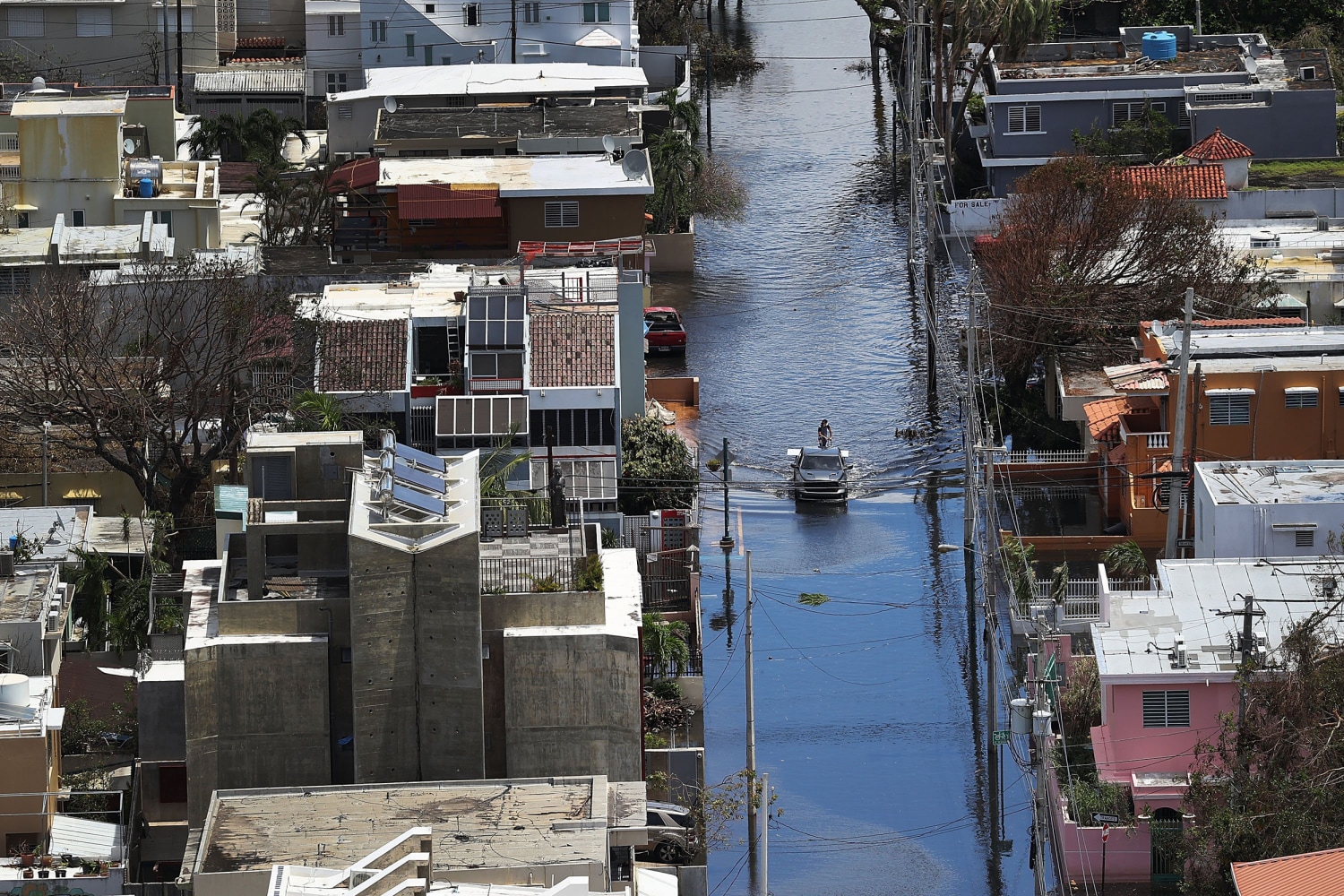
“You feel like you’re forgotten. I’m in an area that’s flooded and there’s basically dead animals — cats, dogs, rats just floating around — the smell is crazy and I don’t see anyone here anywhere as of today or yesterday,” she said.

“We need more of everything, we need help,” she said.

Federal agencies rescuing people and delivering humanitarian aid to Puerto Rico in the wake of Hurricane Maria faced an island that remains largely without power, running water, fuel and access to cell service on Monday, five days after the storm first made landfall.

FEMA Administrator Brock Long and Homeland Security Adviser Tom Bossert arrived on the island on Monday and met Gov. Ricardo Rossello in San Juan as relief crews continued to work to provide much needed supplies to the island.

More than 10,000 federal staff were on the ground in Puerto Rico and the U.S. Virgin Islands, assisting with rescue efforts, restoring power and getting badly needed supplies to parts of the islands, FEMA said on Twitter Monday.

Related: Here’s How to Help Victims of Hurricane Maria

Nine search and rescue were working “around the clock” in the region, FEMA said in another tweet.

The agency said Sunday that it had provided more than 1.5 million meals, 1.1 million liters of water and nearly 12,000 emergency roofing kits.

FEMA representatives didn’t immediately return requests Monday for comment on islanders’ complaints.


But White House Press Secretary Sarah Huckabee Sanders said Monday that Long and Bossert were sent to assess the damage from the ground.

“We’ve done unprecedented movement in terms of federal funding to provide for the people of PR and others that have been impacted by these storms,” she said during the White House press briefing. “We’ll continue to do so and continue to do everything that we can possibly under the federal government to provide assistance.”

Maria was the third major storm to hit U.S. shores in just a month, after Hurricanes Irma and Harvey wreaked havoc across the Caribbean and southeastern U.S.

Maria, which made landfall as a Category 4 hurricane, has been blamed for 16 deaths on Puerto Rico, officials said Monday.


William Booher, director of public affairs for FEMA, told the Associated Press on Saturday there was no difference in the agency’s response in Puerto Rico, compared with Texas, Louisiana or Florida after recent hurricanes. FEMA has had sufficient resources to deal with back-to-back-to-back hurricanes, he said, adding that “we’ve been able to address each one of them.”

Rossello also praised federal relief efforts on Monday and said FEMA was doing a “phenomenal job,” according to the Associated Press.

But earlier Monday, he also said the island was facing an “unprecedented disaster” and called for swift action from President Donald Trump’s administration.

“Given Puerto Rico’s fragile economic recovery prior to the storms, we ask the Trump Administration and U.S. Congress to take swift action to help Puerto Rico rebuild,” he said in a statement.

Meanwhile, advocates, residents and officials implored the federal government to send more help and take seriously the long-term impact Maria would have for Puerto Rico.

Image: A man stands on a car on a  flooded street in the aftermath of Hurricane Maria in San Juan


Image: A man stands on a car on a  flooded street in the aftermath of Hurricane Maria in San Juan

Frances Colón, founder of the Washington, D.C.-based non-profit Cenadores, said the “scale of the federal response right now is not on scale with the level of devastation.” Colón formed Cenadores to organize Puerto Ricans on the mainland to volunteer to help the island.

“We still have townships not reached. The government had a diesel ship parked in the bay and the government and National Guard is so maxed out they couldn’t ensure security so the fuel could reach its destination,” said Colón, who lives in Miami and worked 12 years for the State Department as a science and technology adviser. “We need boots on the ground from the federal government. We need FEMA, National Guard, a federal response at [Hurricane] Katrina scale.”

“Everyone is overwhelmed because the disaster is bigger than everyone,” she said.

Image: People sit in their apartment with the window blown out in San Juan


Image: People sit in their apartment with the window blown out in San Juan

“The response can’t be tepid. It’s been a week and still communication is down and there are towns that haven’t been reached.”

PHOTOS: Hurricane Maria Lashes Puerto Rico, Storm-Battered Caribbean

Armando Valdés Prieto, a lawyer who has been helping with volunteer operations in San Juan said he felt the sheer magnitude of the devastation on the island made distributing federal aid difficult.

“The scope and magnitude of what’s going on is so large that I’m not entirely sure that they really know where to start,” he said by phone Monday afternoon.

He said that while he felt a lot was being done, being unable to communicate with parts of the island compounded problems.

“We’re still kind of in an assessment phase where I guess it’s a little hard to gauge whether or not things are being done right,” he added.

Related: Puerto Rico Holds Its Breath Over Hurricane-Battered Dam

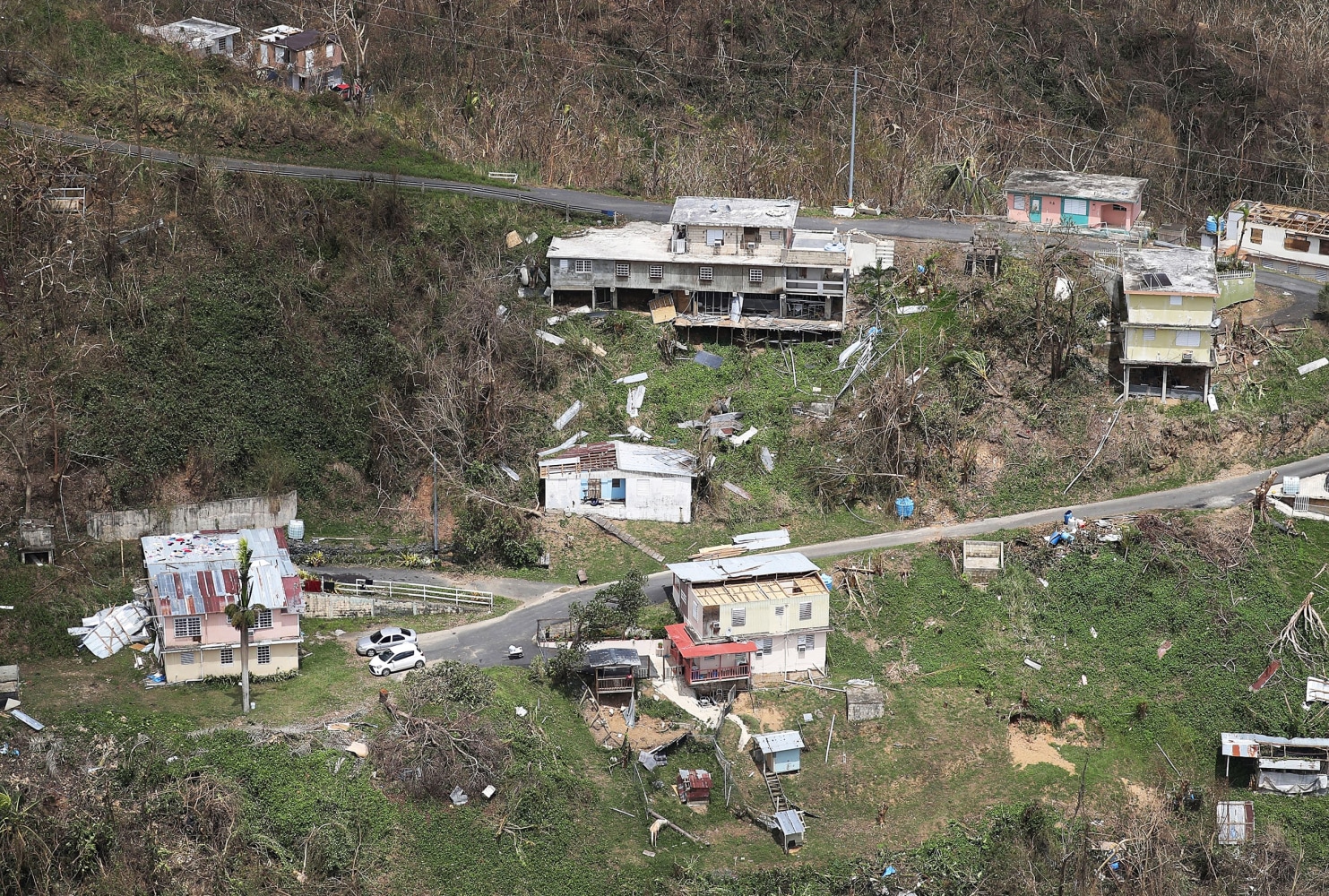
Image: Downed trees surround damaged homes in the aftermath of Hurricane Maria


Image: Downed trees surround damaged homes in the aftermath of Hurricane Maria

Adding to the island’s woes is stifling heat. San Juan tied for its maximum temperature at 94 degrees on Sunday, according to the NWS.

“It’s really, really hot and there’s not a lot of respite from the heat,” said Valdés Prieto, adding that many people did not have electrical power and could not use their air conditioners.

And the island’s Aqueduct and Sewer Authority said Monday that only about 40 percent of their customers, or 500,000 people, had water service.