Jeff Sessions Scolds California in Immigration Speech: ‘We Have a Problem’

Mr. Sessions described the state’s so-called sanctuary laws as a radical maneuver that would threaten public safety and throw open the nation’s borders to even more illegal immigration.

Immigration law “is in the books, and its purposes are clear and just. There is no nullification, there is no secession. Federal law is the supreme law of the land,” said Mr. Sessions, one of the administration’s most adamant immigration restrictionists. He accused the state of intentionally using “every power the legislature has to undermine the duly established immigration laws of America.”

The lawsuit, which the Justice Department disclosed on Tuesday in advance of Mr. Sessions’s speech, capped a clash between the Trump administration and California that has lasted more than a year, with each side reaping political profit from the battle. The administration has sought to demonstrate that it will not tolerate noncompliance with federal immigration enforcement; California’s top officials, professed leaders of the anti-Trump resistance, have pushed the state to cooperate with Immigration and Customs Enforcement as little as possible.

Even as Mr. Sessions spoke, that opposition was making itself heard. Outside the hotel where Mr. Sessions was speaking, several hundred protesters marched, holding signs saying “Go Home Jeff” and “Crush ICE” and chanting, “What do we want? Sessions out!”

Shortly after Mr. Sessions’s speech, Mr. Brown and the state’s attorney general, Xavier Becerra, both Democrats, appeared together in the Capitol to denounce the lawsuit.

“California is in the business of public safety,” Mr. Becerra said. “We are not in the business of deportation.”

The suit, filed on Tuesday evening in Federal District Court in Sacramento, is the first Mr. Sessions’s Justice Department has filed against a local or state government over its immigration policies.

Photo
Gov. Jerry Brown, left, and the California attorney general, Xavier Becerra, at a news conference after Mr. Sessions’s speech in Sacramento.

Credit
Jim Wilson/The New York Times

It targets three state laws passed in recent months: one that limits state and local agencies’ ability to share information about criminals or suspects with federal immigration officers, unless they have been convicted of serious crimes; a second that prohibits local businesses from allowing ICE to examine employee records without a court order or a subpoena; and a third that gave California officials more oversight over the state’s immigration detention centers.

Advertisement

Continue reading the main story

Mr. Brown and Mr. Becerra defended the legislation as constitutional on Wednesday, saying that the laws prevented neither ICE agents from working in local jails and prisons nor employers from cooperating with ICE. The employee records law, Mr. Becerra said, simply ensures that workers and employers are guaranteed “their rights and their privacy and that those are being respected.”

Asked whether the law would, in effect, require warning undocumented workers to flee ahead of an ICE visit, Mr. Brown compared the provision to the practice of notifying criminal suspects that they have a right to a lawyer. “We are just following the law, and the law allows people to be advised of their rights,” Mr. Brown said. “Anything else smacks of a more totalitarian approach to things.”

Newsletter Sign Up

Continue reading the main story

Mr. Sessions had another comparison in mind.

What if, he asked, a state enacted legislation hampering the work of employees from the Occupational Safety and Health Administration or the Environmental Protection Agency? “Would you pass a law to do that?” he said.

Beyond the specifics of the laws, Mr. Sessions railed about several instances in which he said state officials had frustrated the work of federal law enforcement. He heartily ripped into Libby Schaaf, the Democratic mayor of Oakland, for issuing a warning last week that ICE planned to arrest immigrants across Northern California, an alert that infuriated agency officials who said her tip-off had allowed hundreds of their targets to slip away.

Ms. Schaaf’s actions “support those who flout the law and boldly validates illegality,” Mr. Sessions said, calling her warning “an embarrassment to the proud state of California.”

“So here’s my message to Mayor Schaaf,” he said. “How dare you, how dare you needlessly endanger the lives of our law enforcement officers to promote a radical open borders agenda?”

Ms. Schaaf said last week that she had not publicized any information that endangered ICE officers. She said she issued the warning because “I know that Oakland is a city of law-abiding immigrants and families who deserve to live free from the constant threat of arrest and deportation.”

Inside the hotel ballroom on Wednesday, Mr. Sessions faced a polite, if somewhat divided, audience.

Some police chiefs and sheriffs in liberal-leaning areas have argued that their agencies must distance themselves from ICE to avoid scaring off immigrant residents who may be more reluctant to serve as witnesses or come forward to report crimes. But there are many other officials across the country who say they would prefer to work with ICE if the legal issues surrounding such cooperation are clarified, and some who are eager to help the federal government outright with immigration enforcement.

Advertisement

Continue reading the main story

Those tensions were palpable at Mr. Sessions’s speech, which was hosted by the California Peace Officers Association, a law enforcement advocacy group. The crowd responded to the speech with brief applause; about 10 of the more than 200 officers in the room stood to clap.

“I’m stuck in the middle,” said Deputy Chief Derek Williams of the police department in Ontario, a midsize city east of Los Angeles with a large Hispanic population. “It’s extremely bifurcated now.”

While the new state laws do not affect his work on a day-to-day basis, he said, the sharp increase in ICE activity has fostered “a lack of trust with law enforcement” among immigrant residents. “It’s a difficult time for us,” he said.

Among those who endorsed Mr. Sessions’s message was Paul R. Curry, a lobbyist for the California Correctional Supervisors Organization, which represents supervisors in the state prison system. He said California police chiefs were often caught between ICE’s requests and the orders of their mayors, who might embrace sanctuary policies.

“Every police officer is sworn to uphold the law not only of the state but the nation,” Mr. Curry said. “The progressive agenda is running afoul of the force of our laws in the country.”

Correction: March 7, 2018

An earlier version of this article misquoted Attorney General Jeff Sessions’s remarks about Mayor Libby Schaaf of Oakland. He said Ms. Schaaf’s actions to alert residents about a planned immigration raid “support those who flout the law and boldly validates” — not “invalidates” — “illegality.”


Continue reading the main story
Trump Lawyer Obtained Restraining Order to Silence Stormy Daniels

Ms. Clifford filed a lawsuit in Los Angeles Superior Court on Tuesday asserting that the nondisclosure agreement that accompanied the $130,000 payment was void because Mr. Trump never signed it.

Ms. Sanders said that the president had denied having an affair with Ms. Clifford or making the payment himself. She added that she was not aware of whether Mr. Trump knew about the payment to Ms. Clifford at the time.

“I’ve had conversations with the president about this,” Ms. Sanders said. “This case has already been won in arbitration, and there was no knowledge of any payments from the president, and he has denied all these allegations.”

Lawrence S. Rosen, a lawyer representing Mr. Cohen, said in a statement on Wednesday that an arbitrator, who “found that Ms. Clifford had violated the agreement,” barred her from filing her lawsuit and making other disclosures of confidential information.

Ms. Clifford’s lawyer, Michael Avenatti, said that he did not consider the restraining order, dated Feb. 27, valid, and that his client would proceed with her lawsuit in open court. “This should be decided publicly,” he said.

Photo
The White House’s spokeswoman, Sarah Huckabee Sanders, said on Wednesday that the president’s lawyer had won an arbitration proceeding against the actress.

Credit
Doug Mills/The New York Times

Ms. Clifford’s nondisclosure contract, made public through her lawsuit, calls for disagreements to be settled through confidential, binding arbitration. The lawsuit was filed a week after Mr. Cohen initiated arbitration proceedings, but the court papers did not say what was at issue or refer to the restraining order.

The contract gives Mr. Trump the right to seek financial penalties of more than $1 million in arbitration should Ms. Clifford break or threaten to break her agreement to stay silent. It also gives him the right to obtain an injunction barring her from speaking while disputes are considered in arbitration or open court. Those terms prompted Ms. Clifford to change her plans about going public, according to two people familiar with the situation who were not authorized to speak about it.

Advertisement

Continue reading the main story

Ms. Clifford had suggested she was free to speak out after Mr. Cohen disclosed last month that he had arranged the payment, prompting her to claim that the contract had been breached.

Newsletter Sign Up

Continue reading the main story

The restraining order took her by surprise. A close friend of Ms. Clifford’s, J. D. Barrale, said in an interview that she learned Mr. Cohen initiated arbitration proceedings when she landed on a flight from Los Angeles to Texas. “She was shocked,” Mr. Barrale said.

Mr. Avenatti said Ms. Clifford had “never even been provided an opportunity to respond” to Mr. Cohen’s action in arbitration.

A copy of the restraining order, obtained by The Times and first reported by NBC News, left open the possibility that it could be modified in the future. But Mr. Avenatti said he questioned its validity because it was brought on behalf of Mr. Cohen, not Mr. Trump.

Asked if Ms. Clifford would drop her court case if Mr. Cohen provided her with more money, he said she would not. “At this point, we are well beyond that — this is a search for the truth,” he said.

The lawsuit by Ms. Clifford adds weight to allegations in a separate legal complaint brought by Common Cause, a public interest group that has asked the Federal Election Commission and the Justice Department to investigate the $130,000 payment by Mr. Cohen. Common Cause argues that the payment amounted to an undeclared in-kind contribution to Mr. Trump’s presidential campaign.

Federal election law requires contributions and expenditures for a campaign to be promptly disclosed, and prohibits a candidate from dipping into campaign funds to cover personal expenses. There is no evidence that campaign money was used to make the payment.

Common Cause filed a similar complaint about a $150,000 payment made shortly before the election by American Media Inc., owner of The National Enquirer, to Karen McDougal, a former Playboy Playmate who has said she had an affair with a married Mr. Trump about a decade ago. The company dismissed the complaint as meritless.

The Enquirer never published a story about the alleged affair, and Common Cause asserts that if the payment was intended to keep Ms. McDougal quiet, it would be an illegal coordinated expenditure by a company on behalf of the Trump campaign.


Continue reading the main story

Trump’s Hard-Line Take on Trade Plays Into China’s Hands

Gary Cohn had one of the toughest jobs in Washington: restraining an impulsive president from waging a trade war he’s been itching to fight. Now that Cohn is leaving as director of Trump’s National Economic Council, the way is clear for the president to slap hefty tariffs on steel and aluminum imports from around the world. Trump also has a freer hand to punish China for its alleged theft of intellectual property. The U.S. is weighing restrictions on Chinese investments and tariffs on a broad range of Chinese imports, people familiar with the matter told Bloomberg News on March 6.

Trump and the nationalists who have his ear, such as Commerce Secretary Wilbur Ross and trade adviser Peter Navarro, have a point. The U.S. steel and aluminum industries really have been devastated by unfair Chinese competition. China has begun closing some of its steel mills under international pressure, but its production capacity remains twice as high as it was in 2006, the year the country issued the State Council Notice Promoting Structural Adjustment for Overcapacity. The pattern with aluminum is similar.

Trump and his advisers are also correct that economic strength is a matter of national security—and that right now China plays that game much more effectively than the U.S. does. China routinely forces foreign companies to turn over their intellectual property—the crown jewels of any corporation—as the price for doing business in the country. The Made in China 2025 project aims to develop domestic sources for a wide array of advanced technologies, something that would reduce its dependence on potential adversaries such as the U.S. and Japan. The 2018 National Defense Strategy document prepared by the Pentagon accuses China and Russia of “undermining the international order from within.”

It’s important to credit Trump on these points, because a lot of commentators have dismissed his promise of metals tariffs as nothing more than a play for votes or an eruption of machismo. They may be that, but they’re not only that. None other than Michael Froman, who was President Obama’s chief trade negotiator and is no friend of Trump’s, said on Feb. 5: “It is in our national interest to have a strong steel and aluminum industry domestically.”

The tragedy is that Trump has made the U.S., rather than China, the focus of the world’s opprobrium. Citing national security as a justification for the metals tariffs will give other countries the excuse to do the same, tearing a hole in the delicate web of trade agreements the U.S. spent decades spinning. And applying the tariffs to all countries, as he has threatened to do, weakens the united front of American trading partners that’s needed to confront China and get it to change its behavior. “This will be seen as the latest, and one of the more significant, signals that the U.S. under Trump is not a reliable economic partner,” says Roland Rajah at the Lowy Institute, a Sydney-based think tank.

As critics are fond of pointing out, China is the 11th-biggest seller of steel to the U.S. and comes in fourth in selling America aluminum. The Trump tariffs are a serious risk for about “zero percent” of the Chinese economy, Bloomberg Economics analyst Tom Orlik wrote on March 1. Far more affected will be Canada, the No. 1 exporter to the U.S. of both metals.

Suddenly we’re discussing possible trade wars between the U.S. and some of its most reliable allies. European Commission President Jean-Claude Juncker adopted some of Trump’s bravado in a talk in Germany on March 2. “We will now impose tariffs on motorcycles, Harley-Davidson, on blue jeans, Levi’s, on bourbon. We can also do stupid. We also have to be this stupid,” the European Union’s highest-ranking official said. The headline in London’s City A.M. riffed on the song American Pie: “Hit the Chevy with a Levy, Tax Your Whiskey Rye.”

Trump, of course, fired back on Twitter that if Europe retaliated, the U.S. would counterretaliate with tariffs on auto imports. On Feb. 5, Trump tweeted that he might exempt Canada and Mexico if they sign a “new fair” North American Free Trade Agreement. That, unfortunately, undercut his argument that the tariffs were necessary for national security.

The spectacle of Western leaders attempting to out-stupid each other plays into China’s hands and may explain why its officials have stayed relatively quiet. Liu He, a high-level emissary of President Xi Jinping, kept a low profile on a visit to Washington, calling for cooperation. As Napoleon is supposed to have said: Never interrupt an opponent who is making a wrong decision.

The reason Trump keeps attacking allies over trade is that despite the best efforts of globalist advisers such as Cohn, he continues to regard trade with a Game of Thrones mindset, as a war in which one side must lose. Exports are good and imports are bad in Trumponomics, and a trade deficit is prima facie evidence that the other side has acted in bad faith.

Whoever taught Trump undergraduate economics at Wharton must be aghast. In fact, both sides win in an international transaction, or they wouldn’t do the deal. What’s more, it’s routine for countries to have surpluses with some trading partners and deficits with others—just as a head of household has “trade deficits” with her supermarket, doctor, and dentist and a “trade surplus” with her employer.

To be sure, though a deficit with any particular country isn’t a sign of trouble, it isn’t healthy for the U.S. to have persistent deficits with the world as a whole. Better trade deals could narrow them by breaking down barriers to exports of world-leading U.S. goods and services. Trump is right about that.

But America’s trade deficits also reflect the country’s failure to save enough money to finance needed investments in factories, housing, roads, etc. The trade deficit is the statistical companion of the savings shortfall: The U.S. is borrowing to finance its consumption instead of paying for imports with exports. On that score, things are getting worse. The Tax Cuts and Jobs Act that Trump triumphantly signed at the end of 2017 will increase the federal budget deficit, which in turn will worsen the national savings shortfall and cause the trade deficit to get bigger, economists say. Like identical twins, the budget and trade deficits come from “the same zygote,” said the headline of a JPMorgan Chase Co. research note on March 2.

By invoking national security under the rarely used Section 232 of the Trade Expansion Act of 1962, the U.S. is setting a precedent for skirting the World Trade Organization’s procedures. The WTO is slow and not always effective, but if countries begin to ignore it and start using high tariffs and quotas against one another, global trade growth could shudder to a halt. That would harm everyone.

“National security has been kind of reserved, as it should be, for special circumstances,” says Nicole Lamb-Hale, who was assistant secretary of commerce for manufacturing and services in the Obama administration. “Other countries will say, ‘The United States did it, so we can do it, too,’ ” says Lamb-Hale, a managing director at Kroll Inc., an investigations and security company.

The idea that the U.S. would need to ramp up metal production to replace ships, tanks, and planes destroyed in battle is World War II-style thinking, says Jeff Bialos, a partner in the law firm Eversheds Sutherland in Washington, who was a deputy undersecretary of defense in the Clinton administration. “Now it’s qualitative superiority, not quantitative superiority,” he says. “We fight wars today with what we have” when the shooting starts.

Aixtron SE to Chinese-controlled Grand Chip Investment GmbH by blocking the acquisition of its U.S. branch. In September, EC President Juncker proposed an EU-wide system for screening incoming direct investment. Last year, Australia ordered the compilation of a registry of key assets to provide regulators with more information when deciding whether deals raise national security concerns. It was surprised when a Chinese investor negotiated directly with the government of the Northern Territory to capture a 99-year lease for the port of Darwin, which is next to a large contingent of U.S. Marines.

Now the U.S. is in danger of losing the moral high ground on trade and investment. Daniel Rosenthal, co-chairman of Kroll’s advisory practice on the Committee on Foreign Investment in the U.S. (CFIUS), says the U.S. has been hammering China for years for using national security as a pretext. Says Rosenthal: “We significantly degrade our argument, because now we’re doing what they’re doing.” —With Enda Curran, Andrew Mayeda, and Joe Deaux

Trump Expected To Formally Order Tariffs On Steel, Aluminum Imports

Trains with scrap metal stay in front of the Huettenwerk Krupp Mannesmann GmbH steel mill in Duisburg, Germany. President Trump is expected to order tariffs on aluminum and steel imports as early as Thursday.

Lukas Schulze/Getty Images


hide caption

toggle caption

Lukas Schulze/Getty Images

Trains with scrap metal stay in front of the Huettenwerk Krupp Mannesmann GmbH steel mill in Duisburg, Germany. President Trump is expected to order tariffs on aluminum and steel imports as early as Thursday.

Lukas Schulze/Getty Images

President Trump is expected to sign a formal order imposing steep tariffs on imported steel and aluminum as early as Thursday. It’s the boldest move to date for the president who campaigned on a protectionist platform sharply at odds with Republicans’ free-trade orthodoxy.

“We’re going to build our steel industry back, and we’re going to build our aluminum industry back,” Trump said when he first announced the proposed tariffs on March 1. He also said, “They’ve been horribly treated by other countries, and they have not been properly represented. More importantly, because of that, workers in our country have not been properly represented.”

Trump’s plan calls for a 25 percent tariff on imported steel and a 10 percent levy on imported aluminum. Although the president prefers to apply the tariffs on imports from any country, some exceptions could be made.

“There are potential carve-outs for Mexico and Canada, based on national security, and possibly for other countries as well,” White House press secretary Sarah Huckabee Sanders said Wednesday.

Canada is the leading supplier of imported steel and aluminum to the U.S., accounting for 16 percent of imported steel and 41 percent of imported aluminum, as CNBC has reported.

Domestic steelworkers applauded the president’s move.

“Everybody’s just happy,” said Mark Goodfellow, head of the Steelworkers Local 420A in Massena, N.Y., where Alcoa employs about 500 people. “It feels like the American worker is getting a break and finally getting a shot to compete on a level playing field.”

U.S. Steel announced plans to restart one of two idle blast furnaces in Granite City, Ill., and call back some 500 workers.

Both the steel and aluminum industries have been under heavy pressure from imports. In recommending tariffs or quotas, the Commerce Department noted that employment in the domestic steel industry has shrunk by 35 percent in the last two decades, while the aluminum industry shed nearly 60 percent of its jobs between 2013 and 2016.

“Those are bedrock, backbone industries of this country,” said White House trade adviser Peter Navarro. “And the president is going to defend them against what is basically a flood of imports that have pushed out American workers, aluminum smelters. And we can’t afford to lose them.”

Authority for the tariffs comes from a seldom-used law from the 1960s that’s designed to protect domestic industries deemed vital to national defense.

But Defense Secretary James Mattis questioned that premise, noting that military demand for steel and aluminum can be met with just 3 percent of domestic production. What’s more, unless the U.S. declares war on its neighbor to the north, metal supplies from Canada are not likely to be compromised.

Experts say the real challenge for industry is China, which produces almost as much steel in a month as the U.S. does all year. But the U.S. has already imposed anti-dumping measures against Chinese producers, and relatively little Chinese metal flows directly into the U.S. market.

“Even though China’s over-capacity is weighing down global prices, it’s not the direct cause of a loss of our aluminum and steel industries,” Navarro said. “The direct cause is simply the foreign steel that crosses our borders. And that is what we must stop.”

Critics worry that tariffs will increase costs for businesses and consumers and could spark retaliation from America’s trading partners. Republican lawmakers have been urging the White House to adopt a more surgical approach, including carve-outs for U.S. allies such as Canada.

“If these tariffs are implemented with a broad brush, it will have the potential to backfire, cost us jobs at home, force consumers to pay higher prices for goods, and ultimately hurt our economy,” warned Rep. Erik Paulsen, R-Minn., chairman of the Joint Economic Committee.

The tariffs have also caused friction within the administration. Trump’s top economic adviser and free-trade advocate Gary Cohn announced his resignation on Tuesday.

“President Trump is a unique negotiator,” Agriculture Secretary Sonny Perdue said this week, as Radio Iowa reported. “Sometimes he keeps people off balance, even his own staff.”

Many farmers are heavily dependent on export markets and could be hard-hit by a trade war. Asked for his advice, Perdue chuckled softly and said, “Pray.”

Teen who escaped California ‘house of horrors’ posted YouTube videos describing harsh home life: report


Video

‘House of horrors’ parents back in court amid new details

Prosecutors seek to block the Turpins from contacting the children before the trial.

The 17-year-old girl who escaped the California “house of horrors” and alerted authorities of the alleged abuse at the hands of her parents reportedly uploaded videos on YouTube under an alias describing her harsh home life.

The daughter of Louise Anna and David Allen Turpin detailed the harsh living conditions by singing what appeared to be her own written songs, ABC 7 reported.

“You blame me for everything, you blame me in every way, you blame me for what they say, what they say,” one of the songs went.

She also posted videos of her interacting with two Maltese-mix breeds. The dogs and the youngest of the Turpin children were the only ones who did not appear to suffer from malnutrition, police have said.

‘HOUSE OF HORRORS’ SIBLINGS ENJOYING LASAGNA, ‘STAR WARS’ AND MODERN TECHNOLOGY, ATTORNEY SAYS

The videos also captured dirt on the walls and clothes piled on the floor.

Good Morning America” reported the girl also appeared to have had an Instagram account. The accounts contains selfies of the teen and pictures of pop star Justin Bieber.

The 17-year-old girl escaped the California home and called police.

 (Reuters)

The teen’s most recent video was reportedly uploaded seven days before she escaped her home in Perris, California, in January — the location that held her and her 12 siblings. When authorities probed the residence, they reported the home smelled of human waste. The oldest sibling weighed only 82 pounds. The children range in age from 2 to 29.

Authorities said the abuse was so long-running that the children’s growth was stunted. They said the couple shackled the children to furniture as punishment and had them live a nocturnal lifestyle.

CALIFORNIA HOUSE OF HORRORS PARENTS FACE LIFE IN PRISON ON TORTURE, ABUSE CHARGES

David and Louise Turpin are being held in prison each on $12 million bail. They face up to life in prison after being charged with torture and child abuse.

The case sparked national attention as details of the abuse came to light.

David Allen and Louise Anna Turpin face life in prison after being charged with torture and animal abuse.

 (Reuters)

Prosecutors allege the children were subjected to “frequent beatings” and “even strangulation,” and weren’t allowed to be unshackled to go to the bathroom. They also allegedly were allowed to take only one shower a year.

The siblings also lacked common knowledge such as knowing what medication was or who a police officer is.

Last week, Jack Osborn, whose law firm is representing the seven adult Turpin children are enjoying popular movies, food and modern technology. On Friday, star cellist Yo-Yo Ma performed an exclusive concert for the siblings, People reported.

Fox News’ Greg Norman and the Associated Press contributed to this report.

Stormy Daniels sues Trump, says ‘hush agreement’ invalid because he never signed

Adult film star Stormy Daniels sued Donald Trump Tuesday, alleging that he never signed the nondisclosure agreement that his lawyer had arranged with her.

The civil suit, filed in Los Angeles Superior Court and obtained by NBC News, alleges that her agreement not to disclose her “intimate” relationship with Trump is not valid because while both Daniels and Trump’s attorney Michael Cohen signed it, Trump never did.


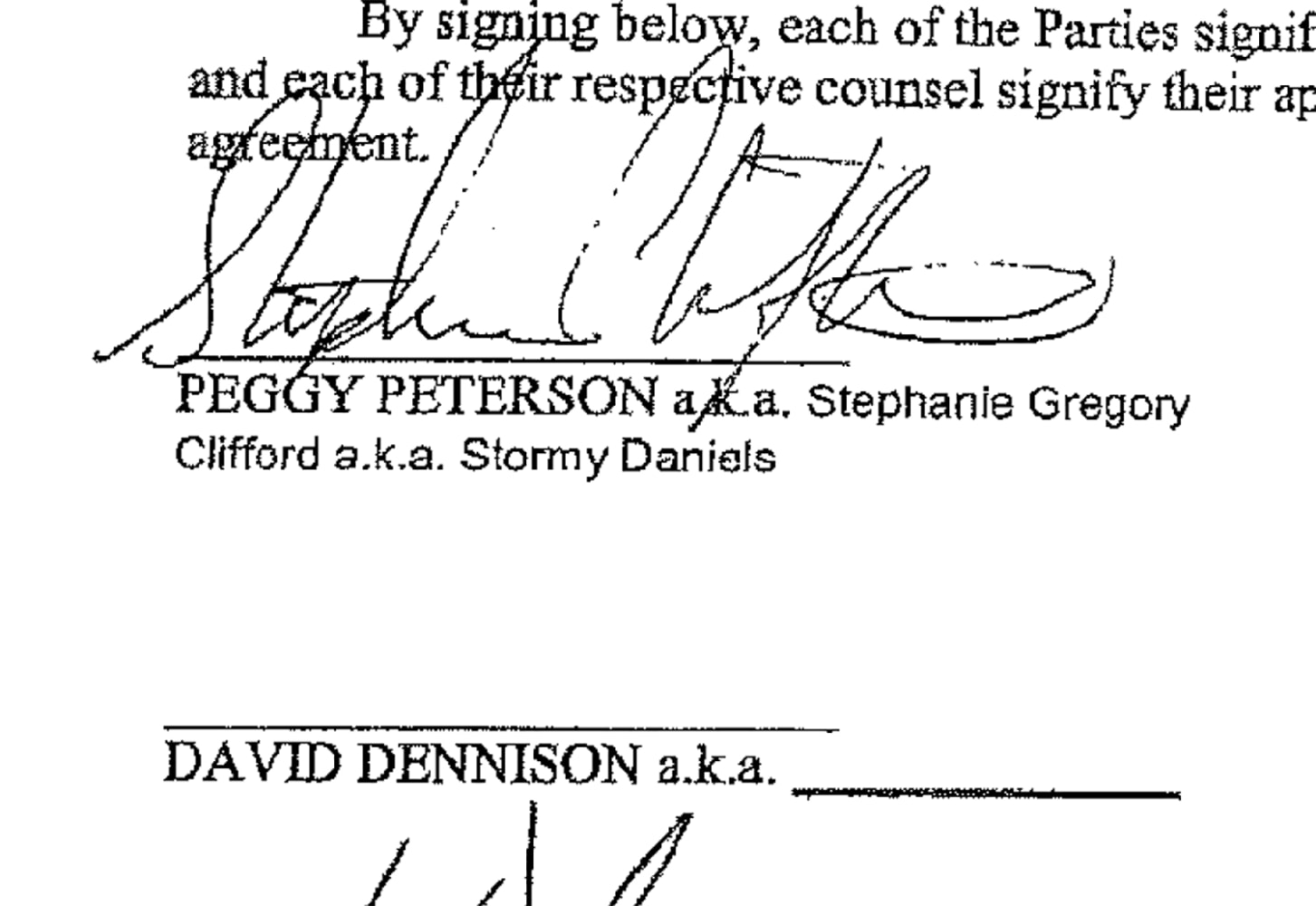
Stephanie Clifford, known professionally as Stormy Daniels, signed both the agreement and a side letter agreement using her professional name on October 28, 2016, just days before the 2016 presidential election. Cohen signed the document the same day. Both agreements are appended to the lawsuit as Exhibit 1 and Exhibit 2.

Click here to read the “Hush Agreement” and the side letter agreement

The “hush agreement,” as it’s called in the suit, refers to Trump throughout as David Dennison, and Clifford as Peggy Peterson. In the side letter agreement, the true identity of DD is blacked out, but Clifford’s attorney, Michael Avenatti, says the individual is Trump.


Each document includes a blank where “DD” is supposed to sign, but neither blank is signed.

According to the lawsuit, which Avenatti announced in a tweet, Clifford and Trump had an intimate relationship that lasted from summer 2006 “well into the year 2007.” The relationship allegedly included meetings in Lake Tahoe and at the Beverly Hills Hotel.

The 2016 hush agreement directed that $130,000 be paid into the trust account of Clifford’s then-attorney. In return, Clifford was not to disclose any confidential information about Trump or his sexual partners to anyone beyond a short list of individuals she’d already told about the relationship, or share any texts or photos from Trump.

The suit alleges that Cohen has tried to keep Clifford from talking about the relationship as recently as Feb. 27, 2018.

“To be clear, the attempts to intimidate Ms. Clifford into silence and ‘shut her up’ in order to ‘protect Mr. Trump’ continue unabated,” says the suit. “On or about February 27, 2018, Mr. Trump’s attorney Mr. Cohen surreptitiously initiated a bogus arbitration proceeding against Ms. Clifford in Los Angeles.” Binding arbitration is specified as a means of dispute resolution.


Clifford and her attorney, Michael Avenatti, are asking the Los Angeles County Superior Court to declare that both the hush agreement and the side agreement “were never formed, and therefore do not exist, because, among other things, Mr. Trump never signed the agreements.”

“In the alternative, Plaintiff seeks an order of this Court declaring that the agreements in the forms set out in Exhibits 1 and 2 are invalid, unenforceable, and/or void under the doctrine of unconscionability.”

The suit also says that Trump must know that Cohen is trying to silence Clifford, since rules for the New York bar, of which Cohen is a member, require him to keep his client informed at all times. “[I]t strains credulity to conclude that Mr. Cohen is acting on his own accord and without the express approval and knowledge of his client Mr. Trump.”


The White House did not immediately respond to a request for comment. President Trump’s outside attorney, John Dowd, declined to comment on the lawsuit.

Trump has never addressed the alleged relationship publicly, and White House spokesperson Raj Shah told members of the press he had never asked the president about the alleged relationship. Cohen has acknowledged the payment, but has repeatedly declined to tell NBC News what the payment was for.

Clifford had previously given conflicting accounts of her relationship with Trump. In the lawsuit, Clifford alleges that in January 2018, Cohen, “concerned the truth would be disclosed … through intimidation and coercive tactics, forced Ms. Clifford into signing a false statement wherein she stated that reports of her relationship with Mr. Trump were false.”

1 Missouri police officer killed, 2 others wounded in shooting; suspect dead

A Clinton, Mo. police officer was killed in a shooting Tuesday.

 (Facebook)

At least one Missouri police officer was killed and two other officers were wounded in a shooting Tuesday night at a home about 75 miles outside Kansas City, authorities said.

Missouri State Highway Patrol Sgt. Bill Lowe said at a news conference early Wednesday that the Clinton County 911 center received a call late Tuesday where two women could be heard screaming in the background. Clinton police officers responded to the home and were met with gunfire.

Lowe said the officers were shot at by an unidentified suspect from inside the home. Lowe said officers went inside to try and apprehend the suspect who then fatally shot one officers and wounded the other two.

Missouri State Highway Patrol said on Twitter the wounded officers were transported to a hospital. One suffered minor injuries and the other had moderate injuries, police said.

The officers were not immediately identified.

Lowe said a SWAT team entered the home but found the suspect dead.

It is the second Clinton police officer to die in the line of duty in the last seven months, according to Fox 4 KC.

“It’s a small department,” Lowe said. “It’s small enough that you know each individual officer and the community knows each individual officer, and it’s hard to put into words when you’re talking about an agency of this size, a community of this size where something tragic like this happened just seven months ago.”

The Associated Press contributed to this report.

Ryan Gaydos is an editor for Fox News. Follow him on Twitter @RyanGaydos.

Trump Administration Sues California Over Immigration Laws

The lawsuit claims that the statutes “reflect a deliberate effort by California to obstruct the United States’ enforcement of federal immigration law.” It also says the laws regulate private entities that want to cooperate with the federal authorities and “impede consultation and communication between federal and state law enforcement officials.”

Mr. Brown called the lawsuit a “political stunt.”

“At a time of unprecedented political turmoil, Jeff Sessions has come to California to further divide and polarize America,” Mr. Brown said in a statement. “Jeff, these political stunts may be the norm in Washington, but they don’t work here. SAD!!!”

California began battling the Trump administration even before Mr. Trump took office, standing in opposition on a number of issues, including marijuana, environmental regulations and taxes. But immigration has proved to be the most contentious fight, with local officials assuring undocumented immigrants that they would do all they could to protect them.

Document: Justice Dept.’s Suit Against California


Last year, California enacted the sanctuary laws, which restrict when and how local law enforcement can cooperate with federal immigration enforcement officers.

Both Mr. Sessions and Mr. Trump have threatened to pull federal grant money from cities and states that have sanctuary laws to protect undocumented immigrants. They argue that the policies flout federal laws and help criminals evade deportation.

And the Justice Department asked 23 jurisdictions across the country this year to provide documentation that they had not kept information from federal immigration authorities, or receive a subpoena for the information. It is also exploring possible criminal charges for local politicians who enact sanctuary policies.

The lawsuit filed on Tuesday evening in Federal District Court in Sacramento is the first against a local or state government over its immigration policies filed by the Justice Department under Mr. Sessions. Department officials said that they would not rule out the possibility of other lawsuits against local governments whose policies interfere with the federal government’s authority on immigration. Colorado, Illinois, New Mexico, Oregon and Vermont have state sanctuary laws, as do cities and counties in more than a dozen states, according to the Center for Immigration Studies.

Advertisement

Continue reading the main story

One, the California Values Act, strictly limits state and local agencies from sharing information with federal officers about criminals or suspects unless they have been convicted of serious crimes. The law, which took effect Jan. 1, was the centerpiece of the State Legislature’s effort to thwart the Trump administration’s immigration policies.

Soon after the law was enacted, Thomas D. Homan, the acting director of United States Immigration and Customs Enforcement, said that the state should expect to see “a lot more deportation officers” and that elected officials who support the policy should be arrested.

“We’ve got to start charging some of these politicians with crimes,” he said. “These politicians can’t make these decisions and be held unaccountable for people dying. I mean, we need to hold these politicians accountable for their actions.”

Mr. Homan and three other immigration and border protection officials filed declarations with the suit claiming that California’s laws had already negatively affected their work.

“The administration is just angry that a state has stood up to them — one that embraces diversity and inclusivity and is the sixth-largest economy in the world thanks to the hard-working immigrants who want to become American citizens,” said Kevin de León, the leader of the California State Senate who wrote one of the sanctuary city laws named in the suit.

State lawmakers also passed the Immigrant Worker Protection Act, which prohibits local business from allowing immigration to gain access to employee records without a court order or subpoena. Mr. Becerra warned that anyone who violated the new law would face a fine of up to $10,000.

In the state budget bill, California lawmakers prohibited new contracts for immigration detention in the state and gave the state attorney general the power to monitor all state immigration detention centers.

The state and several local governments including the cities of San Francisco and Sacramento have also set up legal defense funds to help defend immigrants during deportation proceedings.

Advertisement

Continue reading the main story

“I’m worried about the ‘Dreamers,’ hard-working immigrant families and law-abiding people who are just trying to make their way like the rest of us,” Mayor Darrell Steinberg of Sacramento said this year when asked about the state’s sanctuary legislation. “Civil disobedience is a respectful way to show your love for country.”

Tensions between local and federal officials reached yet another height last week, when Mayor Libby Schaaf of Oakland publicly warned of coming large-scale immigration arrest operations. Mr. Homan compared the mayor to a “gang lookout yelling, “Police!” and said she gave people living in the United States illegally a chance to flee. He said her warning meant that the federal immigration authorities arrested about 200 people rather than the 1,000 they had anticipated rounding up.

Although Mr. Homan and other federal officials have warned about targeting California as it steps up immigration enforcement efforts, the number of people arrested has not drastically increased so far. In December, the most recent month for which data is available, 1,715 unauthorized immigrants in California were arrested by ICE, compared with 1,379 in December 2016.

This is not the first time that the Justice Department has sued a state. During the Obama administration, the department filed a civil rights lawsuit against Georgia for segregating students with disabilities from classrooms and sued North Carolina over a bill to restrict bathroom use for transgender citizens. Mr. Sessions withdrew that lawsuit.

In a call with reporters on Tuesday night, Mr. Becerra said that he was confident California would prevail in court and that state and federal laws were not in conflict.

“In California, our state laws work in concert with federal law,” he said. “Our teams work together to go after drug dealers and go after gang violence. What we won’t do is change from being focused on public safety. We’re in the business of public safety, not deportation.”

Mr. Becerra said that he was not surprised by the news of the lawsuit and that the state had already won legal battles against the Trump administration. “We’ve seen this B-rated movie before,” he said. “We’re not doing their bidding on immigration enforcement and deportation.”


Continue reading the main story

Trump’s North Korea Bluster Scores a Win, But at High Risk

North Korea’s offer to suspend nuclear and missile tests in exchange for talks with the U.S. reflects an emerging truth about President Donald Trump’s unconventional foreign policy style: It may heighten the risk of conflict, but also the potential for breakthroughs.

As Trump said in a tweet on Tuesday: “the U.S. is ready to go hard in either direction.”

Few diplomats or analysts believe that Kim Jong Un’s offer, relayed by South Korea, will in fact deliver a denuclearized Korean peninsula in exchange for the U.S. security guarantees suggested as a basis for talks.

The Kim dynasty has a history of dangling the prospect of a negotiated settlement on its nuclear arsenal, and then walking away after getting concessions. It has also made enormous human and financial sacrifices to build its arsenal and accused the U.S. of failing to uphold prior agreements.

The U.S., in turn, has run hot and cold from one administration to the next on the value of pursuing diplomacy with Pyongyang. Neither side has budged from long-stated preconditions for talks to happen.

Read a QuickTake on how North Korea defies the world

“Caution, we’ve been here so many times before,” said James Hoare, a British diplomat and historian who opened the U.K.’s first embassy in Pyongyang in 2001.

Still, without Trump’s threats to unleash nuclear “fire and fury,” North Korea’s supreme leader might not have moved even this far.

“It may be we have to give Trump credit,” said Hoare, now an associate fellow at Chatham House, a U.K. think tank. “But if he really has been playing ‘crazy’ in some clever game, it’s an extremely dangerous one with horrific possible consequences for people on the Korean peninsula, Japan and elsewhere in the region.”

North Korea isn’t the only area where Trump’s willingness to risk all could potentially produce benefits.

NATO Secretary General Jens Stoltenberg last year lauded an accelerated increase in defense spending among non-U.S. members as a message of solidarity to Washington. Trump had previously shocked the alliance by suggesting commitment to NATO’s collective defense clause might be conditional on whether a member state had spent enough.

Whether there has in fact been a “Trump effect” on NATO spending is debated. Rising security threats that set budgets before his election were mainly responsible, according to John Chipman, director general of the International Institute for Strategic Studies in London. Still, he said, “uncertainty about the U.S. may continue to drive increases.”

Answering NATO’s Call

Change in annual defense spending by European NATO members and Canada

Source: NATO

Note: 2017 figure is an estimate

Fear of U.S. disengagement under Trump does appear to have helped revive some long-stalled initiatives to consolidate European military capabilities and procurement. At the December launch of a new EU agreement on Permanent Structured Cooperation in defense, known as PESCO, German Defense Minister Ursula von der Leyen said Europe needed to be able to act alone, “especially after the election of the U.S. president.”

U.S. officials see the development as a two-edged sword, warning last month that PESCO must not be allowed to duplicate or undermine NATO. European leaders say there is no conflict.

In other areas such as trade and relations with Iran, it isn’t clear whether Trump’s brinkmanship and unpredictability can produce results to offset the risks that critics believe he is taking.

Trump’s recently announced import tariffs on steel and aluminum could give the U.S. leverage to hurry renegotiation of the North American Free Trade Agreement on better terms. “We’re not looking to get into trade wars,” Treasury Secretary Steven Mnuchin said Tuesday, as he confirmed a proposal to waive the tariffs for NAFTA members Mexico and Canada.

Harley Davidson

Yet if the tariffs remain, trade wars could start looking for the U.S. The European Union has already outlined duties on 2.8 billion euros ($3.5 billion) of U.S. imports — including Harley Davidson motorcycles — that the bloc plans to introduce should Trump’s taxes on steel and aluminum made outside the U.S. take effect.

The president’s threat to withdraw certification of the 2015 nuclear deal with Iran unless it gets strengthened by May is another high stakes play, according to Ian Bremmer, president of Eurasia Group, a New York-based risk consultancy.