Chat with us in Facebook Messenger. Find out what’s happening in the world as it unfolds.
Trump lawyers set for key meeting with special counsel next week
Leave a reply

Chat with us in Facebook Messenger. Find out what’s happening in the world as it unfolds.
Advertisement
Supported by
What’s open — and what’s not — in San Diego, Ventura and Santa Barbara Counties.

By and
Dec. 15, 2017
The tourism industry in Southern California is starting to bounce back, albeit slowly, following the wildfires that materialized seemingly out of nowhere over the last two weeks and affected areas throughout the region.
Although the fires are still burning in less inhabited areas, they’re burning out elsewhere. While some attractions and hotels have reopened, many are still closed.
But where the fire has been extinguished, the gradual reopening of businesses indicates a returning sense of normalcy — or perhaps a desire to move on as the holiday season enters full swing.
San Diego County, where the now-contained Lilac fire burned 4,100 acres, appears to have completely recovered: as of Thursday morning, only the Rancho Monserate Country Club had not reopened. According to Branden Halle, a public information officer for the Thomas fire who lives in San Diego County, people driving across the border to Mexico at Chula Vista will see normal traffic.
Candice Eley, the director of communications for the San Diego Tourism Authority, said that all of the country’s visitor attractions, such as the San Diego Zoo and Legoland, are open for business.
Other areas, too, have returned to their routines. Farther north, at Nobu Malibu, the destination beachfront sushi bar, a host who answered the phone did not know that a fire had affected the city at all. (A minor brush fire was quickly doused by firefighters on Dec. 7, with the help of some quick-thinking residents.) The restaurant is open for business as usual.
But the situation isn’t as positive in Ventura and Santa Barbara Counties, where the Thomas fire has burned more than 283,000 acres. Although the Red Flag Warning, which indicated Ventura’s peak vulnerability to wildfire, ended Friday morning, the state of emergency declared by California Governor Jerry Brown is still in effect.
Many vacationers who had planned trips to these destinations in the coming week have already canceled their reservations, according to front desk employees at a number of hotels in the region. They may have good reason to: as of Thursday afternoon, many attractions were still closed, the air was toxic, and hotel rooms were being used to house firefighters and residents who have had to evacuate their homes because of the fires.
In Santa Barbara, for example, several outdoor attractions are still closed because of dismal air conditions, including the Santa Barbara Harbor. (The Santa Barbara Zoo reopened today, after a three-day closure, offering free admission.) The Montecito Inn, a beachside hotel, is advising residents and visitors to stay indoors because of the poor air quality.
On the water, though, the smoke doesn’t seem to be as bad, said Glen Fritzler, the owner of Sea Landing, a company that offers fishing trips and whale watching tours out of Santa Barbara. Business was slower than usual and future reservations are down, but Sea Landing stayed open to honor existing reservations.
“Some people do love fishing and whale watching and will do anything to do it, and we’re trying to accommodate them,” Mr. Fritzler said. “To them, it’s a reprieve to get away from it.”
Also, more than three dozen businesses are open in downtown Santa Barbara, according to Visit Santa Barbara’s site, including the Santa Barbara Museum of Art and Sama Sama Kitchen, a popular Southeast Asian restaurant.
Traveling around the area isn’t problematic: flights in and out of Santa Barbara Municipal Airport, which never closed, are running smoothly, and nearly all of the highways are operating at full capacity.
But Joe Rosa, a public information office for Cal Fire, said that the Thomas fire was only 30 percent contained as of Thursday morning and emphasized that drivers on the 101 Freeway, which straddles the Santa Barbara coastline, should make way for fire trucks and other emergency vehicles using the road.
Furthermore, Mr. Rosa said, a wind shift or spot fires across the highway could force firefighters to shut down sections of the 101 and the 126, a small highway that runs east-west through Ventura County, at any time. (State Route 154, an inland scenic route through Santa Barbara, will be closed daily from 5 a.m. to 9 a.m. until further notice). “We just want folks to keep their heads up, and their eyes open,” Mr. Rosa said.
South of Santa Barbara, Ventura County is still seeing a significant impact on its tourism industry because of the fires.
In the resort town of Ojai, for example, ashes continue to powder the scorched landscape. Last week, the Thomas fire scalded the town and threatened to close in on its center, forcing evacuations. A few days later, the wind swept the fire back.
Highway 150, which connects Ojai to the coastal city of Carpenteria, is still largely closed; drivers leaving Ojai can travel on Route 33 instead. And the air is still considered to be highly toxic: currently, Ojai’s particulate matter levels place it in the “Very Unhealthy” category on www.AirNow.gov, a national air-quality tracker.
This unhealthy air is part of the reason the Ojai Valley Inn, a 220-acre resort, closed on Dec. 9 and won’t reopen until Jan. 11, said Chris Kandziora, the property’s vice president of sales and marketing. “The fires didn’t touch our grounds at all, but we made the decision to close because they’re still encroaching on our area, and we want the entire town to be ready to welcome visitors,” he said. (The resort will undergo a cleaning and renovation while it is closed, he said).
Ojai Rancho Inn, on the other hand, reopened on Dec. 7 after being closed for three days, but Sheila Piala, the hotel’s manager, said that most of the guests are evacuees.
“I don’t know how much of a tourist attraction we are at the moment, but businesses are open, and they’re feeding people,” Ms. Piala said. “We opened up because so many people needed a place to go, and we’ve been safe, knock on wood.”
The fire isn’t stopping the inn from hosting its annual holiday crafts fair this weekend, although the event certainly will be held indoors.
One rung below Ojai at the “Unhealthy” level on AirNow is Camarillo, a city in Ventura County that is the home of Camarillo Premium Outlets, one of the largest outlet malls in the state.
But the particulate matter didn’t seem to deter Camarillo shoppers on Thursday. “It’s a little bit hazy,” said Jazmine Lucente, who works at an Adidas outlet store. “But no one’s really in danger. People are still shopping.” She added that some shoppers were wearing respirator masks outside.
Please verify you’re not a robot by clicking the box.
Invalid email address. Please re-enter.
You must select a newsletter to subscribe to.
* Required field
View all New York Times newsletters.
View all New York Times newsletters.
Advertisement
UNITED NATIONS (Reuters) – U.S. Secretary of State Rex Tillerson on Friday urged North Korea to carry out a “sustained cessation” of weapons testing to allow the two countries to hold talks about Pyongyang’s nuclear and missile programs.
“North Korea must earn its way back to the table. The pressure campaign must and will continue until denuclearization is achieved,” Tillerson told a meeting of the United Nations Security Council on North Korea’s weapons programs. He did not specify how long the lull should last.
He told reporters after the meeting that the United States would not accept any preconditions for talks with North Korea.
Tillerson had raised hopes this week that the United States and North Korea could negotiate to resolve their standoff when he said that the United States was “ready to talk any time North Korea would like to talk.”
But the White House distanced itself from those remarks by Tillerson and said that now is not the time for negotiations.
North Korea’s ambassador to the United Nations on Friday made no mention of Tillerson’s call for a halt to testing when he addressed the same U.N. meeting.
Ambassador Ja Song Nam said his country would not pose a threat to any state, as long as its interests were not infringed upon.
He described the Security Council session as “a desperate measure plotted by the U.S. being terrified by the incredible might of our Republic that has successfully achieved the great historic cause of completing the state nuclear force.”
North Korea has made clear it has little interest in negotiations with the United States until it has developed the ability to hit the U.S. mainland with a nuclear-tipped missile, something most experts say it has yet to prove.
North Korea conducted missile tests at a steady pace since April, then paused in September after firing a rocket that passed over Japan’s Hokkaido island.
But it renewed tests in November when it fired a new type of intercontinental ballistic missiles (ICBM), the Hwasong-15, which flew higher and further than previous tests.
Japanese Foreign Minister Taro Kono told the Security Council that North Korea was “nowhere near ready” to abandon its nuclear and missile programs and was not interested in a meaningful dialogue. He said any lull in missile tests did not mean that North Korea was sitting idly.
“The latest launch was conducted 75 days after North Korea’s provocations in September. Some optimistic views labeled 75 days of silence as a positive signal. However, the missile launch in November made it clear that North Korea was continuing to relentlessly develop its nuclear and missile programs even while they were seemingly silent,” Kono said.
Tillerson also urged China and Russia on Friday to increase pressure on North Korea by going beyond the implementation of U.N. sanctions but the two countries were wary of the idea.
China’s Deputy U.N. Ambassador Wu Haitao said all parties must implement U.N. sanctions, but added that unilateral sanctions undermine the unity of the Security Council and “hurt the legitimate right and interests of other countries and should therefore be abandoned.”
Russian U.N. Ambassador Vassily Nebenzia said Moscow was committed to implementing U.N. sanctions on North Korea and echoed China’s concerns about unilateral sanctions.
U.S. President Donald Trump wants China, North Korea’s main ally and trading partner, to impose an oil embargo on Pyongyang, over and above Beijing’s adherence to U.N. sanctions.
The Security Council has ratcheted up sanctions on North Korea over its weapons programs since 2006.
U.N. Secretary-General Antonio Guterres told the Security Council on Friday it was time to immediately re-establish and strengthen communication channels with North Korea, including inter-Korean and military-to-military channels, to reduce the risk of a misunderstanding escalating into conflict.
Writing by Alistair Bell; Editing by Bernadette Baum and James Dalgleish
Republicans were joyful Friday as they finalized their tax plan, bridging differences between the House and Senate bills and moving another step closer to getting legislation to President Trump by Christmas.
They also appear to have locked down the votes they need to pass the measure through the House and Senate after Sens. Marco Rubio (R-Fla.) and Bob Corker (R-Tenn.) pledged their support.
Overall, the Tax Cuts and Jobs Act represents the largest one-time reduction in the corporate tax rate in U.S. history, from 35 percent down to 21 percent. The bill also lowers taxes for the vast majority of Americans, as well as small-business owners — at least until the cuts expire after eight years.
Last-minute changes to the GOP’s big plan give a larger tax break to the wealthy and preserves certain tax savings for the middle class, including the student-loan interest deduction, the deduction for excessive medical expenses and the tax break for graduate students. A change made Friday morning to win over Rubio would expand the benefits of a child tax credit to give more money to working-class families.
Here’s a rundown of what’s in the final bill. (If you want to read all 505 pages, click here.)
What is changing
A new tax cut for the rich: The final plan lowers the top tax rate for top earners. Under current law, the highest rate is 39.6 percent for married couples earning over $470,700. The GOP bill would drop that to 37 percent and raise the threshold at which that top rate kicks in, to $500,000 for individuals and $600,000 for married couples. This amounts to a significant tax break for the very wealthy, a departure from repeated claims by Trump and his top officials that the bill would not cut taxes on the rich. The new tax break for millionaires goes beyond what was in the original House and Senate bills, with Republicans seeking to ensure wealthy earners in states such as New York, Connecticut and California don’t end up paying substantially higher taxes as a result of the bill.
A massive tax cut for corporations: Starting on Jan. 1, 2018, big businesses’ tax rate would fall from 35 percent to just 21 percent, the largest one-time rate cut in U.S. history for the nation’s largest companies. The House and Senate bills originally had the big-business tax rate falling to 20 percent, but Republicans were not able to make the math work to keep the rate that low and start it right away in the new year, so they compromised by moving the rate to 21 percent. It still amounts to roughly a $1 trillion tax cut for businesses over the next decade. Republicans argue this will make the economy surge in the coming years, but most independent economists and Wall Street banks predict only a modest and short-lived boost to growth.
You can deduct just $10,000 in state, local and property taxes: One of the most controversial parts of the GOP tax plan is the push to greatly scale back how much state and local taxes Americans can deduct on their federal income taxes. Under current law, the state and local deduction (SALT) is unlimited. In the final GOP plan, people can deduct up to $10,000. The House initially restricted the $10,000 deduction to just property taxes, but the final bill allows any state and local taxes to be deducted, whether for property, income or sales taxes. The move is widely viewed as a hit to blue states such as New York, Connecticut and California, and there are concerns it could cause property values to fall in high-tax cities and leave less money for public schools and road repairs.
Working-class families get a bigger child tax credit: Thanks to a late push by Rubio and Sen. Mike Lee (R-Utah), the child tax credit would be more generous for low-income families and the working class. The current child tax credit is $1,000 per child. The House and Senate bills expanded the child tax credit, with the Senate going up to a maximum of $2,000 per child. The final bill keeps the $2,000-per-child credit (families making up to about $400,000 get to take the credit), but it also makes more of the tax credit refundable, meaning families that work but don’t earn enough to actually owe any federal income taxes will get a large check back from the government. Benefits for those families were initially limited to about $1,100, but through changes Rubio and Lee pushed for, it’s now up to $1,400.
The individual health insurance mandate goes away in 2019: Beginning in 2019, Americans would no longer be required by law to buy health insurance (or pay a penalty if they refuse to do so). The individual mandate is part of the Affordable Care Act. The provision is unpopular, but it’s what keeps insurance markets stable while making other, more popular parts of the law work, such as the requirement that insurance companies cover people with preexisting conditions. Removing it was a top priority for Trump and congressional Republicans. The final bill does not start the repeal until 2019, though. The Congressional Budget Office projects the change will increase insurance premiums and lead to 13 million fewer Americans with insurance in a decade, while also cutting government spending by more than $300 billion over that period. Some Republicans hope to make other changes to health care to prevent insurance costs from rising dramatically by the time the repeal kicks in.
You can inherit up to $22 million tax-free: In the end, the estate tax (often called the “death tax” by opponents) would remain part of the U.S. tax code, but far fewer families will pay it. Under current law, Americans can inherit up to $5.5 million tax-free (that threshold is $11 million for married couples). The House wanted to do away with the estate tax entirely, but some senators felt that was too much of a giveaway to the mega-rich. The final compromise was to double the threshold, so now the first $11 million that people inherit in property, stocks and other assets won’t be taxed (and yes, that means $22 million for married couples).
“Pass through” companies get a 20 percent reduction: Most American businesses are organized as “pass through” companies in which the income from the business is “passed through” to the business owner’s individual tax return. S corporations, LLCs, partnerships and sole proprietorships are all examples of pass-through businesses. In the final GOP bill, the majority of these companies get to deduct 20 percent of their income tax-free, a large reduction that mirrors what was in the Senate bill. The National Federation of Independent Business initially opposed the House version, arguing that it didn’t do enough for small businesses. But the NFIB later endorsed the House and Senate plans. Service businesses such as law firms, doctor’s offices and investment offices can take only the 20 percent deduction if they make up to $315,000 (for married couples).
No corporate “AMT” tax: The final GOP bill gets rid of the corporate alternative minimum tax, a big relief to the business community. The Senate included the corporate AMT in its version of the bill, but the House did not. The corporate AMT makes it difficult for businesses to reduce their tax bill much lower than 21 percent. CEOs complained that this was a backdoor tax that would make them less likely to build new plants, buy more equipment and invest in more research, since the corporate AMT made the tax credits for those investments essentially null and void.
Fewer families will have to pay the individual AMT: The AMT for individuals started in 1969 as a way to prevent rich families from using so many credits and loopholes to lower their tax bill to almost nothing. But what started out as a way to prevent the wealthiest Americans from tax dodging started to hit more and more families over time. The AMT begins to apply to singles earning over $54,300 and couples earning over $84,500, although nearly everyone who ends up paying the AMT earns six figures. The House wanted to scrap the AMT entirely, but in the end, the final GOP tax plan lifts the threshold.
What is NOT changing:
The bill keeps in place the student loan deduction, the medical expense deduction and the graduate student tuition waivers. The House bill got rid of these popular deductions, but the Senate bill kept them. In the end, Republicans decided it was better to allows millions of middle-class families to continue using these breaks if they qualify for them.
Retirement accounts such as 401(k) plans stay the same. No changes to the tax-free amounts people are allowed to put into 401(k)s, IRAs and Roth IRAs.
Churches, synagogues, mosques and other nonprofits (the Johnson Amendment stays in place) can’t get political and endorse candidates in elections. Trump and conservative Republicans wanted to “totally destroy” (Trump’s words) the Johnson Amendment, which has been in place since 1954 and prevents religious institutions and nonprofits from getting involved in elections via fundraising or endorsements. The House bill included a repeal of the Johnson Amendment, but Democrats were able to get the Senate parliamentarian to determine that including the repeal in the bill didn’t comply with the rules of the Senate.

LOUISVILLE — Kentucky lawmaker Dan Johnson fatally shot himself Wednesday, two days after allegations surfaced that he had molested a member of his church when she was 17 years old, officials said.
Bullitt County Coroner Dave Billings said Johnson — a Republican state representative and self-proclaimed “Pope” of his Louisville church — died of “a penetrating gunshot wound to the head.”
The authorities found Johnson’s body Wednesday night after responding to a report about a concerning statement on his Facebook page. Officials had tracked the lawmaker’s phone to his location, near a bridge in Mount Washington, Ky., in a spot called the River Bottoms.
Johnson had suffered a single gunshot wound to his head, said Billings, the coroner. The Bullitt County Sheriff’s Office said a gun was recovered at the scene.
Billings officially ruled the 57-year-old’s death a suicide. Johnson’s body will now be released to his family for a funeral, the coroner told The Washington Post on Thursday morning. “I’m going to talk to his wife right now,” Billings said.
At his church Tuesday, Johnson had denied the molestation allegations and rejected calls to resign from Kentucky’s House of Representatives.
The following afternoon, he posted a message on Facebook again denying the accusations, saying they were “false . . . and only GOD knows the truth, nothing is the way they make it out to be.”
In the chilling, since-deleted post, Johnson added: “I cannot handle it any longer . . . BUT HEAVEN IS MY HOME.”
Hours later, he was found dead.
On Thursday, a sign outside Johnson’s Heart of Fire Church in Louisville read: “Satan accuses. God says youre not guilty.” It’s unclear how long the message has been on the sign.
A sign outside the Heart of Fire Church in Louisville. (James Higdon/The Washington Post)
State leaders from both parties had called for Johnson’s immediate resignation after the Kentucky Center for Investigative Reporting published a report Monday detailing allegations that Johnson woke his daughter’s friend during a sleepover in 2013 and forced himself on her, slipping his hands up her shirt and bra and putting his fingers in her vagina.
“What you did was beyond mean; it was evil,” the victim said she wrote in a Facebook message to Johnson shortly after the alleged assault, according to KyCIR.
Johnson said that the incident never happened. “This allegation concerning this lady, this young girl, absolutely has no merit, these are unfounded accusations, totally,” he said on Tuesday, according to the Courier-Journal.
[‘I would have won Alabama’: Trump spreads blame for Moore’s loss]
The young woman, now 21, told KyCIR that for years she had considered Johnson to be a “second dad.” She became close with his daughter, Sarah, and familiar with the boozy weekend parties Johnson would throw at the “Pope’s House” — the fellowship hall next to the Heart of Fire Church. Those parties, KyCIR reported, featured scantily clad women, body shots and costumes.
In the first hours of 2013, as a New Year’s Eve party came to an end, the woman said, she was spending the night with Johnson’s daughter in the apartment under the fellowship hall, according to the report. The Washington Post does not identify victims of sexual assault without their consent.
Johnson entered the apartment, drunk and stumbling, so the then-teenager helped him navigate the stairs, she said. She thought he was putting his arm around her for balance, until his hand allegedly slipped up the girl’s shirt, KyCIR reported.
The victim then woke up later that night on the sofa, she told KyCIR, and found Johnson kneeling above her. She told KyCIR that Johnson kissed her forehead and then slipped his hands up her shirt and bra. The report said he groped her, stuck his tongue in her mouth and put his fingers in her vagina. She begged him to stop and tried to force the man, who weighed twice as much as she did, off her without waking Johnson’s daughter, KyCIR reported.
“He told her she’d like it. She said no, she didn’t. She pleaded with him: go away, go away,” KyCIR reported. He eventually did.
The KyCIR report highlights how Johnson — known in his church community as “Danny Ray Johnson” — painted a picture of himself over the years as a pro-gun, antiabortion “patriot,” which helped propel him into the Kentucky legislature in 2016, when he won the House’s 49th District seat. But the seven-month investigation, comprised of more than 100 interviews and thousands of pages of public records, alleges the Republican’s persona is orchestrated to mask troubling incidents — including sexual abuse, arson and false testimony.
Michael Skoler, the president of Louisville Public Media — which operates KyCIR — said in a statement Wednesday to The Post that the organization was “deeply sad” to hear about Johnson’s death and was grieving “for his family, friends, church community and constituents.”
“Our aim, as always, is to provide the public with fact-based, unbiased reporting and hold public officials accountable for their actions,” Skoler said. “As part of our process, we reached out to Representative Johnson numerous times over the course of a seven-month investigation. He declined requests to talk about our findings.”
Johnson’s wife told the Associated Press in a statement Thursday that she wants to replace him in the state legislature. Rebecca Johnson called her husband’s death a “high-tech lynching based on lies and half-truths,” the AP reported.
[‘How is my daughter a pervert?’: Alabama dad’s plain-spoken rebuke of Roy Moore strikes a nerve]
Paul Ham, the chairman of the Bullitt County GOP, said Thursday that “the community is not handling it very well” and slammed the KyCIR report, which he called “the catalyst that started the whole thing.”
“The story was based on hearsay: no arrest, no conviction, no jail time,” he said. “Back when the Constitution meant something, a man could stand before a jury of his peers. But now, it’s just, ‘Let’s just make some accusations and run with it.’ We’re in a very bad place.”
Following the news of Johnson’s death, another Kentucky Republican, state Rep. C. Wesley Morgan, lashed out at the media — and his own party.
Dan and I both were aware of the slanderous lies that were told about us by our very own party. And the character assassination attempts that were orchestrated by much of the news media. We will be lucky if Judge Roy Moore does not do the same. These character hit jobs must stop.
— Wesley Morgan (@WesleyMorganKY) December 14, 2017
Media, @KyDems and especially @KYGOP should be ashamed of itself. Republicans, you turned your back on an ally and forced a good man who was trying to do right by the people of Kentucky to suicide. All because he wasn’t ever your pick. You wanted him gone. Think about that.
— Wesley Morgan (@WesleyMorganKY) December 14, 2017
Hours later, Morgan shared the National Suicide Prevention Lifeline‘s 1-800 number, and said: “People will say and do terrible things to you in this world. But nothing is worth taking your life.”
Sen. Rand Paul (R-Ky.) tweeted about Johnson’s death, saying: “I cannot imagine his pain or the heartbreak his family is dealing with.”
Kentucky Gov. Matt Bevin (R) said he was saddened by the news of Johnson’s death, writing on Twitter: “My heart breaks for his family … May God indeed shed His grace on us all.”
Bevin also called for an end to “all the nasty, vulgar comments other despicable responses to the news.”
The accusations against Johnson came as dozens of high-profile men have been fired or have resigned from their jobs in politics, media, entertainment and business after facing allegations of sexually harassing or assaulting women and men.
They include Hollywood mogul Harvey Weinstein and broadcaster Charlie Rose.
Sen. Al Franken (D-Minn.) and Rep. John Conyers Jr. (D-Mich.) both said last week that they would leave Congress over sexual misconduct allegations. On Thursday, several Republicans said that Rep. Blake Farenthold (R-Texas) will not seek reelection next year. Farenthold is under scrutiny for allegations that he sexually harassed female staff members and created a hostile work environment.
In Kentucky, other House Republicans facing scandal in recent months remain in the state legislature. Former Kentucky House speaker Jeff Hoover, after admitting he paid to settle a sexual harassment claim made by a woman in his office, resigned from his leadership position last month but is still a state representative. Three other lawmakers involved in the secretive settlement lost their committee chairmanships but also still serve as representatives.
It wasn’t the first time leaders called for Johnson to step down. In 2016, while running for office, he posted racist photos on his Facebook page that compared President Barack Obama and first lady Michelle Obama to monkeys. He disregarded the calls for him to drop out of the race — and won.
At a news conference at the church Tuesday, alongside family, campaign members and other church members, Johnson said the woman accusing him was motivated by his political opponents, according to the Louisville Courier-Journal. The woman supported Hillary Clinton in the 2016 election, Johnson said, and disagreed with his conservative stance on abortion rights.
“This is an assault on all real people. There’s no perfect people, and you get into office and all of sudden political hacks come against you and start accusing you after you’re in office,” Johnson said.
He added that there is a “season” of sexual abuse allegations in politics, referring to the accusations against President Trump and Republican U.S. Senate candidate Roy Moore of Alabama. He said he didn’t think all the women who’ve spoken out about abuse across the nation were lying, however.
[Alabama results remake 2018 election playbook for both parties]
The woman accusing Johnson told KyCIR that she never returned to the apartment below the fellowship hall. When she didn’t show up to the church for service the following Sunday, Johnson sent her a Facebook message, the report said. In the message, he said his daughter told him he had been “mean” to the victim, and to his son, Boaz, the night of the party, the KyCIR report said.
“Sarah said I was mean to Bo You and Her by telling you all to go to bed so sorry don’t remember I was told we all got drugged at TK’s anyway so sorry if I sounded mean, you know you are one of my favorites, love you sorry! Boaz did Great Sunday! Your future Husband!” the message read, according to KyCIR. TK’s refers to T.K.’s Pub, a local bar.
The victim told KyCIR that she responded the next day, saying: “Drugged or not, I think you know what happened that night and that’s why you’re sending this message. I never thought something like that would happen to me, especially by someone like you. I looked at you as a Dad, but now I sincerely hope I don’t see you again, but I might try to maintain a relationship with your kids. And there is no point in responding to this message either because I don’t want to talk about it ever again.”
Louisville metro police said they closed the case after investigating the allegations, according to KyCIR.
On Tuesday, Johnson acknowledged that he sent the victim a Facebook message shortly after the night she stayed over, but again said he did not remember what happened on the night of the alleged abuse because he was “drugged” at the bar, according to the Courier-Journal. He said he didn’t file a police report about the alleged drugging because he did not want to bring accusations against a bar.
He later said at the news conference that he did recall what happened on that night and that he never approached the victim while she was sleeping, according to the Courier-Journal.
The KyCIR report also detailed other incidents from Johnson’s past. A grand jury indicted him for complicity to commit arson and making a false police report in 1987, according to the report, which suggests Johnson may have been linked in another arson incident 13 years later in which his own church was burned down.
With friends and family standing behind him, Kentucky Rep. Dan Johnson spoke at his church on Tuesday. (Timothy D. Easley/AP)
Eltagouri reported from Washington. This post has been updated.
Read more:
How conservative media reacted to Roy Moore’s stunning loss
Trump seeks to dismiss sexual harassment allegations as ‘fake news’
Why Mike Tirico’s history of alleged sexual harassment hasn’t led him to Matt Lauer’s fate
WASHINGTON — Omarosa Manigault Newman knew she stood out in this White House.
“I’m the only African-American woman who sits at the table,” the former “Apprentice” contestant and departing White House senior staffer said in an interview Thursday morning.
Wednesday’s announcement that the controversial aide was leaving her White House post has brought with it new questions about diversity — or lack of it — in the Trump White House.
In the ABC interview, Newman referred to herself as “the only African-American woman in this White House,” adding that she had “quite a story to tell” in the future about her time in an administration that has struggled with racial issues and outreach to minority communities.

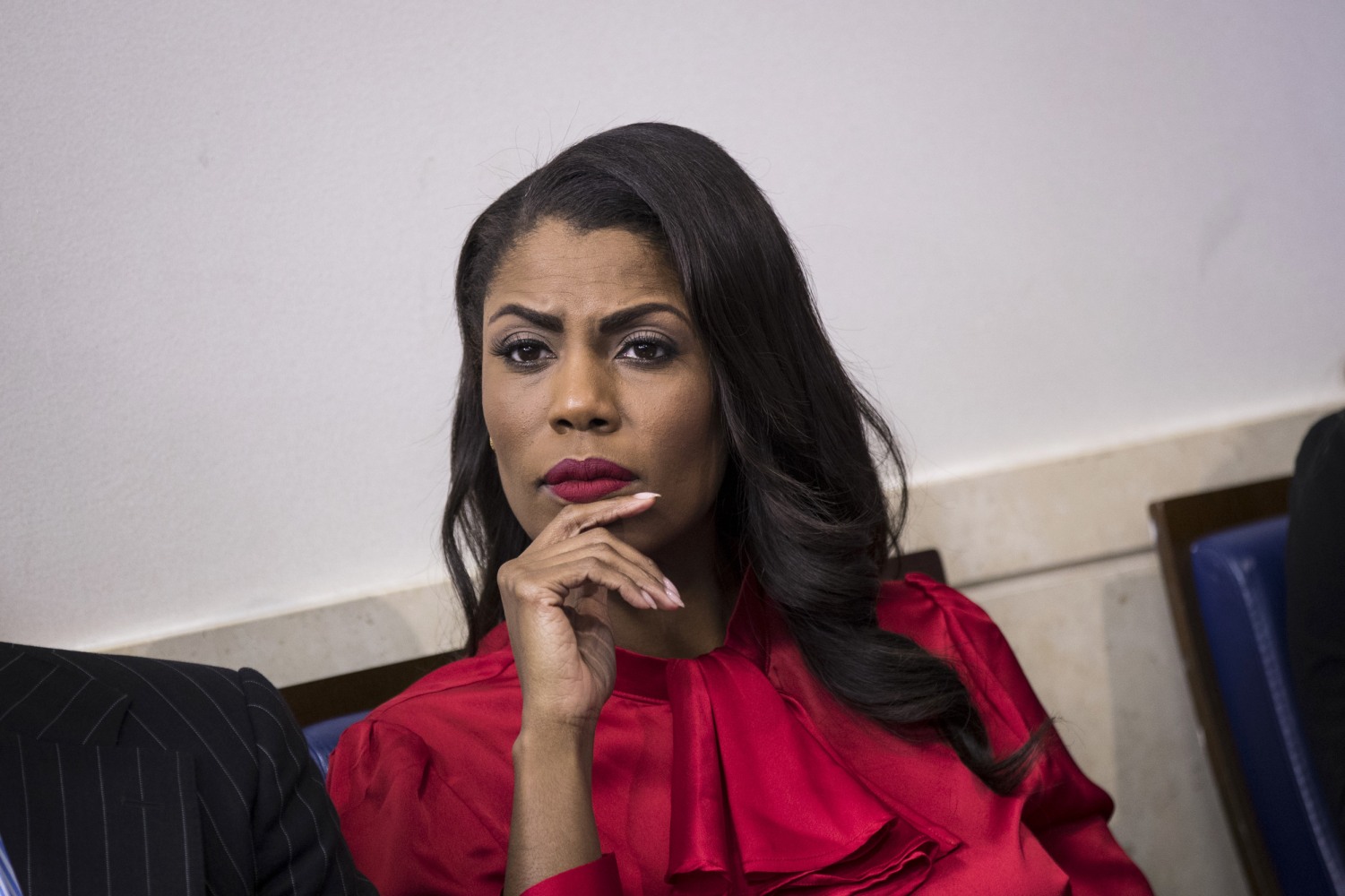
That she’s the only at African-American woman at a senior level in the White House is not a stretch of the truth.
Newman, along with Housing and Urban Development Secretary Ben Carson, were the only black voices among more than 30 Cabinet secretaries and senior staff members around President Donald Trump. Though the position is not Cabinet level, Surgeon General Jerome Adams, an African-American, has been serving since September.
In a second interview with ABC, Newman pointed to a “lack of diversity” in the administration, calling it “very, very challenging being the only African-American woman in the senior staff” and even admitting it “was very lonely” working with a predominantly white staff who “had never worked with minorities, didn’t know how to interact with them.”
Asked by NBC News on Thursday how many black senior staffers remained at the White House in the wake of Newman’s departure, Press Secretary Sarah Huckabee Sanders declined to cite a number or specify who would take over Newman’s outreach to African-American communities.
“We have a really diverse team across the board at the White House,” she said, stressing that there’s also an effort to “continue to grow the diversity here” in the administration.
As for outreach efforts to minorities, Sanders noted that there are voices, including Carson’s, who play a role, but that Trump has also relied on some outside the White House.
“The president met with Senator Tim Scott,” Sanders said, referring to the South Carolina Republican. “I know he wants to continue those conversations as well to look at the best ways to do that and to do outreach to that community.”
The president himself told reporters Thursday afternoon that he liked Omarosa, but ignored a question about how many African-Americans he had in his inner circle.
Meanwhile, Newman said Thursday that the question of who would fill the void she left is one best asked of Trump and his chief of staff, John Kelly, whom she clashed with during her time in the White House.
Despite statements that the White House is “really diverse,” a June release of staff salaries showed that Newman was the only African-American at the top rung of the salary scale.

autoplay
autoplay
And while women have seen their profiles raised in this administration, including Communications Director Hope Hicks and Sanders, there are few staffers of color in high-level jobs.
An NBC News review found only a small percentage of nonwhite staffers were appointed as assistants to the president or special assistants to the president. The White House did not respond to a request for comment on these findings.
Last week, former White House strategist Steve Bannon, at a gathering of black conservative leaders, called out the administration that he was once part of for what he cited as a lack of diversity, saying the limited number of black staffers was “inexcusable.”
“You can’t defend it,” Bannon said, adding later, “I hope, and I think, that there’s action … taking place to solve that.”
The president repeatedly pitched himself as a friend to African-American voters during the campaign, asking at several rallies what they had to lose after voting for Democrats and not seeing any changes. In office, he has repeatedly inflamed race relations with his comments. After a white supremacist rally in Charlottesville, Virginia, turned into a violent clash in August, leaving one person dead, Trump blamed “both sides.”
“There are two sides to a story. I thought what took place was a horrible moment for the country, but there are two sides to a story,” the president said. Trump’s comments sparked swift criticism from lawmakers of both parties, and even members of his own administration.
Publicly, Newman was not one of them, and throughout her White House tenure she had a rocky relationship with black community leaders and activists.
Thursday morning she spoke cryptically about “a lot of things” she saw while in the service of the president —but in the second interview defended Trump, saying “he is not a racist” despite past missteps.
“Yes, I will acknowledge many of the exchanges, particularly in the last six months, have been racially charged,” Newman told ABC. “Do we then just stop and label him as a racist? No.”
“As the only African-American woman in this White House, as a senior staff, and assistant to the president, I have seen things that have made me uncomfortable, that have upset me, that have affected me deeply and emotionally, that has affected my community and my people,” she said.
“And when I can tell my story, it is a profound story that I know the world will want to hear.”
There’s a problem. Here’s what Disney’s C.F.O., Christine McCarthy, told analysts this morning:
We expect to fully realize roughly $2 billion of cost synergies by 2021.
As Andrew reminded earlier this week, “synergies” is a code word for “layoffs.” And Disney executives said that the company expects to start realizing synergies within the first year after the deal closes.
It isn’t clear yet how many jobs would be cut if the transaction succeeds, but this would be a rare deal if it actually generated new positions on balance.
— Michael J. de la Merced
Fox has a bit of unfinished business before it can go forward with its deal with Disney.
It’s in the process of seeking regulatory approval in Britain to take full control of the British satellite television giant Sky in a deal worth about $15 billion. The two companies said on Thursday that Fox plans to proceed with the acquisition and hopes to complete the acquisition of the 61 percent of Sky that it doesn’t own by the end of June.
Sky would then be wholly owned by Disney, following the closing of the Fox deal.
The context: Mr. Murdoch helped found Sky in the early 1990s and has long sought total ownership of it. He last tried to do so five years ago, but was forced to back off amid the controversy over phone hacking by British tabloids, including the since-shuttered Murdoch-owned News of the World.
Mr. Murdoch’s company had previously said that its existing stake in Sky was “not a natural end position.”
The complications: British regulators have been concerned about how much control the Murdoch family would exert over the country’s media and whether Fox, as an entity, would uphold broadcasting standards here.
Advertisement
Continue reading the main story
In June, the regulator Ofcom ruled that Rupert Murdoch and other company executives were “fit and proper” to hold broadcasting licenses in Britain, even as it also concluded that a sexual harassment scandal at Fox News had amounted to “significant corporate failures.”
Britain’s culture minister, Karen Bradly, asked the country’s competition regulator in September to carry out an in-depth review of the Sky transaction. That review is ongoing and provisional findings by the Competition and Markets Authority are expected to be released in January.
The official word: “While 21st Century Fox’s existing plans to acquire Sky remain in place, we expect the current investigation to continue,” a spokesman for the Department for Digital, Culture, Media Sport said on Thursday.
The question: Some analysts have speculated that the British government might be more comfortable with a Sky deal if Disney is the ultimate owner, but whether the Sky deal ultimately received approval remains an open question for now.
— Chad Bray
As part of his company’s $52.4 billion deal for Fox, Bob Iger of Disney agreed to renew his contract through 2021 to help complete the merger and integrate the new businesses.
That would seem to mean a 2020 presidential run is off the table for Mr. Iger.
In March, The Hollywood Reporter reported that Mr. Iger “had told friends he is considering their nudges that he make a run for president in 2020 as a Democrat. “
The publication added:
Iger told THR in June that “a lot of people — a lot — have urged me to seek political office” but denied he would consider a run for California governor or senator, positions that historically have served as stepping stones to the White House. However, Iger didn’t specifically address the prospect of a White House run at the time.
Here are a few other notable business people that are on the list:
• Howard Schultz of Starbucks
• Mark Cuban
• Oprah Winfrey
• Mark Zuckerberg of Facebook
— Stephen Grocer
That’s the question that media executives and Wall Street bankers have been asking this morning.
Could a digital company like Amazon, Google or Apple emerge with a higher bid? Or Verizon or Comcast?
Advertisement
Continue reading the main story
Or could some of them team up to buy the assets and split them among themselves? For example, Comcast has always wanted Fox’s international assets, while any of the digital players would love to own Fox’s content business.
The Fox-Disney deal has about a $1.5 billion breakup fee if a higher bid were to emerge. If regulators block the deal, Disney would have to pay about $2.5 billion.
The Murdochs’ voting control is worth 39 percent of 21st Century Fox in most situations, except for this: If the company were up for sale, they can only vote their economic stake, which is about 17 percent. And of course, even if the deal is completed as presented today, the next chess piece that will become a point of focus is Hulu given its ownership: Disney would control 60 percent of the service, but Comcast would still own 30 percent and Time Warner owns another 10 percent.
It gets complicated quickly.
— Andrew Ross Sorkin
Disney announces it has reached a deal to acquire 21st Century Fox, as predicted by a Simpsons episode that first aired on November 8, 1998. pic.twitter.com/kzloJQHeM8
—
Darren Rovell (@darrenrovell)
Dec. 14, 2017
Ryan Parker of The Hollywood Reporter tweeted that one of “The Simpsons” showrunners, Al Jean, told him, “I predict people will make far too much of this mere coincidence.”
Matt Selman, an executive producer of “The Simpsons,” tweeted this:
—
Matt Selman (@mattselman)
Dec. 14, 2017
And, more important, how some of them will split an estimated fee bounty of up to $154 million.
For Disney:
• Guggenheim Partners
• JPMorgan Chase
• Cravath Swaine Moore
For Fox:
• Goldman Sachs
• Centerview Partners
• Deutsche Bank
• Skadden, Arps, Slate, Meagher Flom
• Hogan Lovells
• Simpson Thacher Bartlett
Here’s how much each set of advisers could collect
According to estimates from Freeman Company:
• Disney’s bankers could split between $62 million and $71 million.
• Fox’s bankers could share between $73 million and $83 million.
Advertisement
Continue reading the main story
— Michael J. de la Merced
Here’s Paul Pendergrass’s take:


One is a tech C.E.O. who has publicly espoused socially liberal initiatives. The other is one of the most prolific and prominent conservative donors around.
But Mr. Cook and Mr. Koch have written an op-ed in the WaPo imploring Congress to give “dreamers” — the young immigrants at the center of a fight over illegal immigration — a path to staying in the U.S.
From the piece:
This is a political, economic and moral imperative. The sooner that Congress resolves this situation — on a permanent basis — the sooner dreamers can seize the opportunity to plan their lives and develop their talents.
This extraordinary set of circumstances has brought the two of us together as co-authors. We are business leaders who sometimes differ on the issues of the day. Yet, on a question as straightforward as this one, we are firmly aligned.
— Michael J. de la Merced
Let’s break down the Disney deal with Fox that was just announced:
• Disney will pay about $29.45 a share in an all-stock transaction, buying a big chunk of Fox businesses valued at about $66 billion, including debt.
• Fox shareholders as a whole will own about 25 percent of The Walt Disney Company.
• As expected, today’s announcement has no mention of a role for James Murdoch at Disney. That may come down the line as he negotiates with Disney.
• The Murdochs, who own about 17 percent of existing shares in Fox, will own less than 5 percent of Disney and won’t have any board seats there.
What Robert Iger of Disney has to say
We’re honored and grateful that Rupert Murdoch has entrusted us with the future of businesses he spent a lifetime building, and we’re excited about this extraordinary opportunity to significantly increase our portfolio of well-loved franchises and branded content to greatly enhance our growing direct-to-consumer offerings.
What’s at stake: Disney wants to bolster its defenses against Netflix and Amazon. The deal will give the media giant another production studio to pump out content for its forthcoming video streaming service. And Fox’s international broadcasting operations will extend its reach abroad.
A deeper dive: Ben Thompson of Stratechery takes a look at how effective a response this is to Netflix. He writes, “What has been so impressive over the last few months is the extent and speed with which Disney has seemingly figured it out — and acted accordingly.”
• The corporate tax rate going down to 21 percent,instead of 20 percent
• The top tax rate going down to 37 percent
Advertisement
Continue reading the main story
• A $10,000 deduction that can be split between mortgage payments and state and local taxes
• A repeal of the corporate alternative minimum tax, but not the individual A.M.T.
• The repeal of the individual insurance mandate
• A preservation of tax breaks for medical expenses and tuition stipends for graduate students
• A tax deduction for pass-through businesses that largely mirrors the Senate bill’s treatment
The cost: still unclear.
From President Trump: “We’re very close to getting it done; we’re very close to voting.”
The Senate holdouts: So far, Bob Corker of Tennessee looks likely to again reject the bill on budget deficit grounds. It’s unclear whether Susan Collins of Maine or Marco Rubio are on board after having raised concerns, though neither has raised fresh objections in recent days.
The tax flyaround
• Although Mr. Trump has talked of the tax code drawing companies back to the United States from Ireland, the overhaul may make little difference with investment in the European Union country. (WaPo)
• Even as Jamie Dimon extols the benefits of the G.O.P. tax plan, banks could face higher taxes on important transactions like repo agreements. (Axios, WSJ)
• Jeff Gundlach of DoubleLine Capital warned that the tax overhaul could pose problems for the $1.5 trillion market for junk bonds. (MarketWatch)

Credit
Eric Thayer for The New York Times
You can watch the meeting here.
This is perhaps the biggest victory yet for the F.C.C. chairman, Ajit Pai, who has already opened the door for more media mergers, curtailed a high-speed internet program for low-income families and allowed broadband providers to raise rates to business customers.
Advertisement
Continue reading the main story
A useful explanation of the net neutrality changes: Geoff Fowler of the WaPo illustrates the issue using airport security lines.

Credit
Eric Thayer for The New York Times
The Fed has concluded that Republican tax plan isn’t economic “rocket fuel,” though it will modestly improve economic growth. The regulator predicts 2.5 percent growth next year, up from 2.1 percent — but not enough to change the Fed’s plan for three rate increases next year.
When told that the president thinks the Republican tax plan could lead to growth of more than 4 percent, here’s what Ms. Yellen said:
“I wouldn’t want to rule anything out. It is challenging, however, to achieve growth of the levels that you mentioned.”
Ms. Yellen’s parting comment: “Let me emphasize that correlation is not causation.”
Looking abroad: Mario Draghi’s final European Central Bank news conference of 2017 is today. Here’s what to expect.

Credit
Daniel Leal-Olivas/Agence France-Presse — Getty Images
Any final deal on Britain’s withdrawal from the European Union will have to be submitted to Parliament as legislation before it can be put into effect. It was a defeat for the prime minister, who wanted more leeway to negotiate with the European Union.
Ms. May is scheduled to be in Brussels for an E.U. Council meeting, where the Europeans are expected to allow Brexit negotiations to proceed to discussions about trade, amid renewed questions about her authority.
On top of that, she is under pressure to explain what exactly Britain wants from an E.U. trade relationship, even though she has yet to find a consensus within her own cabinet.
From Jim Brunsden, George Parker and Caroline Binham of the FT:
“We asked the European side to leave it open for now,” said one of Mrs. May’s allies. “We didn’t want them setting down at this European Council what exactly the parameters of a deal might be.”
Extra credit: Facebook said that it found no evidence of Russian interference in last year’s Brexit vote.

Credit
Chad Batka for The New York Times
• Salma Hayek described how Harvey Weinstein harassed her, including by trying to shut down her movie, “Frida,” which he co-produced. (NYT and NYT en español)
Advertisement
Continue reading the main story
• Four women have accused the hip-hop mogul Russell Simmons of sexual harassment and assault. (NYT)
• The angel investor Ron Conway said that he tried to warn Hillary Clinton’s presidential campaign about getting too close to Shervin Pishevar, who now faces accusations of sexual misconduct. (Forbes)
• PBS suspended its airing of Tavis Smiley’s talk show amid an investigation into unspecified allegations of misconduct by the host. Mr. Smiley has denied wrongdoing. (Variety)
• Meet Rotten Apples, a website that tracks which movies and TV shows have ties to men accused of sexual misconduct. (NYT)
• A Netflix executive who dismissed misconduct allegations against the actor Danny Masterson, who starred in the service’s series “The Ranch,” no longer works for the company. (NYT)
• Only after an Adweek story did employees of the Martin Agency, which created award-winning ads for Geico, learn that their chief creative officer, Joe Alexander, had been accused of harassment. (WSJ)
• The documentary filmmaker Morgan Spurlock admitted to committing sexual harassment in the past and that he settled an accusation out of court. (Deadline)
• This week’s NYT Magazine explores the fallout of sexual misconduct allegations and how to move forward. And the NYT gender editor, Jessica Bennett, answered readers’ question. (NYT, NYT)
Advertisement
Continue reading the main story
The U.S. Attorney’s office for the Northern District of California confirmed in a court filing that it has opened an inquiry into the ride-hailing giant. (We don’t know the nature of the case.)
But prosecutors told the judge overseeing the trade-secrets trial between Uber and Alphabet’s self-driving car company that Uber hasn’t produced some evidence relevant to that court fight.
The next step: A letter from a former Uber security employee, accusing the company of secretly surveilling competitors, is expected to be released, in a redacted form, by the court on Friday.

Credit
Doug Chayka
• Farhad Manjoo writes in his latest State of the Art column: “Tech giants began to grudgingly accept that they have some responsibility to the offline world. The scope of that responsibility, though, is another matter entirely.” (NYT)
• A look at how the Philippine government under Rodrigo Duterte uses Facebook to push back against critics. (Bloomberg Businessweek)
• Why investment management giants like Fidelity are racing to keep up with Silicon Valley. (Bloomberg)
• Target agreed to acquire Shipt, a same-day delivery service similar to Instacart, for $550 million in effort to keep up with Amazon. (Recode)
• Apple agreed to invest $390 million into Finisar, the maker of a key component in the iPhone X, to lock up an important parts manufacturer. (Axios)
Advertisement
Continue reading the main story
• Microsoft’s new partners in A.I. include Reddit and UPS. And Google has established an A.I. center in China. (Axios, NYT)
• UBS hired Martin Blessing, the former C.E.O. of Commerzbank, as the head of its wealth management unit, marking him as a contender to become the Swiss bank’s next chief. (FT)
• UBS also hired Chris Cormier from Bank of America to run its tech, media and telecom equity business in the Americas. (Reuters)
• Blackstone has hired Atsuhiko Sakamoto from Bain Capital to build out a leveraged buyout team in Japan. (Reuters)
• A major union has won significant job protection and increased pay for about 20,000 ATT wireless employees. The union has offered to help make the case for the company’s proposed acquisition of Time Warner. (NYT)
• Walmart is trying to ease some of the financial strain on its workers by allowing them to receive wages before their next payday, but labor groups say that the company should be paying its employees more. (NYT)
• Atos is continuing its unsolicited bid to buy the security software maker Gemalto even after the company’s board unanimously rejected the $5.1 billion offer. (Bloomberg)
• When N.F.L. owners signed off on Roger Goodell’s five-year extension, they were looking for continuity. (NYT)
Advertisement
Continue reading the main story
• China has put Jia Yueting, a tech tycoon, onto an official online blacklist of credit defaulters, which means he can be blocked from flights, high-speed trains and big purchases. (NYT)
• Kingdom Holding Company, Prince Alwaleed bin Talal’s investment firm, has become a black hole of information, and all meaningful activity has been suspended in his absence, according to bankers. (FT)
• The rise of economic nationalism is clashing with the open-market ideals of the European Union’s founders and affecting products from Italian chocolates to German faucets. (WSJ)
• Bitcoin made Michael Poutre, chief executive of Crypto Company, one of the richest men in the United States, briefly. “It is yet another sign of the extraordinary popular delusion being created by Bitcoin and the rush for everything crypto,” writes James Mackintosh. (WSJ)
• Tesla is “headed for a brick wall,” according to Jim Chanos of the hedge fund Kynikos Associates. (Bloomberg)
Want this in your own email inbox? Here’s the sign-up.
You can find live updates throughout the day at nytimes.com/dealbook.
Follow Andrew @andrewrsorkin, Michael @m_delamerced and Amie @amietsang on Twitter.
We’d love your feedback as we experiment with the writing, format and design of this briefing. Please email thoughts and suggestions to bizday@nytimes.com.
Continue reading the main story
Advertisement
Supported by

WASHINGTON — A day after House and Senate Republican leaders said they had reached agreement on a merged version of their tax bill, they continued looking for ways to pay for the tax overhaul and faced the possible defection of a Republican senator, Marco Rubio of Florida.
Republicans plan to unveil a final bill on Friday, with the aim of voting on the legislation early next week and delivering it to President Trump for signing before Christmas.
But many of the changes made to assuage the concerns of businesses and Republican lawmakers are expected to drive up the cost of the bill and will need to be paid for to ensure the legislation does not add more than $1.5 trillion to the deficit over a decade. On Thursday, Mr. Rubio indicated he would vote no on the bill unless the expanded version of the child tax credit that he and another senator, Mike Lee of Utah, have been pushing was included. That change, which would allow families to claim the child tax credit even if they owe no income taxes, would drive up the cost of the bill even more.
“I think my requests have been pretty reasonable and consistent and direct. Right now the refundability level is $1,100, it needs to be higher,” Mr. Rubio said. “It’s a pretty straightforward ask. If the refundable portion of the child credit is substantially increased beyond the $1,100 it currently is, I’ll vote for the bill. If it’s not, I won’t.”
In an online town hall meeting on Wednesday night, Mr. Lee told constituents that negotiations were ongoing to include such an expansion in the conference tax bill.
Among the potential ideas being discussed on Capitol Hill to pay for the bill is allowing the tax cuts for individuals to expire even sooner than the 2025 date already stipulated in the Senate bill. Another idea under consideration, according to Senator Thom Tillis, a North Carolina Republican, is raising the tax rate on profits that companies have parked overseas as a way to pay for the bill.
“We’re literally trying to squeeze about $2 trillion in tax reform into a $1.5 trillion box and that’s been a problem,” Senator Ron Johnson, a Wisconsin Republican, who held out on supporting the initial version of the Senate tax bill until it gave more generous tax breaks to “pass through” businesses.
In an early morning cheer on Twitter, Mr. Trump encouraged Republicans to get the job done.
https://twitter.com/realDonaldTrump/status/941291666564141057
House and Senate Republicans agreed in principle on Wednesday to the framework of a consensus bill. Late changes included a slightly higher corporate tax rate of 21 percent, rather than the 20 percent in the legislation that passed both chambers, and a lower top individual tax rate of 37 percent for the wealthiest Americans, who currently pay 39.6 percent. But the bill will still scale back some popular tax breaks, including the state and local tax deduction and the deductibility of mortgage interest.
Breaking from the House bill, the agreement would allow taxpayers to continue to deduct high out-of-pocket medical expenses, and it would retain a provision allowing graduate students who receive tuition waivers to avoid paying taxes on that benefit. Also included is the Senate’s repeal of the Affordable Care Act requirement that most Americans have health insurance or pay a penalty and a provision that opens the Arctic National Wildlife Refuge in Alaska to energy exploration.

Republicans have resolved the differences between the two versions of their tax bill.
Dec. 8, 2017
Still, the bill contains a host of tax changes that are expected to increase the cost of the bill that passed the Senate, such as repealing the corporate alternative minimum tax and increasing the income threshold at which the individual alternative minimum tax kicks in.
While the late changes to the tax bill were mean to alleviate concerns of skeptical Republicans, it was not clear how they would be paid for while still complying with the strict Senate budget rules that will allow the bill to pass without votes from any Democrats. Republicans can add no more than $1.5 trillion to the deficit if they are to pass the bill along party lines.
On Thursday, Republican leaders continued to express confidence that they were getting close to passing the most sweeping tax overhaul in decades.
“I think there’s going to be strong support in the House and Senate on this or we wouldn’t be moving forward,” Representative Kevin Brady of Texas, the Republican chairman of the House Ways and Means Committee, said on CNN.
Mr. Brady has scheduled a signing of the signature sheets for the conference report — which is the deal that’s been struck between the House and Senate lawmakers on the congressional conference committee — between 10 a.m. and noon on Friday. A majority of the House and Senate lawmakers who are on the conference committee have to sign affirmatively for the bill to move forward.
But other concerns are looming, including the health of two Republican senators, John McCain of Arizona, who is in the hospital, and Thad Cochran of Mississippi, who recently received medical treatment for health problems. Republicans, who hold a narrow 52-48 majority, can only afford to lose two senate votes, and Senator Bob Corker of Tennessee has already expressed his opposition to the bill.
Vice President Mike Pence decided on Thursday to delay a trip to the Middle East trip that he was planning to take next week so that he can preside over the tax vote in the event he needs to break a tie between Republicans and Democrats in the Senate.
Democrats have been largely sidelined in the final stages of the tax discussions.
They assailed the single public meeting of the conference committee on Wednesday as a “sham” and a “farce” and they continue to point to polls that show Republicans will likely pay for pushing tax cuts that do not appear to be popular with the general public. Democrats have also been calling on Republicans to delay the vote so that Alabama’s incoming Democratic senator, Doug Jones, has time to be seated.
“It’s the same rushed, awful process as before and it can only result in mistakes and unintended consequences that can wreak havoc on the economy,” Senator Chuck Schumer of New York, the Democratic minority leader, said on Thursday. “Every day, the more people know about the bill, the more they don’t like.”
At his weekly news conference on Thursday, Speaker Paul D. Ryan, Republican of Wisconsin, dismissed polls suggesting people are not supportive of the tax plan and predicted that the public would eventually warm to the legislation.
“Results are going to be what sells this bill, not the confusion before it passes,” Mr. Ryan said.
Please verify you’re not a robot by clicking the box.
Invalid email address. Please re-enter.
You must select a newsletter to subscribe to.
* Required field
View all New York Times newsletters.
View all New York Times newsletters.
Advertisement
Fire officials confirmed Thursday that a firefighter died while battling the Thomas fire, which ranks as the fourth-largest in the state’s modern history.
“I am very saddened to report that a firefighter fatality has occurred on the Thomas Incident,” Chief Ken Pimlott, the director of the California Department of Forestry and Fire Protection, said in a statement. “Please join me in keeping our fallen firefighter and his loved ones in your prayers and all the responders on the front lines in your thoughts as they continue to work under extremely challenging conditions.”
Pimlott said the victim was a Cal Fire engineer from the San Diego unit. Details about the firefighter’s death were not immediately available.
“IMT 4, CAL FIRE Local 2881 and Southern Region leadership are working to support the Unit and his family, who have been notified,” Pimlott said.
There will be a news conference at 6 p.m.
Despite a couple of days of reduced winds and feverish efforts by firefighters to establish new containment lines, the 242,500-acre Thomas fire has surpassed the size of the Zaca fire, which scorched Santa Barbara County in 2007, according to Dave Zaniboni, a spokesman for the Santa Barbara County Fire Department.
Firefighters hope the 240,207-acre Zaca fire burn scar, as well as the younger vegetation it contains, will help them fight the Thomas fire’s growth along its western edge.
Firefighters have taken advantage of a two-day lull in winds to increase fire containment to 30%. Those efforts could be tested soon, however, as forecasters predict a new blast of Santa Ana winds Thursday, and sundowner winds over Santa Barbara County on Friday.
In Thursday’s incident report, fire officials said they didn’t expect to reach full containment of the blaze until Jan. 7 — more than three weeks from now.
The state of California began keeping records of wildfire acreage in 1932. While other large fires raged on the West Coast prior to that year, those records are less reliable, according to the California Department of Forestry and Fire Protection.
At a morning briefing Thursday, fire commanders said another day of extremely low humidity and moderate winds would greet firefighters as they continued to build containment lines above Carpinteria, Montecito and Santa Barbara.
The mountains north of the coast produce notoriously unpredictable and dangerous conditions for firefighters, said fire behavior analyst Tim Chavez. In the Matilija wilderness, which straddles the border between the two counties, observers saw 50-foot flames backing down a hillside overnight, he said. It’s unusual to see flames that tall working their way down a mountain, officials said.
“This thing is 60 miles long and 40 miles wide,” Chavez said of the blaze. “There’s a lot of fire out there.”
Gusty Santa Ana winds are expected for Los Angeles and Ventura counties Thursday, said Stuart Seto, a weather specialist with the National Weather Service. In the mountains, gusts of 55 mph are possible.
In the valleys, 15 to 25 mph gusts are predicted, with some gusts of up to 40 mph, Seto said. Over the past few days, a break in the weather has allowed firefighters to increase containment.
“That’s the thing, it’s just going to do the opposite now. The humidities are still down in the single digits,” Seto said. “These winds, especially in the mountain areas, are really going to start blowing the fire around again. What it does is carry the embers further down and can create more fires.”
Winds will be north to northeast, and usually the Ventura side is more affected than the Santa Barbara side, Seto said.
“But it’s still going to have an effect up in the mountain areas of Santa Barbara,” he added. Winds up there will be up to 25 mph and a little gusty, “so there’s still going to be a big concern up in that area,” he said.
Throughout mountain areas on Thursday there’s a greater risk for large fire plumes, which can cause erratic fire behavior.
“It carries the heat up, and it looks like a thunderstorm cloud,” Seto said. “From there, the fire could spread out. Sometimes they collapse, and it’s a strong down-rush of winds and it spreads the fire.”
Sundowner winds are expected Friday into Saturday in the Santa Barbara area. On Sunday, winds are expected to return to offshore conditions, Seto said.
The fire has destroyed more than 900 homes in Ventura and Santa Barbara counties since it began Dec. 4 near Thomas Aquinas College in Santa Paula. In its first day, the fire spread southwest, toward Ventura, and northwest, eventually hugging Ojai before pushing to the Central Coast.
brittny.mejia@latimes.com
Twitter: @Brittny_Mejia
ALSO
‘This fire is a beast’: Massive inferno keeps growing despite epic battle by firefighters
Witnesses saw snapped, sparking power line at start of destructive L.A. wildfire
Track the key details on Southern California’s fires
Wealthy Bel-Air wrestles with homeless crisis after encampment fire burns homes
UPDATES:
1:00 p.m.: This article was updated with additional details about the death of the firefighter.
12:45 p.m.: This article was updated with the death of a firefighter.
10:04 a.m.: This article was updated with details on Cal Fire wildfire records.
9:55 a.m.: This article was updated with details on homes destroyed and an expected containment date.
This article was originally published at 8:50 a.m.
The discarding of net neutrality regulations is the most significant and controversial action by the F.C.C. under Mr. Pai. In his first 11 months as chairman, he has lifted media ownership limits, eased caps on how much broadband providers can charge business customers and cut back on a low-income broadband program that was slated to be expanded to nationwide carriers.
His plan for the net neutrality rules, first outlined early this year, set off a flurry of opposition. Critics of the changes say that consumers may have more difficulty finding content online and that start-ups will have to pay to reach consumers. In the past week, there have been hundreds of protests across the country, and many websites have encouraged users to speak up against the repeal. After the vote, numerous groups said they planned to file a lawsuit challenging the change.
The five commissioners were fiercely divided along party lines. In front of a room packed with reporters and television cameras from the major networks, the two Democratic commissioners warned of consumer harms to come from the changes.
The F.C.C. voted to dismantle rules that require internet providers to give consumers equal access to all content online. Here’s how net neutrality works.
By AARON BYRD and NATALIA V. OSIPOVA on Publish Date November 21, 2017.
Photo by Michael Bocchieri/Getty Images.
Watch in Times Video »
Mignon Clyburn, one of the Democratic commissioners, presented two accordion folders full of letters in protest to the changes, and accused the three Republican commissioners of defying the wishes of millions of Americans.
“I dissent, because I am among the millions outraged,” said Ms. Clyburn. “Outraged, because the F.C.C. pulls its own teeth, abdicating responsibility to protect the nation’s broadband consumers.”
Brendan Carr, a Republican commissioner, said it was a “great day” and dismissed “apocalyptic” warnings.
“I’m proud to end this two-year experiment with heavy-handed regulation,” Mr. Carr said.
During Mr. Pai’s speech before the vote, security guards entered the meeting room at the F.C.C. headquarters and told everyone to evacuate. Commissioners were ushered out a back door. The hearing restarted a short time later.
Advertisement
Continue reading the main story
Despite all the uproar, it is unclear how much will change for internet users. The rules were essentially a protective measure, largely meant to prevent telecom companies from favoring some sites over others. And major telecom companies have promised consumers that their experiences online would not change.
Mr. Pai and his Republican colleagues have echoed the comments of telecom companies, who have told regulators that they weren’t expanding and upgrading their networks as quickly as they wanted to since the creation of the rules in 2015.
“There is a lot of misinformation that this is the ‘end of the world as we know it’ for the internet,” Comcast’s senior executive vice president, David Cohen, wrote in a blog post this week. “Our internet service is not going to change.”
But with the F.C.C. making clear that it will no longer oversee the behavior of broadband providers, telecom experts say, the companies could feel freer to come up with new offerings, such as faster tiers of service for business partners such as HBO’s streaming service or Fox News.
Such prioritization could stifle certain political voices or give the telecom conglomerates with media assets an edge over rivals.
Consumer groups, start-ups and many small businesses say there are examples of net neutrality violations by companies, such as when ATT blocked FaceTime on iPhones using its network.
These critics of Mr. Pai, who was nominated by President Trump, say there isn’t enough competition in the broadband market to trust that the companies will try to offer the best services for customers. The providers have the incentive to begin charging websites to reach consumers, a strong business model when there are few places for consumers to turn when they don’t like those practices.
“Let’s remember why we have these rules in the first place,” said Michael Beckerman, president of the Internet Association, a trade group that represents big tech firms such as Google and Facebook. “There is little competition in the broadband service market.”
Advertisement
Continue reading the main story
Mr. Beckerman said his group was weighing legal action against the commission. Public interest groups including Public Knowledge and the National Hispanic Media Coalition said they planned to challenge Mr. Pai’s order in court. Eric T. Schneiderman, the New York attorney general, also said he would file a lawsuit.
Dozens of Democratic lawmakers, and some Republicans, have pushed for Congress to pass a law on the issue, if only to prevent it from flaring up every couple of years at the F.C.C. — and then leading to a court challenge.
One Republican commissioner, Mike O’Reilly, said he supported a federal law created by Congress for net neutrality. But he said any law should protect the ability of companies to charge for faster lanes, a practice known as “paid prioritization.”
Any legislation action appears to be far off, however, and numerous online companies warned that the changes approved on Thursday should be taken seriously.
“If we don’t have net neutrality protections that enforce tenets of fairness online, you give internet service providers the ability to choose winners and losers,” Steve Huffman, chief executive of Reddit, said in an interview. “This is not hyperbole.”
Netflix, which has been relatively quiet in recent weeks about its opposition to the change, said that the decision “is the beginning of a longer legal battle.”
We’re disappointed in the decision to gut #NetNeutrality protections that ushered in an unprecedented era of innovation, creativity civic engagement. This is the beginning of a longer legal battle. Netflix stands w/ innovators, large small, to oppose this misguided FCC order.
—
Netflix US (@netflix)
Dec. 14, 2017
Continue reading the main story
