NHC Saturday morning advisory and track forecast for Hurricane Nate. (NWS)
Hurricane Nate is headed toward landfall in the northern Gulf Coast. Upgraded to hurricane strength just before midnight Friday, the storm is now packing maximum sustained winds of 90 mph. It is moving speedily to the north at 26 mph.
Hurricane warnings are in place from Grand Isle, La., to the Alabama border with Florida. This includes the city of New Orleans, which has prompted the mayor of the Crescent City to issue mandatory evacuations for parts of the area.
Nate is expected to make landfall Saturday night, now as a Category 2 storm with 105 mph sustained winds. Rain had already begun along the northern Gulf Coast Saturday morning, and conditions will go downhill further through the afternoon and Saturday night.
In the region under a hurricane warning, a dangerous combination of damaging winds, gusting over 100 mph at times, severe coastal flooding, and torrential rain are likely.
Nate is the ninth hurricane to form in the Atlantic this season, which is the highest total since the infamous 2012 season featuring Hurricane Sandy.
Nate, which started forming earlier this week in the southwestern Caribbean, reportedly killed 25 people as it passed along Central America.
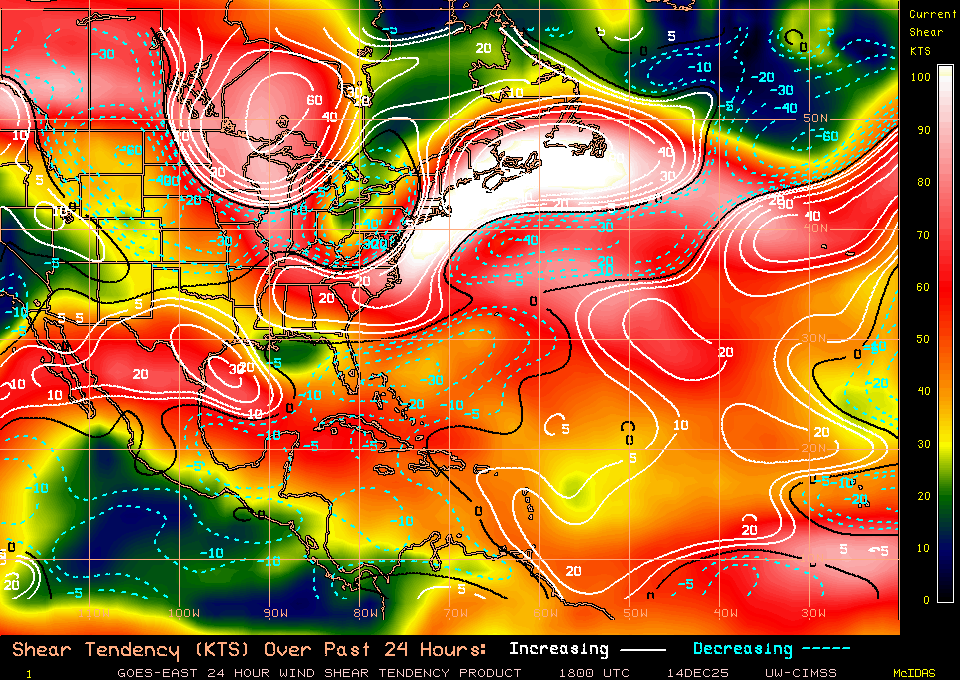
Since Friday, Nate has steadily become better organized over the warm waters of the Caribbean and southern Gulf of Mexico. While some wind shear is preventing the storm from explosively intensifying, Nate is expected to strengthen right up until landfall.
The inner bands of the storm are still located offshore, but with Nate’s fast forward motion, wind speeds and rain intensity will increase throughout Saturday. While landfall is expected to occur Saturday night, tropical storm force are likely to move into the Louisiana coast by midafternoon. They should be impacting Mississippi and Alabama near or shortly after sunset.
Most likely arrival time of tropical force winds via the NHC. (NWS)
Storm surge and damaging wind gusts are the most pressing hazards
Nate is expected to make landfall as a Category 2. Sustained hurricane-force winds and gusts over 100 mph likely to affect some locations from Southeast Louisiana to the near the Alabama-Florida border. These winds could cause widespread downed trees and power outages, as well as some structural damage. The most severe damage will tend to be concentrated in a relatively narrow zone near and just to the east of the storm center. Hurricane-force winds extend about 35 miles from the center, mainly on the east side.
But wind may not be the most dangerous hazard from Nate.
The most immediate threat for the coast will be storm surge generated from the hurricane. Storm surge is best thought of as a general rise in the water level at the coast as the storm comes ashore. It does not include waves on top of it. Water levels as high as 7 to 11 feet above normally dry ground are expected in the hardest hit parts, which the National Hurricane Center expects to be from roughly from the mouth of the Mississippi River to the Mississippi-Alabama border. Around that — as far west as Morgan City, La., and as far east as the Okaloosa-Walton County line in Florida, less severe but still problematic water rises are anticipated — and this whole zone is under a storm surge warning.
“Unfortunately, locations from Grand Isle, La., to Panama City, Fla., will have high tide around midnight, coinciding with landfall and peak storm surge, maximizing coastal inundation anywhere east of the landfall point,” said Brian McNoldy, Capital Weather Gang’s tropical weather expert
On top of the surge, there are giant waves. Nate is already generating wave heights upward of 24 feet in the Gulf of Mexico. While heights seen in open water are unlikely to make it to shore, battering waves are likely to accompany surge along the coast, especially to the east of the center.
Forecast trending to the east of New Orleans
The first round of model runs this morning showed a bit of an eastward shift in Nate’s forecast. If this occurs, it would keep New Orleans on the west, and generally less intense, side of the storm. Given Nate’s fast movement and imminent arrival of bad weather, there’s no reason to let any guard down in these areas, even if the worst misses.
In New Orleans itself, the city’s pumping system is still reeling from several heavy rain events over the summer, with 11 of the 109 city wide pumps still out of service as of earlier this week. Rain from the outer edges of Nate has already reached the area Saturday morning.
8 a.m. simulations from the American GFS model show landfall along the Alabama coast as the most likely scenario.
After landfall
Nate will also be carrying a lot of moisture and promises to drop a large amount of rainfall, despite the fact that the storm is moving quite fast.
A widespread 2 to 6 inches of rain is expected to fall along its track through Sunday. Higher amounts are likely in spots. All of this rain will fall in under 24 hours, so flash flooding will be a concern.
Upward of 10 inches of rain may fall just to the north of Nate’s landfall location. Via WPC
Because the storm is moving so fast, tropical storm-force winds, which could down trees and cause power outages, may extend fairly far inland — through much of Alabama. The National Hurricane Center predicts it could sustain tropical storm strength into Sunday evening, when it should be passing through Tennessee.
Both the “cone of uncertainty” for Nate’s future path and the rainfall forecast for the system include the Mid-Atlantic and Northeast as well. What’s left of Nate will pass west of Washington on Sunday, but we will still be close enough to tap into some much needed rain.
Capital Weather Gang’s Jason Samenow contributed to this story.
President Trump meets Sept. 6 with Senate Minority Leader Charles E. Schumer (D-N.Y.) and other congressional leaders in the Oval Office. (Evan Vucci/AP)
This post has been updated.
Frustrated by Republican inaction on health care, President Trump tweeted Saturday that he had reached out to the Senate Democratic leader in hopes of brokering a deal for a “great HealthCare Bill.”
Trump said that he had called Senate Minority Leader Charles E. Schumer (D-N.Y.) on Friday to ask whether Democrats would work with him on health care — and Trump indicated that he had not been entirely rebuffed.
In a Saturday morning tweet, Trump wrote, “I called Chuck Schumer yesterday to see if the Dems want to do a great HealthCare Bill. ObamaCare is badly broken, big premiums. Who knows!”
I called Chuck Schumer yesterday to see if the Dems want to do a great HealthCare Bill. ObamaCare is badly broken, big premiums. Who knows!
Schumer responded, saying he was willing to work with Trump to “improve the existing health care system” but not to “repeal and replace” the Affordable Care Act, former president Barack Obama’s signature 2010 health-care law.
“The president wanted to make another run at repeal and replace and I told the president that’s off the table,” Schumer said in a statement. “If he wants to work together to improve the existing health care system, we Democrats are open to his suggestions. A good place to start might be the Alexander-Murray negotiations that would stabilize the system and lower costs.”
Schumer was referring to a bipartisan health-care proposal by Sens. Lamar Alexander (R-Tenn.) and Patty Murray (D-Wash.).
On Friday, Democratic lawmakers condemned new rules issued by the Trump administration that widen the range of employers and insurers that can avoid the ACA requirement that birth control pills and other contraceptives be covered by insurance as part of preventive care because of religious beliefs.
“Particularly after the birth control decision yesterday, the administration has to stop sabotaging the law before anything real can happen,” a Democratic aide, speaking on the condition of anonymity because the aide was not authorized to be quoted by name, said Saturday.
Trump’s outreach to Schumer comes after the president infuriated fellow Republicans by negotiating a deal last month with Schumer and House Minority Leader Nancy Pelosi (D-Calif.) to raise the debt ceiling and fund the government.
Trump’s dealings with “Chuck and Nancy,” as he affectionately called them, was seen by some congressional Republicans as an act of betrayal but have earned the president plaudits and framed him as the bipartisan dealmaker he said he would be.
Republicans control the House and Senate but have repeatedly failed to pass their health-care bill through the upper chamber. Their efforts to “repeal and replace Obamacare,” which for years has been the GOP’s campaign mantra, so far have garnered no Democratic support.
But Schumer and other Democrats have said they would be open to discussions with Trump and other Republicans to consider selective changes to the ACA. This summer, Schumer publicly offered to negotiate with Trump if Republicans were willing to drop what he called a “fundamentally flawed approach.”
“Let’s start over,” the Democratic leader said in June, challenging the president to invite Senate Democrats to Blair House for a meeting. “You think we’re not serious? Try us. Democrats are ready to turn the page on health care.”
ZURICH — European officials and business executives are quickly mobilizing a counter effort to the expected U.S. rebuff of the Iran nuclear accord, encouraging companies to invest in Iran while urging Congress to push back against White House moves that could hobble the deal.
The European stance — sketched out on the sidelines of an Iran-focused investment forum in Zurich this week — is an early signal of the possible transatlantic rifts ahead as America’s European partners show no sign of following the White House call to renegotiate the landmark pact with Tehran.
“The nuclear deal is working and delivering and the world would be less stable without it,” Helga Schmid, the secretary general of the European’s foreign policy service, said in a speech at the Europe-Iran Forum.
This amounted to a warning shot that Washington may once again find itself isolated from its key Western allies, who have already broke with the White House over issues such as President Trump’s call to withdraw from the Paris climate accord.
Trump plans next week to declare that the 2015 Iran deal — which curbs Iranian nuclear activities in exchange for sanctions relief — is no longer in the U.S. national interest, according to U.S. and European officials. Such a move would then give Congress 60 days to vote to reimpose sanctions.
This could pave the way for the deal’s collapse or, more likely, Europeans and others such as China and India could keep up their growing economic and diplomatic engagement with Iran with the United States on the outside looking in.
“The risk [of sanctions] is there, but my perception is that everybody outside the U.S. who participated in the deal wants to increase relations with Iran,” Ulrich Von Zanthier, director of financial risk management at KPMG, a global audit and advisory firm, told the conference.
If the United States reintroduces sanctions, “it is what it is,” he said. “But at the moment, we can do business, so let’s do business.”
European diplomats and business leaders said they hope the 60-day period will provide them with a diplomatic buffer zone in which they can convince Congress to salvage the agreement.
“There’s a period of 60 days where things need to work out in a way that upholds the [agreement] with the U.S. still in it,” said a senior executive at a Europe-based multinational company. The executive spoke on the condition of anonymity to discuss sensitive matters related to Iran sanctions.
“There’s no real alternative” to the deal, the executive said, adding that “it’s an illusion to think you can reopen and renegotiate” it.
The agreement, also known as the Joint Comprehensive Plan of Action, or JCPOA, was result of years of negotiations between Iran and world powers. It was hailed as a victory for global diplomacy and nuclear nonproliferation, and allowed Iran to resume oil exports and foreign companies to tap in to a vast new consumer market.
Since then, the International Atomic Energy Agency, the U.N. atomic watchdog tasked with monitoring Iran’s nuclear program, has repeatedly certified its compliance with the deal.
Still, the Trump administration has said the agreement does not go far enough in countering Iran’s ballistic missile program and support for groups that the United States considers as terrorists, such as Lebanon’s Hezbollah.
Trump is expected to announce a major policy shift on Iran next week — one that will more aggressively target Iranian security services and push for more radical enforcement of the deal, officials say.
The deal has been “put into question in harsh terms by some in recent months,” said the foreign policy group chief Schmid, referring to the U.S. administration.
“Some critics say that the agreement does not address Iran’s regional activities,” she said, adding that “this is a nonproliferation agreement. It is not an agreement on regional matters or human rights . . . The JCPOA should not be blamed for something it is not supposed to address,” she said. “As Europeans, we will do everything to make sure it stays.”
Iranian leaders also have insisted the nuclear pact cannot be renegotiated. On Friday, the head of Iran’s nuclear agency, Ali Akbar Salehi, warned that Iran would be forced to abandon the accord if other countries followed the U.S. lead to possibly reimpose sanctions.
“But if the U.S. leaves the deal on its own with the others adhering to it, the situation will be different,” Salehi told Iran’s Fars news agency.
Part of the European effort to save the deal includes reassuring European companies and banks that they have political support for their investments, even as some businesses have struggled to navigate Iran’s volatile economy.
As a measure of confidence, the European Commission has recommended that the European Investment Bank be allowed to operate in Iran in the future, Schmid said.
But for others, the risk may be too great.
Before the nuclear deal, the United States imposed what are known as secondary sanctions, where the Treasury Department penalizes companies or people who do business with Iran. The fear is that the United States may revive those strict regulations — putting foreign companies doing business in Iran under the cloud of possible U.S. clampdowns.
“We need to be compliant with international law, or applicable law. And if sanctions come back and that means we cannot do our work inside or outside Iran, then we will stop,” the executive from the multinational said.
“Iran is a big market. It’s also quite a stable country,” the executive said. But multinational companies “have to consider markets around the world, and Iran today is still relatively small, compared to Europe or the U.S.”
Brian Murphy in Washington contributed to this report.
The Trump administration issued a rule Friday that sharply limits the Affordable Care Act’s contraception coverage mandate, a move that could mean many American women would no longer have access to birth control free of charge.
The new regulation, issued by the Health and Human Services Department, allows a much broader group of employers and insurers to exempt themselves from covering contraceptives such as birth control pills on religious or moral grounds. The decision, anticipated from the Trump administration for months, is the latest twist in a seesawing legal and ideological fight that has surrounded this aspect of the 2010 health-care law nearly from the start.
Several religious groups, which battled the Obama administration for years over the controversial requirement, welcomed the action.
Women’s rights organizations and some medical professionals portrayed it as a blow to women’s health, warning that it could lead to a higher number of unintended pregnancies.
The rule change is among the recent moves by President Trump to dismantle initiatives enacted under the Obama administration. It fulfills a crucial promise Trump made as a candidate to appeal to social conservatives and that he repeated in May when he signed an executive order in the Rose Garden to expand religious liberty.
Senior Health and Human Services officials, briefing reporters early on condition of anonymity, contended the change will still leave “99.9 percent of women” with access to free birth control through their insurance. They said the estimate was based on the finite number of groups that have filed about 50 lawsuits over the provision.
This latest rewriting of the federal policy, in an interim final rule that takes effect immediately, broadens the entities that may claim religious objections to providing contraceptive coverage to nonprofit organizations and for-profit companies, even ones that are publicly traded. Also included are higher educational institutions that arrange for insurance for their students, as well as individuals whose employers are willing to provide health plans consistent with their beliefs.
A separate section covers moral objections, allowing exemptions under similar circumstances except for publicly traded companies.
As part of the rule, made publicly available in the Federal Register late Friday morning, administration officials estimate that 120,000 women at most will lose access to free contraceptives — many fewer than critics predict.
They write that they do not know how many employers or insurers that omitted contraceptive coverage before the ACA did so based on religious beliefs that would now allow them to be exempt. For that reason, the law says, HHS cannot predict how many entities will want exemptions, other than the groups that have filed recent lawsuits or made other public statements against the Obama-era policy.
The analysis concludes that perhaps one-third of women who get insurance through such groups — the estimated 120,000 — would end up paying for birth control on their own.
The new policy “will result in some persons covered in plans of newly exempt entities not receiving coverage or payments for contraceptive services,” the rule acknowledges. But it says there is not “sufficient data to determine the actual effect . . . on plan participants and beneficiaries, including for costs they may incur for contraceptive coverage, nor of unintended pregnancies that may occur.”
The controversy first arose as part of the Obama administration’s initial definition of preventive care that insurers must cover under the ACA — which encompassed birth control, officials decided.
Subsequent accommodations gave exemptions of sorts to houses of worship, nonprofits with religious affiliations and closely held for-profit companies. Such employers have been able to opt out of providing the coverage and instead have their insurance company pay for it by notifying the insurer, a third-party administrator or the federal government. That situation will continue.
Organizations affiliated with the Catholic church, which teaches against birth control other than by natural means, have been among the most vocal opponents. They’ve argued that having to cover the cost of contraception through health insurance plans is tantamount to being forced by the government to be complicit in a sin.
In the past several years, lawsuits have been filed by nuns, Catholic charities, hospitals and universities. Even now, litigation remains in several federal appeals courts.
One challenge was heard by the Supreme Court, and the justices ruled in 2014 that it was illegal to impose the mandate on “closely held corporations” such as Hobby Lobby, the craft store chain. Its Christian owners had objected to the idea of paying for several kinds of the birth control that must be covered.
Despite HHS’s officials 99.9 percent prediction, no one knows how many companies and institutions will now claim an exemption and, in turn, how many women will lose access to no-cost birth control.
The new rule is almost certain to spark fresh litigation. The National Women’s Law Center — which estimates that in 2013 alone, the contraception requirement saved women $1.4 billion in oral contraceptive costs — has vowed to challenge the Trump administration in court. It plans to argue that the new policy amounts to sex discrimination, since it will disproportionately affect women. It also plans to allege religious discrimination, arguing that it will allow employers to impose their religious beliefs on employees.
“The Trump administration is treating birth control as if it’s not even health care. We see this as part of the larger war they are waging on women’s health,” said Mara Gandal-Powers, senior counsel at the National Women’s Law Center. “For some [women], it means choosing between preventive care like contraceptives and paying their rent, their mortgage, electric bill.”
Other groups focused on a different issue, with Anne Davis of Physicians for Reproductive Health arguing that the widened exemptions will leave many women “vulnerable to the whim of their employers. … An employer’s beliefs have no place in these private decisions, just as they would not in any other conversation about a patient’s health care.”
The rule follows some social conservatives’ increasing frustration with the pace at which the Trump administration has addressed their demands on issues such as the ACA contraception requirement. “An awful lot of people who voted for this president did so believing this was going to be something he would solve,” said Mark Rienzi, senior counsel for the Becket Fund for Religious Liberty, who hailed the rule as a correction of overly aggressive liberal actions under President Barack Obama. “There are other ways to get contraceptives. You don’t need to force nuns to give people contraception.”
In his sweeping May 4 executive order on free speech and religious liberty, Trump directed his Cabinet to address the concerns of those who had “conscience-based objections” to contraceptive coverage.
In previewing the rule for reporters, Roger Severino, director of HHS’s office for civil rights and a longtime proponent of religious liberties, reiterated Trump’s May pledge from the Rose Garden. The president had promised that “we will not allow people of faith to be targeted, bullied or silenced any more . . . We are ending the attacks on religious liberties.”
On Friday, Severino elaborated: “That was a promise made, and this is the promise kept. … We should have space for organizations to live out their religious identity and not face discrimination because of their faith.”
The HHS regulation was not the only administration action along these lines to be announced on Friday. Minutes later, Attorney General Jeff Sessions issued sweeping guidance to all executive departments and agencies on the Justice Department’s interpretation of religious liberties. That also triggered an immediate backlash, with civil liberties groups asserting that he was essentially offering a license for discrimination.
Senior Justice Department officials said the guidance was merely meant to offer interpretation and clarification of existing law. But the interpretation seemed to be particularly favorable to religious entities, possibly at the expense of women, LGBT people and others.
The guidance, for example, said the ACA contraceptive mandate “substantially burdens” employers’ free practice of religion by requiring them to provide insurance coverage for contraceptive drugs in violation of their religious of beliefs or face significant fines.
Over the summer, a leaked early draft of the regulation began circulating in Washington, priming both sides for a renewed fight. That draft immediately drew praise from one side and condemnation from the other.
When the contraception mandate was first implemented in August 2012, it required all health insurance offered by employers to cover at least one of the 18 forms of birth control approved by the Food and Drug Administration. Since then, savings on the birth control pill have accounted for more than half of the drop in all out-of-pocket prescription drug spending, according to the Kaiser Family Foundation.
Mr. Cornyn said the continuing legality of the conversion kits was “a legitimate question,” and told reporters he had asked Senator Charles E. Grassley of Iowa, the Judiciary Committee chairman, to convene a hearing on that issue and any others that arise out of the Las Vegas investigation.
Other Republican senators, including Lindsey Graham of South Carolina, Orrin G. Hatch of Utah and Marco Rubio of Florida, said they would be open to considering legislation on bump stocks.
“We certainly want to learn more details on what occurred in Las Vegas,” Mr. Rubio said, “and if there are vulnerabilities in federal law that we should be addressing to prevent such attacks in the future, we would always be open to that.”
In the House, Representative Carlos Curbelo, Republican of Florida, said he was drafting bipartisan legislation banning the conversion kits. Representative Mark Meadows, the head of the conservative Freedom Caucus, also said he would be open to considering a bill, while Representative Bill Flores, Republican of Texas, called for an outright ban.
“I think they should be banned,” Mr. Flores told the newspaper The Hill. “There’s no reason for a typical gun owner to own anything that converts a semiautomatic to something that behaves like an automatic.”
In an often deadlocked Washington, none of the pronouncements guaranteed action. The National Rifle Association, which has poured tens of millions of dollars into Republican campaign coffers, remained mum on the bump stock discussion and could stop it cold.
And Erich Pratt, executive director of another gun rights group, Gun Owners of America, vowed to block any legislation.
“We see this as an item that is certainly protected by the Second Amendment, and realistically, they are already on the market, so passing a law banning them isn’t going to stop bad guys like this creep in Las Vegas,” he said.
Advertisement
Continue reading the main story
But Senator Dianne Feinstein, the California Democrat, tried to force the issue, introducing legislation, backed by about two dozen Democrats, that would ban bump stocks.
Ms. Feinstein cautioned that bipartisan support for such narrow legislation would hardly constitute a sea change. She tried to ban bump stocks in 2013, but that was part of broader legislation to renew the assault weapons ban, which went nowhere.
Newsletter Sign Up
Continue reading the main story
Thank you for subscribing.
An error has occurred. Please try again later.
You are already subscribed to this email.
View all New York Times newsletters.
See Sample
Manage Email Preferences
Not you?
Privacy Policy
Opt out or contact us anytime
“I mean, if not this, what?” she asked. “It doesn’t take a weapon away. It just means you can’t convert it into something it’s not meant to be.”
At a hastily convened news conference, Ms. Feinstein said the Las Vegas massacre, which left 58 people dead and about 500 injured at a country music festival Sunday night, had hit home with her. Her daughter had planned to attend the concert but decided against going at the last minute.
Ms. Feinstein, who has spent years shepherding gun safety legislation — almost always unsuccessfully — said she introduced the measure on the advice of Senator Chuck Schumer of New York, the Democratic leader, who reasoned that by offering a narrowly tailored provision, she might get Republican support.
Bump stocks replace a rifle’s standard stock, which is the part held against the shoulder, freeing the weapon to slide back and forth rapidly, harnessing the energy from the kickback that shooters feel when the weapon fires. The stock “bumps” back and forth between the shooter’s shoulder and trigger finger, causing the rifle to rapidly fire again and again, far faster than an unaided finger can pull a trigger.
In marketing the devices, two Texas companies, Bump Fire Systems and Slide Fire Solutions, were apparently concerned that they would not be legal. But in June 2010, after an inquiry from Slide Fire, the Bureau of Alcohol, Tobacco, Firearms and Explosives, or A.T.F., sent a letter saying that the company’s bump stock product “is a firearm part and is not regulated as a firearm under the Gun Control Act or the National Firearms Act.”
The Las Vegas gunman fired down on concertgoers from the 32nd floor of a nearby hotel. With his fixed firing positions and distance from his victims, he almost certainly was more lethal because of the conversion kits. But until the shooting, many lawmakers said, they had never heard of bump stocks.
Advertisement
Continue reading the main story
The devices were introduced during the past decade by Bump Fire and Slide Fire, both based in Moran, Tex., near Abilene. Bump Fire’s website appeared to be down for much of Wednesday. The company wrote on its Facebook page on Tuesday that its servers had been overwhelmed by “high traffic volume.”
Multiple items on Slide Fire’s site on Wednesday featured the notice, “Due to extreme high demands, we are currently out of stock.”
Bump Fire sells stocks for an AK-47 and an AR-15 for $99.99 each. Slide Fire’s stocks are priced between $140 and $300. Neither company responded to a request for comment.
On Gunbroker.com, an auction site for firearms and shooting accessories, at least three dozen listings featuring bump stocks had attracted multiple bids.
Zack Cernok, a Pennsylvania gun owner, was one of those trying to buy a Bump Fire bump stock.
“I don’t even have the gun for it, but I want the stock just to have it down the line,” he said. “I just like the idea of them and want to see how it feels and if it’s worth it — for $100, it’s almost not a bad investment to buy it, try it out and sell it if I don’t like it.”
Investigators probing the Las Vegas massacre continued searching Thursday for what could have motivated the deadliest mass shooting in modern American history, even as they detailed more evidence suggesting that the gunman meant to inflict even greater damage.
Since the moment Stephen Paddock fired the first round out of his high-rise hotel suite overlooking the Las Vegas Strip, unleashing a hail of gunfire on the concertgoers far below, authorities have pieced together many details about the 64-year-old and his attack.
They know he planned extensively, prepared methodically, secretly assembling an arsenal of guns and thousands of rounds of ammunition in his two-room suite in the Mandalay Bay Resort and Casino. Authorities have tracked his gun purchases, tried to piece together his movements in the hours and days before the attack and spoken to his relatives and girlfriend.
What local and federal investigators say remains elusive, though, is an explanation for why Paddock carried out the rampage, killing 58 people and injuring hundreds more before taking his own life. They also are still trying to determine whether he had any help.
Paddock, a retired accountant and avid gambler, was “disturbed and dangerous,” Joseph Lombardo, the Las Vegas sheriff, said at a news briefing Wednesday night.
“Stephen Paddock is a man who spent decades acquiring weapons and ammo and living a secret life, much of which will never be fully understood,” Lombardo said.
Lombardo said authorities hoped to figure out what may have sparked Paddock’s rage.
“Anything that would indicate this individual’s trigger point and would cause him to do such harm, we haven’t understood it yet,” he said.
As the sprawling investigation stretched across the country and around the world, authorities hoped that Marilou Danley, Paddock’s girlfriend, could provide some answers about his mind-set and what could have motivated him. But in a statement released after she was interviewed by the FBI in Los Angeles, Danley said she had no idea of what was about to happen.
“It never occurred to me in any way whatsoever that he was planning violence against anyone,” Danley said in a statement that was read aloud by her attorney. She described Paddock as a “kind, caring, quiet man” and said he never gave any sign “that something horrible like this was going to happen.”
Danley was out of the country when the attack occurred, which she said was by Paddock’s design. Paddock bought her a ticket to visit family in the Philippines, she said, and then wired money that he explained was meant to buy a home for Danley’s relatives. In her statement, Danley said she thought this meant Paddock was breaking up with her.
“I am devastated by the deaths and injuries that have occurred and my prayers go out to the victims and their families and all those who have been hurt by these awful events,” Danley said. “I am a mother and a grandmother, and my heart breaks for all who have lost loved ones.”
Danley pledged to cooperate with authorities, noting that she “voluntarily flew back to America” to speak with them.
Police have called her a “person of interest,” viewing her as a key part of the investigation, although they have not suggested that she is considered an accomplice or involved in any way. Aaron Rouse, special agent in charge of the FBI’s Las Vegas division, declined to say whether Danley was still considered a person of interest at the briefing Wednesday night, although he said she was not in federal custody.
Rouse said that the investigation will take time, noting that the bureau was chasing leads “all across the United States and all across the world.”
The FBI has found no evidence to suggest that the attack was terrorism, Rouse said, adding that the investigation is continuing.
“We will get to the bottom of this no matter how long it takes,” he said.
The number of injuries are at 489, 317 of those have been discharged from hospital. Deaths at 59, including the suspect.
While investigators still do not know what set Paddock off, they have found evidence that he may have intended an even deadlier attack.
When police stormed Paddock’s room, they found 23 guns, some equipped with “bump” stocks that can allow guns to fire at a more rapid clip, along with thousands of rounds of unused ammunition. Police also found a slip of paper in the room, which is visible in photos that have circulated online; while authorities have not said what was on the paper, Lombardo said it was not a suicide note.
In Paddock’s car, investigators also found several cases containing the chemical tannerite, an explosive, along with an additional 1,600 rounds of ammunition. At Paddock’s homes, authorities found dozens of other guns, additional ammunition and more tannerite.
All told, police have recovered 47 guns in the case, most of them bought since October 2016, according to the Bureau of Alcohol, Tobacco, Firearms and Explosives. Lombardo said police had focused on why Paddock bought 33 rifles between October 2016 and last Thursday, when he checked in at the hotel, and were exploring whether something happened that compelled him to buy so many guns over that time period.
Lombardo said investigators found evidence that Paddock might have intended to escape the attack alive, although he declined to say what that evidence was.
Police were still exploring whether anyone else was involved, Lombardo said. While authorities have described Paddock as the lone attacker, Lombardo pointed to the sheer amount of preparation involved and gear the gunman brought into his room in questioning whether he truly did everything alone.
“You’ve got to make the assumption he had to have some help at some point,” Lombardo said, adding that investigators have not identified any particular person.
But authorities were also exploring whether Paddock had another target before firing upon the country music festival Sunday night. Before that attack, Paddock had rented a room at the Ogden hotel in Las Vegas during a different music festival in September, Lombardo said, although it was still unclear what his intentions were there and authorities were still reviewing surveillance footage.
Speaking Wednesday night, Lombardo offered the most detailed timeline yet of the incident, describing how officers heard the gunshots, closed in on Paddock’s suite and — 75 minutes later — breached the door to find Paddock dead, a handgun not far from his body.
The timeline offered by Lombardo depicts officers checking room after room, unsure what they would find inside. Gunshots first rang out at 10:05 p.m., and two minutes later, two officers arrived on the floor below Paddock and heard gunfire above them, Lombardo said.
The gunfire ended, Lombardo said, at 10:15 p.m. At 10:17 p.m., Lombardo said, officers arrived on the hotel’s 32nd floor, and just a minute later, a hotel security officer relayed that he was shot. By 10:30 p.m., eight more officers were on the floor, clearing room after room.
As with the rest of the attack, Paddock appeared merciless and meticulous. He set up cameras in his room and the hallway to monitor police officers as they approached. At 11:20 p.m., SWAT officers breached the door and found Paddock’s body, Lombardo said. Before they arrived, he had put a gun in his mouth and pulled the trigger. It remains unclear when exactly Paddock shot himself.
WASHINGTON – President Trump left Wednesday for Las Vegas to speak with survivors of the mass shooting that left 59 people dead, just one day after traveling to survey hurricane recovery efforts in Puerto Rico.
“It’s a very sad thing,” Trump told reporters of the deadly shooting, as he exited the White House. “We’re going to pay our respects.”
The president and first lady Melania Trump will travel to a local hospital to visit with patients and medical professionals, according to the White House schedule. They then head to an undisclosed location to meet with what the schedule simply listed as “civilian heroes” and first responders.
“The police who have done really a fantastic job in a very short time,” he said Wednesday. “And yeah they’re learning a lot more. And that’ll be announced at the appropriate time. It’s a very, very sad day for me, personally.”
More: Trump: Las Vegas shooting suspect is ‘a sick man, a demented man’
Previewing his Las Vegas trip with reporters on Tuesday night, Trump said he has been fully briefed on the investigation into Stephen Paddock, the suspected gunman who fired guns into a crowd of concert goers on Sunday night which also injured more than 500 people.
Trump declined to discuss what might have motivated the shooter, only that he was “a sick and demented person.”
The president has also described the reaction to the Vegas shooting as a “miracle.”
On Twitter, he said Tuesday that “it is a ‘miracle’ how fast the Las Vegas Metropolitan Police were able to find the demented shooter and stop him from even more killing!”
While some lawmakers said the shooting underscores the need for more and better gun control, Trump has declined to discuss that subject.
“We’ll talk about that on a later date,” he told reporters aboard Air Force One as he returned from Puerto Rico.
More: The three gun debate bills to pay attention to in Congress
More: Congress faces paralysis on guns in wake of Las Vegas shooting spree
Declaring that visit a success, Trump said Puerto Rico residents praised the government’s efforts to help them recover from Hurricane Maria.
“I think it means a lot to the people of Puerto Rico that I was there,” Trump said. “They’ve really responded very nicely, and I think it meant a lot to the people of Puerto Rico.”
During a briefing, Trump also cracked a joke about the cost of the recovery, saying that “now I hate to tell you, Puerto Rico, but you’ve thrown our budget a little out of whack,” a comment that drew barbs from critics.
Senate Minority Leader Chuck Schumer, D-N.Y., hit Trump for having “the gall to complain about Puerto Rico” while he has proposed “tax cuts for billionaires” throughout the United States. He also noted that Trump didn’t tell jokes about Texas and Florida after their hurricanes.
“Mr. President, enough,” Schumer said. “Stop blaming Puerto Rico for the storm that devastated their shores, and roll up your sleeves and get the recovery on track. That’s your job as President.”
Before leaving for Las Vegas, Trump protested some of the news coverage of the Puerto Rico visit and presumably other events.
“Wow, so many Fake News stories today,” Trump tweeted. “No matter what I do or say, they will not write or speak truth. The Fake News Media is out of control!”
WASHINGTON — Secretary of State Rex Tillerson was on the verge of resigning this past summer amid mounting policy disputes and clashes with the White House, according to multiple senior administration officials who were aware of the situation at the time.
The tensions came to a head around the time President Donald Trump delivered a politicized speech in late July to the Boy Scouts of America, an organization Tillerson once led, the officials said.
Just days earlier, Tillerson had openly disparaged the president, referring to him as a “moron,” after a July 20 meeting at the Pentagon with members of Trump’s national security team and Cabinet officials, according to three officials familiar with the incident.
While it’s unclear if he was aware of the incident, Vice President Mike Pence counseled Tillerson, who is fourth in line to the presidency, on ways to ease tensions with Trump, and other top administration officials urged him to remain in the job at least until the end of the year, officials said.
Officials said that the administration, beset then by a series of high-level firings and resignations, would have struggled to manage the fallout from a Cabinet secretary of his stature departing within the first year of Trump’s presidency.
Pence has since spoken to Tillerson about being respectful of the president in meetings and in public, urging that any disagreements be sorted out privately, a White House official said. The official said progress has since been made.
Yet the disputes have not abated. This weekend, tensions spilled out into the open once again when the president seemed to publicly chide Tillerson on his handling of the crisis with North Korea.
NBC News spoke with a dozen current and former senior administration officials for this article, as well as others who are close to the president.
Tillerson, who was in Texas for his son’s wedding in late July when Trump addressed the Boy Scouts, had threatened not to return to Washington, according to three people with direct knowledge of the threats. His discussions with retired Gen. John Kelly, who would soon be named Trump’s second chief of staff, and Defense Secretary James Mattis, helped initially to reassure him, four people with direct knowledge of the exchanges said.
After Tillerson’s return to Washington, Pence arranged a meeting with him, according to three officials. During the meeting, Pence gave Tillerson a “pep talk,” one of these officials said, but also had a message: the secretary needed to figure out how to move forward within Trump’s policy framework.
Kelly and Mattis have been Tillerson’s strongest allies in the cabinet. In late July, “they did beg him to stay,” a senior administration official said. “They just wanted stability.”
At that time, however, State Department spokesperson Heather Nauert responded to speculation that Tillerson was thinking about resigning by saying he was “committed to staying” and was “just taking a little time off” in Texas.
Tillerson’s top State Department spokesman, R.C. Hammond, said Tillerson did not consider quitting this past summer. He denied that Tillerson called Trump a “moron.” Hammond said he was unaware of the details of Tillerson’s meetings with Pence.
Hammond said he knew of only one time when the two men discussed topics other than policy: A meeting where Pence asked Tillerson if he thought Nikki Haley, the U.S. ambassador to the United Nations, was helpful to the administration, or if he was worried about the role she was playing. He added that whenever the vice president gives advice on how processes could run more smoothly, the advice is a good thing.
Hammond also said that he wouldn’t characterize the secretary’s conversations with Mattis or Kelly as attempts to convince Tillerson to stay in his position.
A Pentagon official close to Mattis denied any awareness of a specific conversation about Tillerson’s future in the administration. But the official said the two men speak all the time and have a regular breakfast together.
The White House declined to comment on the record for this story.
Tillerson and Trump clashed over a series of key foreign policy issues over the summer, including Iran and Qatar. Trump chafed at Tillerson’s attempts to push him – privately and publicly – toward decisions that were at odds with his policy positions, according to officials. Hammond said Tillerson has had no policy differences with Trump. “The president’s policy is his policy,” Hammond said.
In August, Trump was furious with Tillerson over his response to a question about the president’s handling of the racially charged and deadly violence in Charlottesville, Virginia, administration officials said. Trump had said publicly that white nationalists and neo-Nazi sympathizers shared blame for violence with those who came out to protest them.
“The president speaks for himself,” Tillerson said at the time, when asked on “Fox News Sunday” about Trump’s comments.
Hammond said Trump addressed the issue with Tillerson in a meeting the next day. He said that during the meeting, Trump congratulated another White House official, Homeland Security Adviser Tom Bossert, for his performance on the Sunday news talk shows. Bossert had defended Trump’s controversial pardon of former Arizona sheriff Joe Arpaio.
The president, according to Hammond, told Tillerson he was upset with his comments when he saw them the first time. But, Hammond said Trump told Tillerson, after watching the interview a second and third time, the president understood that Tillerson was trying to say Trump is the best person to convey what his values are.
Still, the message was clear that Trump wanted Tillerson to defend him more, Hammond said.
The frustrations run both ways. Tillerson stunned a handful of senior administration officials when he called the president a “moron” after a tense two-hour long meeting in a secure room at the Pentagon called “The Tank,” according to three officials who were present or briefed on the incident. The July 20 meeting came a day after a meeting in the White House Situation Room on Afghanistan policy where Trump rattled his national security advisers by suggesting he might fire the top U.S. commander of the war and comparing the decision-making process on troop levels to the renovation of a high-end New York restaurant, according to participants in the meeting.
It is unclear whether Trump was told of Tillerson’s outburst after the Pentagon meeting or to what extent the president was briefed on Tillerson’s plan to resign earlier in the year.
Tillerson also has complained about being publicly undermined by the president on the administration’s foreign policy agenda, officials said.
Those strains were on display this past weekend when Tillerson said, to the White House’s surprise, that the U.S. is attempting diplomatic talks with North Korea.
Trump quickly took the opposite position, writing on Twitter “I told Rex Tillerson, our wonderful Secretary of State, that he is wasting his time trying to negotiate with Little Rocket Man…,” using his latest epithet for North Korean leader Kim Jong Un.
“…Save your energy Rex, we’ll do what has to be done!” Trump added in a second tweet.
Asked whether the president still has confidence in Tillerson, White House spokeswoman Sarah Sanders said Monday that he does.
Trump has already seen an unusually high level of turnover in his administration, with the departures of his national security adviser, deputy national security adviser, his chief of staff, press secretary, communications director — twice — his chief strategist, the director of the Federal Bureau of Investigation and the acting head of the Justice Department. Last Friday Trump accepted the resignation of Tom Price, the Health and Human Services secretary.
One senior administration official described late July as “a tough period of time” for Tillerson. His frustrations appeared to mount in the preceding weeks. Trump publicly undermined Tillerson in June over a dispute between Qatar and other Persian Gulf states, including Saudi Arabia and the United Arab Emirates. Tillerson had called on the countries to ease their blockade of Qatar, yet just hours later Trump said the Saudi-led effort was necessary.
Tillerson also pushed Trump to certify in July that Iran was complying with the 2015 nuclear deal.
Tillerson has been at odds with Trump on other issues as well, arguing against sanctions on Venezuela and reportedly suggesting Israel return to the U.S. $75 million in aid. Tillerson also is seeking to use the implementation of arms deals Trump struck with Saudi Arabia and the UAE as leverage to prod the two countries to resolve the dispute with Qatar, according to U.S. and Arab officials.
Administration officials speculate that Tillerson would be succeeded by Haley if Tillerson were to depart.
Tillerson’s tenure has been rocky from the start. He was confirmed by a Republican-led Senate on 56-to-43 vote. That represents the most votes against a secretary of state in Senate history.
Since then, Tillerson, the former chief executive of ExxonMobil, has been slow to fill jobs within his department and appears to have alienated officials in the White House, the Cabinet and Congress.
He has become known for being difficult to reach and tends to take his time returning phone calls, administration and congressional officials said. Congressional Republicans balked at his proposed cuts to the State Department budget.
“It’s hard to get him to return phone calls,” a senior Republican congressional aide said of Tillerson. “It’s hard to get him to answer letters.”
Hammond said Tillerson is quick to return calls and respond to lawmakers.
Tillerson has clashed with the president’s son-in-law and senior adviser Jared Kushner, who has a broad portfolio that includes policies in the Middle East, officials said.
A second White House official downplayed any tensions between Tillerson and Kushner, noting that Kushner’s efforts on an Israeli-Palestinian peace agreement are run through the relevant agencies and that a State Department representative went on his most recent trip to the region.
A third White House official disputed the notion that Tillerson has alienated people in the White House, Cabinet and Congress.
Trump’s July 24 speech at the Boy Scouts gathering struck a political tone unusual for the event, with the president talking about his electoral victory and the “cesspool” of Washington. He also joked about firing his Health and Human Services secretary if congressional Republicans didn’t pass a health care bill. The head of the Boy Scouts later apologized for the political tone of the speech.
Tillerson is an Eagle Scout and a former president of the Boy Scouts. He had appeared at the gathering just three days before Trump. Hammond, his spokesman, said Tillerson was not upset with Trump’s speech. He said Tillerson told him that at the end of the day the scouts are going to remember that the president came to speak at their event, and their parents can answer any questions they might have about the message he delivered.
It’s unclear if the latest disagreement between the White House and Tillerson on North Korea spells an end to the late-July reset.
Nicholas Burns, former undersecretary of state for political affairs under President George W. Bush, said Trump “completely undercut Tillerson” with his tweets.
“This was a direct public, I thought, repudiation of what Tillerson said,” Burns said. “It feeds the perception that Tillerson does not have a trusting relationship with the president, and that’s very harmful.”