Tag Archives: united airlines

Tuesday started as a bad day for Mitch McConnell. It only got worse.

Senate Majority Leader Mitch McConnell lost just about every way possible on Tuesday.

The Kentucky Republican had to abandon, again, an effort to repeal the Affordable Care Act amid an uprising from the more moderate wing of the GOP caucus. Then he learned that one of his most influential Republican chairman would not run for reelection next year, setting up a potentially divisive race to succeed the senator.

Finally, before 9:30 p.m. Tuesday, McConnell suffered the final indignity: His preferred candidate in Alabama, Sen. Luther Strange (R), lost the GOP nomination in embarrassing fashion to a conservative insurgent who vowed that his victory would send a message that McConnell and his allies should “run scared for a while.”

While no stranger to defeat in the past — he spent eight years as minority leader — McConnell’s string of losses in such a short timespan Tuesday punctured much of his well crafted image as the consummate insider who could deliver.

Each blow had its own unusual circumstances, with President Trump’s own erratic performance playing a role, but McConnell’s failures came in nearly every facet of congressional leadership.

Roy Moore’s resounding win in the Alabama special election, after McConnell’s allies spent more than $10 million on Strange’s behalf, served as the first time Senate Republicans suffered a major defeat from a right-flank challenger in more than five years. Coupled with the retirement announcement of Sen. Bob Corker (R-Tenn.), it means that GOP incumbents will face more challenges next year and that McConnell’s promise to help them fend off insurgents will not carry the same weight.

On the legislative front, where McConnell was considered a master of the Senate, the leader could not herd his Republican colleagues or craft a parliamentary process to meet their competing needs. The result was an embarrassing failure to do what they promised voters they would for seven years: Repeal and replace former president Obama’s signature health care law.

It left some hard-charging conservatives furious about the outcome.

“There is a complete lack of congressional leadership and no accountability to get results,” said Sen. David Perdue (R-Ga.), first elected in 2014 and a critic of senior GOP senators for abandoning the repeal effort. “From the get go, three Republican Senate chairmen failed to support our efforts to repeal and replace Obamacare as we have all promised to do.”

McConnell’s inner circle did not even try to sugarcoat the failures and what they meant for Republicans heading into the 2018 midterm elections. Moore’s victory, according to the leader’s advisers, is a direct result of congressional Republican’s failure to repeal a health law they vowed to replace for seven years, nor deliver any other tangible legislative victory in the first eight months of Trump’s presidency.

“It should be a wake-up call to every Republican. The deep dissatisfaction among the base with the pace of the Trump agenda is very real,” Josh Holmes, McConnell’s 2014 campaign manager and still close adviser, said Tuesday. Holmes said the entire party must now unify and deliver on their vow to overhaul the tax code so voters will see more money in their pockets.

In a late night statement, McConnell fully endorsed Moore and called for party unity.

“He ran a spirited campaign centered around a dissatisfaction with the progress made in Washington,” he said. “I share that frustration and believe that enacting the agenda the American people voted for last November requires us all to work together.”

What made the Alabama race potentially a sign of things to come, was the degree to which Moore and his supporters tried to turn McConnell into a boogeyman within his own party.

On Tuesday, before the election results were official, most Senate Republicans remained staunchly behind McConnell — who, next June, is slated to become the longest serving GOP leader in Senate history. He has won eight straight leadership elections by acclamation, with no challenger, and none appears on the horizon in the near term.

His colleagues say McConnell is willing to absorb the criticism that conservative activists fire at him, particularly if it keeps the friendly fire away from rank-and-file Republicans.

“Being the spear-catcher for the conference is part of the responsibility of being in leadership, and Senator McConnell, as he likes to point out, is a big boy,” said Sen. John Cornyn (Texas), the majority whip. “He can take it.”

But one thing that could hamper McConnell’s long-term standing would be if he became a real albatross to his own incumbents in primary elections ahead. Two years ago this week John A. Boehner (R-Ohio) announced his resignation as House speaker because even close supporters feared voting for him because conservative activists had grown to despise Boehner.

Sen. Richard C. Shelby (R-Ala.) saw McConnell as a tangential issue to Alabama voters, who know Moore well from his controversial record as a staunch social conservative on the state Supreme Court.

“I don’t think McConnell is the only issue there. Roy Moore is a unique individual,” said Shelby, who used McConnell’s campaign team to beat back a primary challenge last year.

Internal Alabama politics also played a key role, because Strange received the appointment to succeed Attorney General Jeff Sessions from then-Gov. Robert J. Bentley, who resigned amid scandal a few weeks later.

Acting Gov. Kay Ivey, bowing to local political pressure from GOP rivals who did not like Strange, called a snap special election rather than give Strange until 2018 to find his footing. “They need as much time as they can get to get on their feet, so to speak, and build a base, and four or five months is not a long time to do that,” Shelby said.

Still, as he has done with other incumbents, McConnell went all in for Strange with his constellation of super PACs and Washington-based organizations flooding Alabama airwaves for weeks with anti-Moore ads.

Nothing broke through, and once Stephen K. Bannon left his White House post advising Trump, he returned to run Breitbart News and raced to Alabama to throw in with Moore and vow more primary challengers to McConnell’s incumbents.

Trump’s support for Strange was meant to shore up relations with Senate Republicans after their caustic August shouting match carried out through the media and Twitter. Corker, in a meeting with Trump recently, pleaded for the president to go to Alabama on Strange’s behalf. Trump did so, but in a rambling 90-minute speech Friday night, the president suggested “maybe I made a mistake” in supporting the appointed senator.

It did not even matter that Moore spent the final week voicing his opposition to the very health care repeal legislation that Trump was touting.

Alabama Republicans chose the candidate they believed was “more interested in breaking” Washington rather than one who would loyally back Trump, Holmes said.

That’s the message McConnell is taking away from this week — one he will carry with him in the months ahead, particularly on the tax-cut effort.

“They’ve got to reunify,” Holmes said.

If not, McConnell will face more weeks like this one over the next year.

Read more from Paul Kane’s archive, follow him on Twitter or subscribe to his updates on Facebook.

Roy Moore Wins Senate GOP Runoff in Alabama

For his part, Mr. Trump congratulated Mr. Moore in a tweet. “Luther Strange started way back ran a good race. Roy, WIN in Dec!” he wrote.

In a race that began as something of a political afterthought and ended up showcasing the right’s enduring divisions, the victory by Mr. Moore, one of the most tenacious figures in Alabama politics, will likely embolden other anti-establishment conservatives to challenge incumbent Republicans in next year’s midterm elections.

And more immediately, the party will be forced to wrestle with how to prop up an often-inflammatory candidate given to provocative remarks on same-sex marriage and race — all to protect a seat in a deep-red state. Mr. Moore’s incendiary rhetoric will also oblige others in the party to answer for his comments, perhaps for years to come, at a time when many Republicans would just as soon move on from the debate over gay rights.

On Dec. 12, Mr. Moore will face Doug Jones, a former federal prosecutor and the Democratic nominee, in a race that will test the party loyalties of center-right voters who may be uneasy about their nominee. It may also reveal just how reliably Republican the state has become in the quarter-century since a Democrat last won a Senate election here.

Mr. Jones said in a statement that Alabama needed a serious senator who would rise above partisanship and work with everyone in Congress. He criticized the debate among Republicans leading up to Tuesday’s election as lacking substance. “I will never embarrass the people of Alabama,” Mr. Jones said. “I am running so the people of Alabama can be proud of their next senator.”

Mr. Moore, 70, has proved himself to be a political survivor. He has been effectively removed from the State Supreme Court twice — the first in 2003, over his refusal to remove a statue of the Ten Commandments in the courthouse; the second last year, when he urged the state’s probate judges to defy federal orders regarding same-sex marriage.

And in recent days, both the president and Vice President Mike Pence had campaigned for Mr. Strange. Mr. Trump, an enormously popular figure in Alabama, cast aside the tradition of presidents treading carefully in contested primaries, as well as the warnings from his own advisers regarding a candidate trailing in the polls.

Photo

Mr. Strange spoke during a rally with President Trump on Friday in Huntsville, Ala.

Credit
Tom Brenner/The New York Times

Yet instead of delivering a tightly crafted testimonial at a rally on Friday, the president rambled for nearly an hour and a half about a range of topics, while openly questioning whether he was making a mistake coming into the state for Mr. Strange, who oriented his entire run around Mr. Trump’s endorsement and stood looking on with a red Make America Great Again hat atop his head.

Advertisement

Continue reading the main story

Mr. Strange conceded defeat on Tuesday night before a subdued audience at a hotel outside of Birmingham, acknowledging in a moment of striking candor that he did not fully grasp the forces at play in his loss.

“We’re dealing with a political environment that I’ve never had any experience with,” Mr. Strange said. “The political seas, the political winds in this country right now are very hard to navigate. They’re very hard to understand.”

He thanked Mr. Trump effusively, praising the president as a “loyal friend” and attempting to absolve him of any blame for the result. “If this causes him any trouble,” Mr. Strange said, “it’s not his fault.”

Mr. Strange’s defeat was the first time an incumbent senator with active White House support has lost since 2010, when Arlen Specter, the longtime senator of Pennsylvania, was beaten in a Democratic primary after switching parties.

But his loss was not just a blow to Mr. Trump. Mr. Moore relentlessly linked the senator to Mr. McConnell, who has made a priority of protecting his caucus from intraparty challenges, but is an increasingly polarizing figure among grass-roots Republicans. Despite the money and staff he directed to the race, Mr. McConnell became as much a liability as he was an asset, leaving Republicans nervously wondering what that may portend in other primaries next year.

On Tuesday night, Mr. McConnell said in a statement that he understood Mr. Moore had channeled “a dissatisfaction with the progress made in Washington.” Saying that he shared that frustration, Mr. McConnell said he was determined to help Mr. Moore win, and made no references to the bitter attacks on his leadership by Mr. Moore and his allies.

Mr. McConnell and his allies were jolted with another reminder of their limited control earlier in the day, when Senator Bob Corker of Tennessee, a popular incumbent, announced he would not run for re-election. As the first senator to opt out of seeking another term in 2018, Mr. Corker opened the way for another rowdy Southern primary in which the national party’s influence may be sorely tested.

Advertisement

Continue reading the main story

Stephen K. Bannon, an ousted White House adviser and an enthusiastic backer of Mr. Moore, crowed about Mr. Corker’s retirement in brief remarks before the former judge took the stage here. Mr. Bannon predicted a populist “revolution” would follow the Alabama results.

Mr. Strange’s demise was in some respects as much a local phenomenon as a national one, stemming from his appointment this year by then-Gov. Robert Bentley to fill the seat vacated by Attorney General Jeff Sessions. Mr. Strange, the state’s attorney general at the time, was overseeing an investigation into Mr. Bentley’s personal relationship with a close aide, suggesting to many in a scandal-weary state that there may have been a corrupt bargain. The newly appointed senator denied any wrongdoing, but never fully confronted the issue in a way that would eliminate the lingering cloud over the appointment.

And by Monday, an adviser to Mr. McConnell, anticipating defeat, started to privately make the case that it was Mr. Bentley’s scandal and the circumstances around the appointment that was most to blame for Mr. Strange’s lackluster support.

When the Alabama race started, it was with less fanfare, merely a side effect of Mr. Trump’s selection of Mr. Sessions as attorney general.

Republicans typically win federal races in Alabama without difficulty, so there was little immediate concern about the fate of Mr. Sessions’s seat, and less still after the appointment of such a conventional politician as Mr. Strange.

Mr. Strange’s status as a proxy for the Republican establishment and a test of the president’s sway came about almost by accident — a consequence of factors having little to do with Mr. Strange himself.

Seeking to ward off insurgents like Mr. Moore and Representative Mo Brooks, who finished third in last month’s primary, Mr. McConnell forcefully backed Mr. Strange’s bid to have his appointment affirmed by voters.

The Senate Republican leader treated Mr. Strange as the political equal of his elected colleagues and ordered strategists in Washington not to work against him. Mr. McConnell and a host of other senators lobbied an initially reluctant Mr. Trump to get involved on Mr. Strange’s behalf over the objections of some advisers. The confusing crosscurrents of the party were on vivid display when the president campaigned for Mr. Strange on Friday.

Advertisement

Continue reading the main story

As staff members from the party’s campaign arm allied with Mr. McConnell looked on, Mr. Strange told the conservative audience that they should elect him so he could “stand up to” Mr. McConnell.

And then the president took the stage and assured attendees he would back Mr. Moore were Mr. Strange to lose, comments that were soon made into an online ad by an anti-establishment conservative group.

Predictably then, the race took on a life of its own, carrying outsize implications for the president and his perceived grip on the Republican Party.

Mr. Strange and his political allies bombarded Alabama voters with a message of total fealty to Mr. Trump, all but trying to put the president on the ballot. Mr. Trump lauded Mr. Strange as an indispensable man, at least when sticking to the staff-crafted script.

Mr. Strange made little attempt to find a new, more moderate universe of voters in the runoff who would recoil from the thought of Mr. Moore as their senator, a strategy fashioned next door in Mississippi when Senator Thad Cochran found himself in a runoff with a hard-line primary challenger in 2014. In fact, some strategists who had been with Mr. Cochran’s campaign said they did not hear from Mr. Strange’s advisers.

The perils of presidential involvement were obvious to some, and conservative allies of Mr. Trump, including Mr. Bannon had counseled him not to meddle in Alabama. To a certain faction of advisers, the race looked like a no-win proposition for the president, since Mr. Trump’s base overlaps so heavily with Mr. Moore’s.

But he was not the only prominent figure here to gamble on Mr. Strange. Senator Richard Shelby, a pillar of Alabama politics for over 45 years, dispensed with his usual caution to support a longtime friend. But he saw how the political winds were blowing well before Tuesday.

On a get-out-the-vote conference call with Mr. Strange’s supporters this month, he recounted an anecdote about the 1970 Democratic governor’s race here between Albert Brewer, a racial moderate, and the segregationist George C. Wallace, a divisive figure in his time. After it became clear that Mr. Wallace had won, the University of Alabama’s young, progressive president, F. David Mathews, mournfully turned to his family and said they would have to “get used to living with George Wallace.”

Now, Mr. Shelby said, they may have to get used to living with Mr. Moore in the Senate, where he could be just as divisive.


Continue reading the main story

North Korea says US ‘declared war,’ warns it could shoot down US bombers

NEW YORK/SEOUL (Reuters) – North Korea’s foreign minister said on Monday President Donald Trump had declared war on North Korea and that Pyongyang reserved the right to take countermeasures, including shooting down U.S. bombers even if they are not in its air space.

Ri Yong Ho said a Twitter message by Trump on Saturday, in which the president warned that the minister and North Korean leader Kim Jong Un “won’t be around much longer” if they acted on their threats, amounted to a declaration of war.

White House spokeswoman Sarah Sanders on Monday denied the United States had declared war, calling the suggestion “absurd”.

Speaking earlier in New York, where he had been attending the annual U.N. General Assembly, Ri told reporters: “The whole world should clearly remember it was the U.S. who first declared war on our country.”

”Since the United States declared war on our country, we will have every right to make countermeasures, including the right to shoot down United States strategic bombers even when they are not inside the airspace border of our country.

“The question of who won’t be around much longer will be answered then,” Ri added.

On Saturday, U.S. Air Force B-1B Lancer bombers escorted by fighters flew east of North Korea in a show of force after a heated exchange of rhetoric between Trump and Kim over North Korea’s nuclear and missile programs.

“That operation was conducted in international airspace, over international waters, so we have the right to fly, sail and operate where legally permissible around the globe,” Pentagon spokesman Colonel Robert Manning said on Monday.

North Korea, which has remained technically at war with the United States since the 1950-53 Korean War ended in a truce and not a peace treaty, has been working to develop nuclear-tipped missiles capable of hitting the U.S. mainland and conducted its sixth and largest nuclear test this month.

FEARS OF MISCALCULATION

Pyongyang, which has pursued its missile and nuclear programs in defiance of international sanctions, accuses the United States of planning to invade and regularly threatens to destroy it and its Asian allies.

However, recent rhetoric from both sides has been unusually harsh, raising fears of miscalculation that could have massive repercussions, even though U.S. officials have repeatedly stressed the administration prefers a negotiated solution.

  • China’s U.N. envoy says North Korea, U.S. rhetoric ‘too dangerous’
  • Notion U.S. has declared war on North Korea is ‘absurd,’ White House says
  • Pentagon: Will provide Trump options if North Korea provocations continue

The latest round of heavy verbal salvoes began when Trump threatened in his maiden U.N. address last Tuesday to “totally destroy” North Korea, a country of 26 million people, if it threatened the United States or its allies.

In an unprecedented direct statement on Friday, Kim called Trump a “mentally deranged U.S. dotard” he would tame with fire.

Kim said North Korea would consider the “highest level of hard-line countermeasure in history” against the United States and that Trump’s comments had confirmed Pyongyang’s nuclear program was “the correct path”.

Ri told the U.N. General Assembly on Saturday targeting the U.S. mainland with its rockets was inevitable after “Mr Evil President” Trump called Kim a “rocket man” on a suicide mission.

On Twitter late Saturday, Trump replied: “Just heard Foreign Minister of North Korea speak at U.N. If he echoes thoughts of Little Rocket Man, they won’t be around much longer!”

On Monday, White House National Security Adviser H.R. McMaster defended Trump’s rhetoric, saying he agreed with the U.S. president that the risk was that Kim Jong Un might fail to realize the danger he and his country were facing.

McMaster voiced confidence that the United States could, for example, impose a military blockade if it chose, perhaps even as a part of a multinational effort. But he acknowledged risks of escalation with any U.S. military option.

“We don’t think there’s an easy military solution to this problem. There’s not a precision strike that solves the problem. There’s not a military blockade that can solve the problem,” he said, adding that ultimately it would come down to an international effort.

Still, McMaster told a conference hosted by the Institute for the Study of War, Washington was concerned a nuclear-armed North Korea capable of hitting the United States was likely to engage in “nuclear blackmail,” for instance to try to achieve its goal of getting U.S. troops off the Korean peninsula.

South Korean Foreign Minister Kang Kyung-wha said it was vital Seoul and the United States handle the situation “with astuteness and steadfastness … to prevent a further escalation of tension or any kind of accidental military clashes in the region which can quickly spiral out of control.”

“There cannot be another outbreak of war on the Korean peninsula; the consequences would be devastating,” she told Washington’s Center for Strategic and International Studies.

CALLS FOR RESTRAINT

Former U.S. Secretary of State Madeleine Albright, the most senior serving U.S. official ever to visit Pyongyang, said it was “important to lower the temperature” of rhetoric.

“I‘m kind of concerned about accidents of some kind that might happen,” she said.

United Nations Secretary-General Antonio Guterres said the only solution to the crisis was a political one.

“Fiery talk can lead to fatal misunderstandings,” U.N. spokesman Stephane Dujarric told reporters.

China, North Korea’s neighbor and main ally, which has nevertheless backed U.N. sanctions over Pyongyang’s nuclear program, called for restraint on all sides.

“We want things to calm down. It’s getting too dangerous and it’s in nobody’s interest,” China’s U.N. Ambassador Liu Jieyi told Reuters.

“We certainly hope (the United States and North Korea) will see that there is no other way than negotiations to solve the nuclear issue on the Korean Peninsula … The alternative is a disaster.”

China’s said it was vital that everyone implement all North Korea-related U.N. resolutions, which call for both tighter sanctions and efforts to resume dialogue.

Chinese President Xi Jinping, speaking to British Prime Minister Theresa May by telephone, said he hoped Britain could play a constructive role in achieving a peaceful solution via talks, Chinese state media said.

Defense experts said North Korea would have difficulty shooting down a U.S. bomber with missiles or fighter planes given its limited capabilities, and if it tried and failed, would appear weak.

“It is unlikely to take such a risk,” said Bruce Bennett of the Rand Corp think tank. “So this sounds like another attempt by North Korea to ‘deter by bluster’ U.S. actions the regime does not like.”

Ri warned on Friday North Korea might test a hydrogen bomb over the Pacific Ocean, in what would be North Korea’s first atmospheric nuclear test. Experts said such a move, while perhaps not imminent, would be proof of North Korea’s ability to successfully deliver a nuclear warhead on a missile.

Reporting by Michelle Nichols in New York, Ben Blanchard in Beijing and Christine Kim in Seoul; Additional reporting by David Brunnstrom, Idrees Ali, Doina Chiacu, Phil Stewart and Matt Spetalnick in Washington, Zhu Zhang in Beijing, Elizabeth Piper in London and Kiyoshi Takenaka in Tokyo; Writing by Philip Wen and David Brunnstrom; Editing by Grant McCool and James Dalgleish

Hurricane Maria: Puerto Ricans Plead for More Federal Aid to Devastated Island

Puerto Ricans described desperate conditions on the hurricane-ravaged island and pleaded for more help from federal agencies on Monday, with some saying they felt the U.S. territory was being forgotten.

“It looks like a bomb went off,” said Monique Casablanca, 37, by phone from Ocean Park in the capital of San Juan.

“I’ve seen very little to no police presence, I’ve seen zero military presence. Nights are excruciating, there’s screaming, there’s gunshots. It’s hot, so it’s hard to sleep right now I haven’t slept in 48 hours,” said Casablanca, a rental property manager.


Casablanca said that while she had seen Federal Emergency Management Agency workers visit the area a few days ago, she had not seen them since.

“You feel like you’re forgotten. I’m in an area that’s flooded and there’s basically dead animals — cats, dogs, rats just floating around — the smell is crazy and I don’t see anyone here anywhere as of today or yesterday,” she said.

“We need more of everything, we need help,” she said.

Federal agencies rescuing people and delivering humanitarian aid to Puerto Rico in the wake of Hurricane Maria faced an island that remains largely without power, running water, fuel and access to cell service on Monday, five days after the storm first made landfall.

FEMA Administrator Brock Long and Homeland Security Adviser Tom Bossert arrived on the island on Monday and met Gov. Ricardo Rossello in San Juan as relief crews continued to work to provide much needed supplies to the island.

More than 10,000 federal staff were on the ground in Puerto Rico and the U.S. Virgin Islands, assisting with rescue efforts, restoring power and getting badly needed supplies to parts of the islands, FEMA said on Twitter Monday.

Related: Here’s How to Help Victims of Hurricane Maria

Nine search and rescue were working “around the clock” in the region, FEMA said in another tweet.

The agency said Sunday that it had provided more than 1.5 million meals, 1.1 million liters of water and nearly 12,000 emergency roofing kits.

FEMA representatives didn’t immediately return requests Monday for comment on islanders’ complaints.


But White House Press Secretary Sarah Huckabee Sanders said Monday that Long and Bossert were sent to assess the damage from the ground.

“We’ve done unprecedented movement in terms of federal funding to provide for the people of PR and others that have been impacted by these storms,” she said during the White House press briefing. “We’ll continue to do so and continue to do everything that we can possibly under the federal government to provide assistance.”

Maria was the third major storm to hit U.S. shores in just a month, after Hurricanes Irma and Harvey wreaked havoc across the Caribbean and southeastern U.S.

Maria, which made landfall as a Category 4 hurricane, has been blamed for 16 deaths on Puerto Rico, officials said Monday.


William Booher, director of public affairs for FEMA, told the Associated Press on Saturday there was no difference in the agency’s response in Puerto Rico, compared with Texas, Louisiana or Florida after recent hurricanes. FEMA has had sufficient resources to deal with back-to-back-to-back hurricanes, he said, adding that “we’ve been able to address each one of them.”

Rossello also praised federal relief efforts on Monday and said FEMA was doing a “phenomenal job,” according to the Associated Press.

But earlier Monday, he also said the island was facing an “unprecedented disaster” and called for swift action from President Donald Trump’s administration.

“Given Puerto Rico’s fragile economic recovery prior to the storms, we ask the Trump Administration and U.S. Congress to take swift action to help Puerto Rico rebuild,” he said in a statement.

Meanwhile, advocates, residents and officials implored the federal government to send more help and take seriously the long-term impact Maria would have for Puerto Rico.

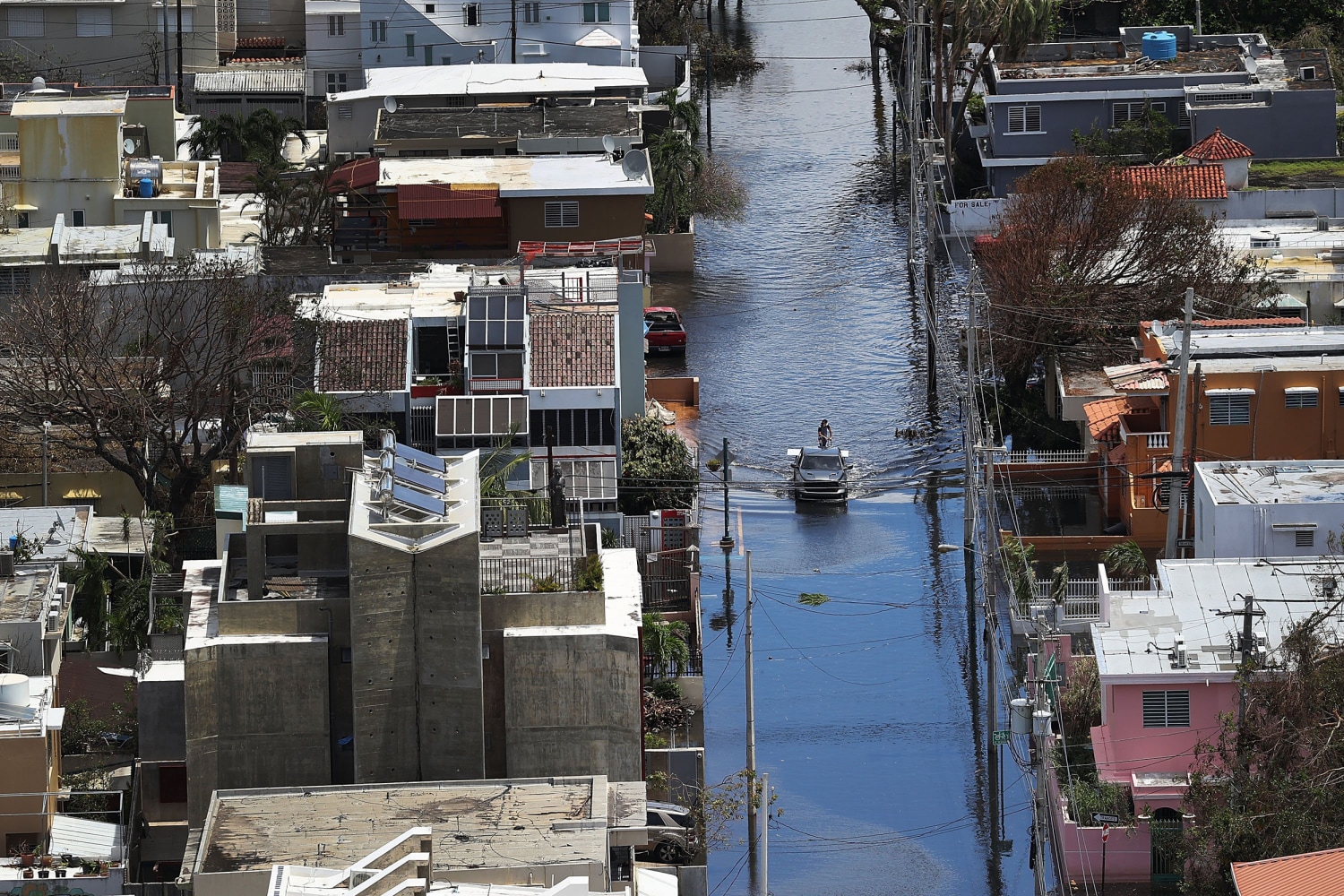
Image: A man stands on a car on a  flooded street in the aftermath of Hurricane Maria in San Juan


Image: A man stands on a car on a  flooded street in the aftermath of Hurricane Maria in San Juan

Frances Colón, founder of the Washington, D.C.-based non-profit Cenadores, said the “scale of the federal response right now is not on scale with the level of devastation.” Colón formed Cenadores to organize Puerto Ricans on the mainland to volunteer to help the island.

“We still have townships not reached. The government had a diesel ship parked in the bay and the government and National Guard is so maxed out they couldn’t ensure security so the fuel could reach its destination,” said Colón, who lives in Miami and worked 12 years for the State Department as a science and technology adviser. “We need boots on the ground from the federal government. We need FEMA, National Guard, a federal response at [Hurricane] Katrina scale.”

“Everyone is overwhelmed because the disaster is bigger than everyone,” she said.

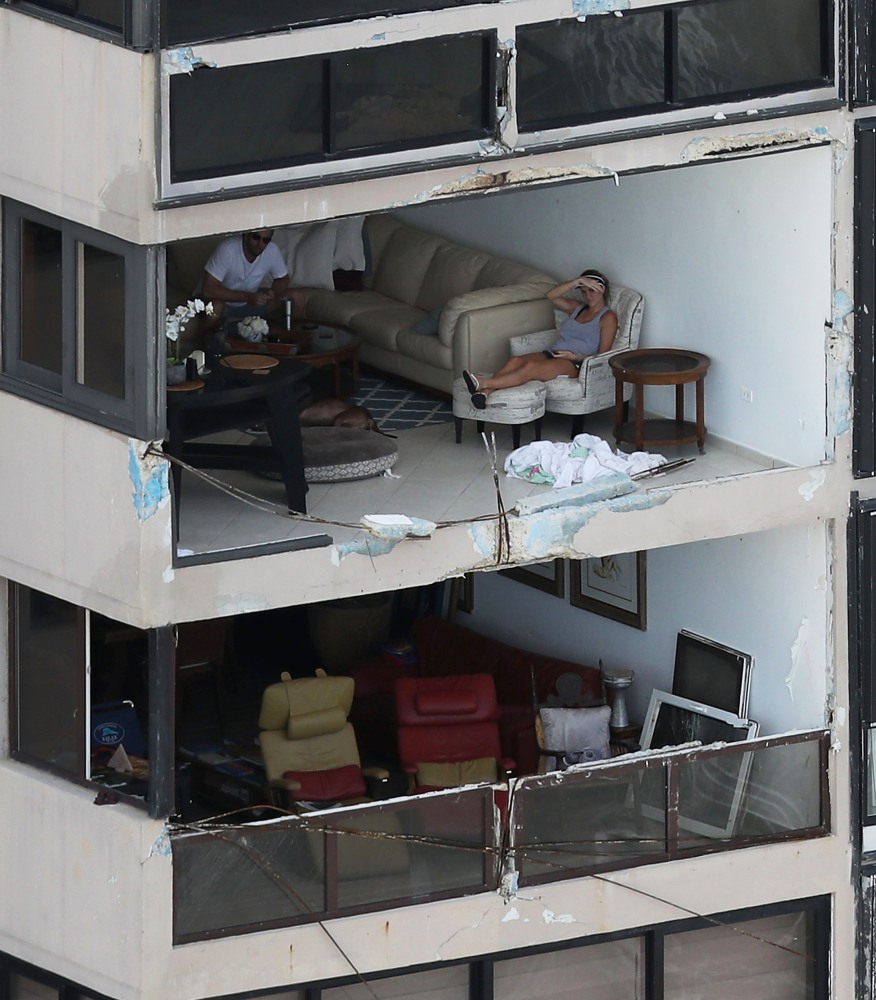
Image: People sit in their apartment with the window blown out in San Juan


Image: People sit in their apartment with the window blown out in San Juan

“The response can’t be tepid. It’s been a week and still communication is down and there are towns that haven’t been reached.”

PHOTOS: Hurricane Maria Lashes Puerto Rico, Storm-Battered Caribbean

Armando Valdés Prieto, a lawyer who has been helping with volunteer operations in San Juan said he felt the sheer magnitude of the devastation on the island made distributing federal aid difficult.

“The scope and magnitude of what’s going on is so large that I’m not entirely sure that they really know where to start,” he said by phone Monday afternoon.

He said that while he felt a lot was being done, being unable to communicate with parts of the island compounded problems.

“We’re still kind of in an assessment phase where I guess it’s a little hard to gauge whether or not things are being done right,” he added.

Related: Puerto Rico Holds Its Breath Over Hurricane-Battered Dam

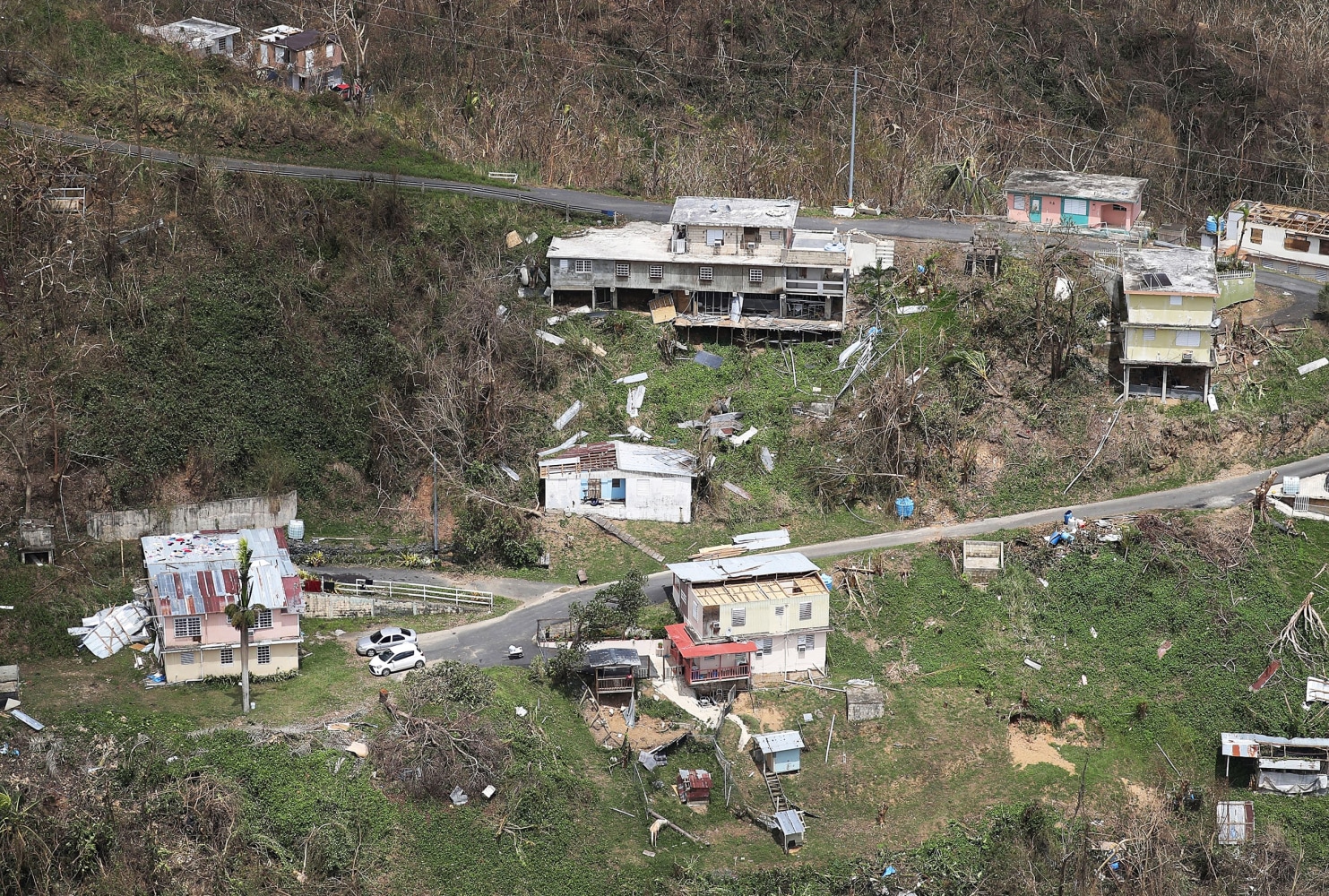
Image: Downed trees surround damaged homes in the aftermath of Hurricane Maria


Image: Downed trees surround damaged homes in the aftermath of Hurricane Maria

Adding to the island’s woes is stifling heat. San Juan tied for its maximum temperature at 94 degrees on Sunday, according to the NWS.

“It’s really, really hot and there’s not a lot of respite from the heat,” said Valdés Prieto, adding that many people did not have electrical power and could not use their air conditioners.

And the island’s Aqueduct and Sewer Authority said Monday that only about 40 percent of their customers, or 500,000 people, had water service.

Health Bill Appears Dead as Pivotal GOP Senator Declares Opposition

Ms. Collins, one of three Republican senators who opposed the last repeal attempt in July, described the latest plan as “deeply flawed.” She expressed concerns about cuts to Medicaid as well as the rolling back of protections for people with pre-existing medical conditions.

Document: Read the C.B.O. Report on the Graham-Cassidy Health Care Bill


“Health care is a deeply personal, complex issue that affects every single one of us and one-sixth of the American economy,” Ms. Collins said in a statement, lamenting the rushed process and the content of legislation that has shifted as Republican leaders scrambled for votes. “Sweeping reforms to our health care system and to Medicaid can’t be done well in a compressed time frame, especially when the actual bill is a moving target.”

The Senate majority leader, Mitch McConnell of Kentucky, now faces the unpalatable choice of admitting defeat or moving ahead with a vote that appears certain to fail.

Republican leaders in the Senate can afford to lose only two of their members, and they now have three firm opponents within their ranks: Rand Paul of Kentucky, John McCain of Arizona and Ms. Collins. Additionally, Senator Ted Cruz, Republican of Texas, has withheld his support and requested changes to the bill.

Time is not on their side: Republicans have only until the end of the month to pass the bill through the Senate while being protected from a Democratic filibuster.

Beginning in October, Republicans would need Democratic votes in order to pass a repeal bill, a seeming impossibility given that Democratic senators have been unified in opposition to the repeal push.

Some Republican senators have suggested starting over, with parliamentary language in a new budget blueprint that once again would shield a repeal bill from a filibuster. But that could terribly complicate Republican efforts to overhaul the tax code, a risk the leadership may not want to take.

Graphic

The Republican Senators Who Have Opposed the Many Bills to Repeal Obamacare

Thirteen lawmakers from 12 states have opposed at least one of the Senate’s five major repeal efforts in recent months.


Ms. Collins’s announcement came three days after Mr. McCain said that he could not “in good conscience” support the latest repeal proposal, written by Senators Lindsey Graham of South Carolina and Bill Cassidy of Louisiana.

Advertisement

Continue reading the main story

The senators released a revised version of their bill on Monday morning, hoping to win over holdout Republicans in part by shifting more funds to states like Alaska and Maine. The bill would take money provided under the Affordable Care Act for insurance subsidies and the expansion of Medicaid and send it to states, with vast new discretion over how to use it for health care or coverage.

But writing a repeal bill that could win over at least 50 of the 52 Republican senators has proved extraordinarily difficult, and putting together a complicated bill against the backdrop of a ticking clock only added to the challenge. Insurers, hospitals, doctors and patient advocacy groups assailed the proposal, as did the late-night talk show host Jimmy Kimmel.

The Capitol complex looked at times like a hospital ward on Monday as patients swarmed through the corridors, pleading with senators not to take away their health insurance. Some wore T-shirts that said, “I Am a Pre-Existing Condition.”

The Senate Finance Committee held a hearing on the repeal bill on Monday, and it was immediately disrupted by people in the audience shouting opposition to the proposal. “No cuts to Medicaid,” they chanted. “Save our liberty!” Capitol police officers removed the protesters, some of whom were in wheelchairs.

As Mr. Cassidy and Mr. Graham revised their bill to try to build support, critics asserted that their last-minute changes further weakened protections for patients, including those with cancer and other pre-existing conditions.

Photo

Senator Susan Collins, Republican of Maine, at the Capitol this month.

Credit
Tom Brenner/The New York Times

Dick Woodruff, senior vice president at the lobbying arm of the American Cancer Society, said that under the bill, patient protections provided by the Affordable Care Act would be up to each state to decide.

“Some states could decide not to cover even preventive services, like cancer screenings, routine mammography or colonoscopy,” Mr. Woodruff said.

Advertisement

Continue reading the main story

Republican senators had to make up their minds with little information about the measure’s implications.

Newsletter Sign Up

Continue reading the main story

The nonpartisan Congressional Budget Office said Monday that “millions of additional people would be uninsured” under the Graham-Cassidy bill, compared with the number of people expected to lack coverage under current law.

“Enrollment in Medicaid would be substantially lower because of large reductions in federal funding for that program,” the budget office said.

But the budget office said it did not have time to produce a more complete assessment, leaving senators without specifics on how the bill would affect coverage and health insurance premiums.

Graphic

Three Ways the New Republican Health Bill Differs From Past Repeal Efforts

A comparison of the Cassidy-Graham measure with four other bills that failed in Congress.


The rushed process contributed to the bill’s demise.

Mr. McCain, who killed the last repeal effort in July with a dramatic middle-of-the-night vote, faulted Republicans for trying to pass sweeping health care legislation without the participation of Democrats or extensive public deliberations.

Mr. Paul had previously said he would oppose the Graham-Cassidy bill because it did not go far enough in repealing the health law. On Monday, he continued to denounce it as a “fake repeal.”

Mr. Paul presented himself as open to compromise, voicing support for a narrower measure. But he rejected the Graham-Cassidy bill’s core concept of providing block grants to the states to use for health care — leaving little room for Republican leaders to win his vote unless they radically altered the legislation.

“I think if you vote for this bill, you put your stamp of approval on a trillion dollars’ worth of Obamacare spending,” he said.

Mr. Paul was not the only conservative with reservations. Mr. Cruz said on Sunday that he had not yet been won over and was seeking changes to the repeal plan, though he said he wanted to ultimately wind up in favor of the bill. An aide to Mr. Cruz said on Monday that he still wanted to see changes.

Advertisement

Continue reading the main story

Before Ms. Collins’s announcement on Monday, Mr. Trump expressed frustration that Republicans had talked for years about repealing and replacing the Affordable Care Act but failed to deliver now that a Republican was in the White House.

On the “Rick Bubba Show,” a radio program, Mr. Trump singled out Mr. McCain, calling his vote in July “a tremendous slap in the face of the Republican Party.” And the president seemed resigned to defeat in the latest attempt at repeal.

“We’re going to lose two or three votes,” he said, “and that’s the end of that.”

Nicholas Fandos contributed reporting.


Continue reading the main story

Tennessee church shooting suspect identified; 1 killed, 7 wounded


Suspect in Tennessee church shooting identified

Police say one person was killed, multiple people wounded

One woman was killed and seven other people were hurt after a shooting suspect, identified as former churchgoer Emanuel Kidega Samson, opened fire at a Tennessee church Sunday, police said.

Samson, identified as a 25-year-old man who immigrated from Sudan two decades ago, is suspected of bringing two pistols and a mask to Burnette Chapel Church of Christ in Antioch, southeast of Nashville, before opening fire just after 11 a.m. He fired “multiple rounds,” police said in a news conference.

Police identified Emanuel Kidega Samson, 25, as the suspected gunman who opened fire at a church in Antioch, Tennessee, on Sunday.

 (Metropolitan Nashville Police Department)

Metropolitan Nashville Police Department tweeted that Samson had been released from the hospital and will be charged with murder and attempted murder. In addition, federal officials tell Fox News the FBI will be initiating a civil rights investigation in association with the shooting at the predominantly white church.

An usher, identified as Robert Engle, 22, confronted the gunman at one point and was pistol-whipped, causing “significant injury around his head,” police added. They said Engle went to his own car, grabbed a pistol and headed back into the church.

Law enforcement confirmed Samson is a legal U.S. resident who immigrated from Sudan in 1996.

It was initially reported that the gunman shot himself, although police said it’s unclear whether he shot himself or the gun unintentionally discharged during his scuffle with Engle.

Police said that Burnette Chapel churchgoers recognized Samson as attending their church one to two years ago, but noted he hadn’t attended services “in quite a while.”

One woman was killed and seven others wounded when a gunman opened fire at the Burnette Chapel Church of Christ on Sunday.

 (Metropolitan Nashville Police Department)

The woman who was shot and killed in the church parking lot, identified as Melanie Smith, 39, was walking to her car when she was hit, police said.

The gunman, with his blue vehicle still running in the parking lot, then entered the back of the church and shot six people – three women and three men – who were rushed to the hospital, police said. 

Police identified those being treated at Vanderbilt University Medical Center and in stable condition as: William Jenkins, 83; Marlene Jenkins, 84; Peggy Span, 65; and Linda Bush, 68. David Span, 60, was also being treated at Vanderbilt, but was listed as in critical but stable condition.

Katherine Dickerson, 64, was in stable condition at Skyline Medical Center. Engle was also being treated at Skyline.

Metropolitan Nashville Police Chief Steve Anderson called Engle a “hero” for his actions at the church Sunday.

Several witnesses claimed the shooter was wearing a “clown mask” when he opened fire, but police said what he wore more closely resembled a ski mask. 

Megan Barry, mayor of Metropolitan Nashville and Davidson County, said in a statement that the shooting “is a terrible tragedy for our city. My heart aches for the family and friends of the deceased as well as for the wounded victims and their loved ones.”

Gov. Bill Haslam added that he and his wife, Crissy, were praying for the victims and “committed to supporting the Antioch community in the aftermath of this tragedy.”

The church has a weekly service starting at 10 a.m. Sunday. The surrounding area was closed off as police investigated the situation.

Fox News’ Jake Gibson and The Associated Press contributed to this report.

Merkel heads for another term in Germany, but far right spoils the party

German Chancellor Angela Merkel was on course to claim a fourth term in office Sunday even as the far right spoiled her victory party, surging into parliament for the first time in more than half a century, according to projections based on exit polls and official results following a nationwide vote.

The results represented at least a partial affirmation of Merkel’s emphasis on Germany’s stability and economic prosperity at a time of upheaval elsewhere around the globe. They clear the way for her to extend her 12-year stewardship to 16, which would tie the record for postwar Germany.

But the groundswell of support for the far right upended any notion that Europe’s largest economy and most important geopolitical player is immune to the populist currents roiling other democracies across the West. It also revealed the depths of lingering resentment toward Merkel’s 2015 decision to welcome more than a million asylum seekers amid the European refugee crisis.

Taken together, the results are likely to complicate Merkel’s ambitions for her final term, with thorny coalition negotiations to come in the weeks ahead, while giving the bomb-throwing Alternative for Germany party (AfD) a prominent platform to influence politics in a country where civility and consensus have long been prized.

“It’s a huge change in the political landscape,” said Hans Kundnani, a senior fellow at the German Marshall Fund. “It will change the nature of debate in the Bundestag.”

The anti-immigration, anti-Islam AfD, founded just four years ago, was on pace to take third place with 13 percent of the vote, according to projections. That’s nearly triple its 2013 result, and matches the outer limit of its support in pre-election polls.

True to its combative reputation, the party wasted no time in vowing to use its voice in the Bundestag, the German parliament, to cause trouble for the government — including by investigating Merkel’s refugee-related decision-making.

“We’re going to hunt Merkel,” Alexander Gauland, the AfD’s co-leader, told cheering supporters. “We’re going to get Germany back.”

Projections showed that Merkel’s center-right Christian Democratic Union won approximately 33 percent — down several points from what most pre-election polls had predicted, and a full seven points lower than its result in 2013. The vote share was among the lowest ever for the party, which has governed Germany for most of its post-war history.

“We’re not going to beat around the bush. We were hoping for a better result,” a restrained Merkel told supporters at CDU election night headquarters in central Berlin. 

While promising to remain as chancellor, Merkel also acknowledged the “strong challenge” from the AfD and its voters. 

“We want to win them back,” she said. “We want to address their fears and concerns.”

The center-left Social Democrats (SPD) were expected to place a distant second with about 20 percent of the vote, a dismal result for Merkel’s coalition partner of the past four years. 

“Taking in so many refugees split the nation, that has become clear,” SPD leader Martin Schulz told supporters. “We didn’t manage to convince a segment of our society that our country is strong enough to handle the task.”

Schulz said the party would not join another government, and would instead go into opposition to offer voters a clear alternative to the CDU for the next election. The decision leaves Merkel with few options for reaching a governing majority. 

Her only viable one may be a so-called Jamaica coalition, a reference to the colors of the three parties that would take part: Merkel’s CDU, the pro-business Free Democrats and the Greens.

But that could be a tricky arrangement given the two junior parties’ differences on key economic and foreign policies. The Greens, in particular, said Sunday they would put strict conditions on their participation.

“We don’t want to govern just to govern,” said Cem Özdemir, co-leader of the Greens.

Kundnani said the Greens — who have already had a run in government with the Social Democrats — will be reluctant to do a deal that could force them to sacrifice core principles. 

“This is going to be a very right-wing government one way or another,” he said.

Still, there will be significant pressure on the parties to strike a deal. Without one, Germany could be forced to hold new elections, an outcome that the mainstream parties will fear would only further strengthen the AfD.

Sunday’s vote continues a Europe-wide trend toward fragmentation, as the two major parties both lost support and the smaller parties gained. The Bundestag will now be crowded with six parties that span the ideological spectrum from far-right to far-left. 

The result follows a relatively low-key campaign in which the major parties largely ducked the chance to challenge Merkel. Despite the lack of pre-election intrigue, turnout was higher than usual, with over three quarters of Germany’s 61 million voters casting ballots from the Baltic Sea to the Alps.

Exit polls showed that many of the AfD’s voters were casting ballots for the first time, while supporters of other parties said they showed up to try to block the party.

“We have to counter the right-wing people,” said Abdessamad Mendoui, a 75-year-old who immigrated to Germany 55 years ago from Morocco, and who walked slowly on Sunday to his polling place in the western city of Frankfurt.

To Merkel’s backers, the election was a chance to endorse German stability at a historically fraught time.

“It doesn’t look good in the world. If you listen to that guy in America and also in the East with his atomic weapons, you get scared,” said Elida Baller, 84, referring to President Trump and Kim Jong Un, the North Korean leader. 

But the AfD’s support was higher than many Germans had thought possible in a country where the memory of extreme-right-wing government is a source of profound national shame.

“For me, the AfD is a Nazi party,” said Hannelore Weimann, 81, after voting in Berlin. “I experienced World War II and I have seen the history and I don’t understand how people can vote for a party like this.”

The party was founded in 2013 as a protest against European bailouts for Greece, and that year it barely missed the 5 percent cutoff for making it into the Bundestag.

But its popularity has surged on the back of resistance to Merkel’s decision in 2015 to open the country’s borders to hundreds of thousands of asylum seekers fleeing war, oppression and extreme poverty. 

The party was especially strong in the former East Germany, winning 23 percent there — compared to just 11 percent in the west.

Jens Töpfer, 36, an engineer who cast one of his two ballots Sunday for the AfD, said he is afraid that Germany is being overrun by refugees. And that could bring dire consequences for the next generation, he said, pointing to his 2-year-old son. 

“Refugees have a different culture that doesn’t fit in here,” he said. “They should go back where they came from and fight for their freedom and reconstruction.”

Germany’s other major parties were united in speaking out against the AfD. Schulz called the far-right party “the gravediggers of democracy.” 

The AfD’s supporters have countered that Merkel is the real threat to democracy, and that her 12-year run — now likely to extend to 16, tying a record set by Helmut Kohl — has stifled debate. 

It’s a view that is shared even by non-AfD voters who have grown frustrated by the robust consensus of the political establishment.

“Every four years we can vote for the person who drives the train, ” said Hubert Lützelberger, 67, a former accountant who cast one of his votes for Die Linke, the far-left party. “But we can’t change the direction of the train.”

Isaac Stanley Becker and Alexandra Rojkov in Brandenburg an der Havel, Rick Noack in Berlin, and Souad Mekhennet in Frankfurt contributed to this report. 

NFL Week 3: Trump praises ‘solidarity’ as Seahawks and Titans stay in locker room

Top Story Lines | Injury News
Fantasy Football | ATS Betting Tips/Picks

[Looking for Redskins coverage? Click here.]

NFL players across the country sent a powerful message to President Trump, responding to his speech and latest tweet urging owners to “fire or suspend” players who protest by not standing for the national anthem.

The nationwide display was one the president praised in a midafternoon tweet, in which he stated that “Standing with locked arms is good, kneeling is not acceptable. Bad ratings!”

The day of demonstrations began in London, with the 9:30 a.m. EDT kickoff between the Baltimore Ravens and Jacksonville Jaguars and they only intensified as the 1 p.m. games arrived. Most vivid was the sight of the empty Pittsburgh Steelers sideline in Chicago. Coach Mike Tomlin preferred to keep his players in the locker room altogether and two other teams followed suit later in the day.

Here’s the visual of the empty @steelers sideline for the national anthem. (📷: @rrdawson22 )

A post shared by Albert Breer (@albert_breer) on Sep 24, 2017 at 10:20am PDT

Steelers offensive tackle Alejandro Villanueva, a former Army Ranger, chose to stand at the head of the tunnel leading onto the field rather than remain in the locker room. Although Tomlin and several members of the staff were on the field, the team remained inside.

Both the Seattle Seahawks and Tennessee Titans followed the Steelers’ example. The Seahawks said in a statement: “As a team, we have decided we will not participate in the national anthem. We will not stand for the injustice that has plagued people of color in this country. Out of love for our country and in honor of the sacrifices made on our behalf, we unite to oppose those that would deny our most basic freedoms. We remain committed in continuing to work towards equality and justice for all.”

The scene was a little different in Gillette Stadium, where a few New England Patriots players took a knee and fans booed and chanted “Stand Up!”

In Philadelphia, Eagles owner Jeffrey Lurie stood on the sideline during the anthem and safety Malcolm Jenkins, as he always does, raised his fist. Eagles players linked arms  as did Giants players across the field.

In London, before the start of the day’s first NFL game, Ravens Coach John Harbaugh joined his players, linking arms, and Ravens Hall of Famer Ray Lewis took a knee. Jaguars owner Shahid Khan locked arms with his players and the Jaguars’ coaches. Khan, who donated to Trump’s inaugural committee, was the second owner to participate in events related to anthem protests. Cleveland Browns owner Jimmy Haslam stood on field and locked arms with players, military personnel and first responders in Week 1 of the 2017 season. More joined as the day went on.

In Detroit, Atlanta Falcons owner Arthur Blank joined his players on the field.

Three Packers players took a knee as other players, including quarterback Aaron Rodgers, joined arms.

The pregame demonstrations overshadowed a number of entertaining and closely contested 1 p.m. games.

The Bears and Steelers needed overtime with Chicago scoring two touchdowns before being handed the win. A video review overturned an electric, would-be game-ending 73-yard run by Tarik Cohen on the second play of the extra session. Instead the play was ruled out of bounds after a 36 yard gain. The Bears’ Jordan Howard scored later on that drive with a 19-yard touchdown run to give Chicago its first win of the season, while handing Pittsburgh its first loss.

The New England Patriots nearly fell to 1-2 at the hands of rookie quarterback Deshaun Watson and the Houston Texans. Instead it was Tom Brady finding Brandin Cooks for the game-winning touchdown and two-point conversion with 23 seconds remaining to rally the Patriots to a 36-33 victory.

In Philadelphia, rookie Eagles kicker Jake Elliott blasted a 61-yard field goal to send the New York Giants to an 0-3 start, despite two touchdown catches – and two interesting celebrations – from wide receiver Odell Beckham Jr.

Detroit suffered disappointment on the final play of the game. Wide receiver Golden Tate appeared to score a game-winning touchdown with 6 seconds remaining. On review, Tate was ruled down at the half yard line. By rule, the review required a 10-second runoff, ending the game and giving the Falcons a 30-26 win. Atlanta starts that season with a record of 3-0.

The game in London offered the first visible response to Trump’s Sunday morning messages.

“If NFL fans refuse to go to games until players stop disrespecting our Flag Country,” Trump tweeted at 6:44 a.m., “you will see change take place fast. Fire or suspend!”

Trump went on to add that “NFL attendance and ratings [are] WAY DOWN. Boring games yes, but many stay away because they love our country. League should back U.S.”

That continued a Friday night tirade in which President Trump used a profanity to describe NFL players who kneel during the national anthem to protest police brutality and social inequality brought a torrent of responses from players, the NFL commissioner, the head of the NFL players’ union and more than a half-dozen owners. It brought condemnation from the NBA’s biggest stars and ensured that Sunday’s games will now focus on the White House.

Patriots owner Robert Kraft, who gave $1 million to Trump’s inaugural and presented him with a Super Bowl LI ring, said in a statement Sunday that he was “deeply disappointed by the tone” of Trump’s comments.

“I am proud to be associated with so many players who make such tremendous contributions in positively impacting our communities,” Kraft said. “Their efforts, both on and off the field, help bring people together and make our community stronger. There is no greater unifier in this country than sports and, unfortunately, nothing more divisive than politics. I think our political leaders could learn a lot from the lessons of teamwork and the importance of working together toward a common goal. Our players are intelligent, thoughtful and care deeply about our community and I support their right to peacefully affect social change and raise awareness in a manner that they feel is most impactful.”

Treasury Secretary Steve Mnuchin defended Trump’s comments, saying that players “have the right to have their First Amendment off the field. This is a job.”

The Raiders’ starting offensive linemen, who comprise the only African-American unit in the league, plan to kneel or sit as a group Sunday night, the NFL Network’s Ian Rapoport reports. They have the full support of owner Mark Davis, who told ESPN: “Over the last year … the streets have gotten hot and there has been a lot of static in the air and recently, fuel has been added to the fire. I can no longer ask our team to not say something while they are in a Raider uniform. The only thing I can ask them to do is do it with class. Do it with pride. Not only do we have to tell people there is something wrong, we have to come up with answers. That’s the challenge in front of us as Americans and human beings.”

Top Story Lines

Marshawn Lynch and the Raiders are ready for one last ride. Like The Post’s Kent Babb, you’re not invited.

Four NFL players push Roger Goodell for activism month. Will the NFL be more open to the idea of expanding “Cleats for a Cause” week?

The president has had a long, stormy relationship with football. The word “unrequited” describes Trump’s feelings for the NFL.

Chris Long of the Eagles makes a donation. The Charlottesville native is donating six game checks to fund scholarships after the violence there.

Trump turns sports into a political battleground. The NFL and the NBA were squarely in the president’s sights.

Did the NFL make a mistake in putting two teams in LA? Never mind Thursday night’s exciting game. The interest hasn’t sparked yet.

Keep an eye on Jared Goff’s emergence. The future of the Redskins’ Kirk Cousin may be affected by it.

The Giants, Seahawks and Texans need to fix their offensive lines. It’s already Week 3.

S’ua Cravens offers little clue about his future. Will he play again for the Redskins or has he really, truly retired?

The Redskins’ plan for the Raiders includes plenty of running plays. If it’s not broken, there’s no need to fix it.


Injury News

Ravens wide receiver Jeremy Maclin left the London game against the Jaguars to be evaluated for a concussion, but later returned to the game. Kelvin Benjamin left the Panthers’ game against the Saints and did not return after sustaining a leg injury.

Here are the inactives for the 1 p.m. and 4 p.m. games.

1 p.m. Inactives

Sammie Coates

Alfred Blue

Jordan Leggett

Stephon Tuitt

Myles Garrett

Vontae Davis

Chris Baker

Brent Grimes

Dont’a Hightower

Eric Rowe

Jordan Phillips

Rontez Miles

Rodney McLeod

4 p.m. inactives

Randall Cobb

Derron Smith

Mike Daniels

Jake Ryan

Davon House

Kentrell Brice

Hayes Pullard III


Ruled out Sunday

Andrew Luck

Sam Bradford

Tyler Eifert

John Ross

Rex Burkhead

Corey Davis

John Brown


Fantasy football advice

Trade advice: A.J. Green could be on the way up. (Read more.)

Sit/start advice for Week 3: C.J. Anderson will return to earth.

Fantasy scout: Can the Bengals’ fantasy stars be saved?

Here’s what you need to be watching this week. (Read more.)

Week 3 cheat sheet

Everything you need to know before you set your lineup. (Read more.)

The Fantasy Football Beat

The Post’s fantasy football experts get you ready for Week 3. (Listen.)


ATS Betting Tips/Picks

Week 3 NFL ATS picks

The top trends and insights from Las Vegas. (Read more.)